In Outdoor TVs, the IP rating is a critical technical specification. It determines how reliably the device performs in rain, dust, and high-humidity environments, while directly affecting product lifespan and long-term maintenance costs. Whether for permanently installed outdoor displays or a televisor inteligente portátil used in commercial settings, selecting the appropriate IP rating should be based on actual installation conditions and exposure risks. Partnering with a manufacturer that offers comprehensive testing certification and proven engineering validation is often more important than simply comparing specification numbers.
What Do IP65, IP66, and IP67 Actually Mean for Outdoor TV Protection?
Many buyers do not fully understand what an IP rating truly means when purchasing an Outdoor TV, nor are they familiar with the common IP ratings available. This lack of clarity can easily lead to incorrect purchasing decisions. Let’s take a closer look at what IP means and what the most common IP ratings actually represent.
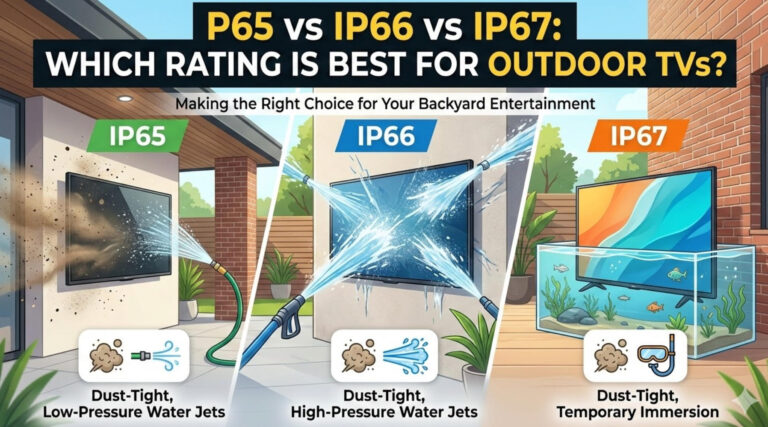
An IP (Ingress Protection) rating consists of two digits. The first digit indicates dust protection, while the second defines water resistance. For outdoor televisions, the first digit is typically “6,” meaning the enclosure is completely dust-tight. The real distinction lies in the second digit, which determines the specific water testing conditions.
IP65 provides protection against low-pressure water jets from any direction, making it suitable for standard rain exposure. IP66 upgrades this to protection against powerful water jets, which is more appropriate for heavy storms or high-pressure cleaning environments. IP67, in contrast, focuses on temporary immersion protection, typically allowing submersion in up to 1 meter of water for about 30 minutes. Importantly, immersion protection does not mean stronger resistance to water impact.
Many procurement teams assume IP67 is universally “better,” but it addresses a different risk—submersion rather than daily rain or directional water exposure. For most fixed outdoor TV installations, strong water jet protection is often more relevant than short-term immersion.
Whether for permanently installed outdoor displays or a portable smart TV used in commercial settings, the appropriate IP rating should always be selected based on actual environmental exposure. Understanding these differences is key to avoiding specification misinterpretation and unnecessary cost.
How Does Installation Environment Determine the Right IP Rating?
When deciding between different IP ratings, we should carefully consider the impact of the installation environment. A higher IP rating is not always better; it must be matched to actual usage conditions to ensure the long-term reliability of Outdoor TVs while avoiding unnecessary costs.
First, the distinction between semi-outdoor and fully exposed environments is crucial. Semi-outdoor areas, such as restaurant patios with overhead cover, typically require moderate protection like IP65 or IP66. Fully exposed locations, such as courtyards, stadiums, or advertising billboards, demand higher water resistance to withstand continuous rain and wind-driven water.
High-pressure cleaning is another environmental factor. In commercial settings like hotel pools, outdoor kitchens, or other areas requiring frequent cleaning, IP66 or above is recommended to protect the device from powerful water jets.
Long-term heavy rain exposure is also a key consideration. In regions with continuous heavy rain or monsoon conditions, IP65 may be insufficient, and a higher rating is necessary to prevent water damage.
Finally, different commercial applications carry different risk levels. Outdoor advertising, dining terraces, and hotel entertainment areas each have unique exposure conditions and maintenance needs. Buyers must select an IP rating that aligns with the specific environment to balance performance and cost, ensuring that both permanently installed Outdoor TVs and portable smart TVs remain reliable in commercial applications over time.
Why Isn’t IP67 Automatically the Best Option for Outdoor TVs?
Although a higher IP rating can withstand harsher conditions, blindly choosing the highest rating when purchasing Outdoor TVs may not be the most suitable approach. IP67 was originally designed for temporary immersion scenarios, such as accidental drops into shallow water or short-term pooling, rather than continuous outdoor exposure or powerful water jets.
Many buyers mistakenly assume IP67 is the safest and most advanced choice in all cases, which can lead to over-specification. In reality, most permanently installed outdoor TVs face constant rainfall, wind-driven water, and occasional high-pressure cleaning—not prolonged submersion. Therefore, the temporary immersion test does not fully represent the durability of a device under everyday outdoor conditions.
Higher IP ratings also come with cost premiums. Achieving a higher grade requires more complex sealing structures and additional materials, increasing procurement costs and potentially affecting thermal performance. Overly tight enclosures can restrict airflow, raising internal temperatures over long-term operation and impacting the stability and lifespan of electronic components.
As a result, IP ratings should be chosen based on actual environmental needs rather than simply aiming for the highest number. For fixed outdoor installations, IP65 or IP66 is often sufficient. In commercial applications requiring mobility, a portable smart TV also needs an appropriate IP rating, not just IP67. Matching the rating to the environment ensures a balanced approach to performance, reliability, and cost.
How Do IP Ratings Influence Thermal Design and Internal Component Protection?
Another often overlooked point is that different IP ratings can significantly impact the thermal design and internal component protection of Outdoor TVs. Higher IP ratings typically require more tightly sealed enclosures to prevent water and dust ingress. While this improves environmental protection, it can also affect heat dissipation. Overly sealed enclosures restrict airflow, making it difficult for internal electronic components to release heat. Over prolonged operation, this can raise internal temperatures, reducing performance and potentially shortening the device’s lifespan.
Condensation is another issue to consider. In high-humidity environments, tightly sealed enclosures can trap air, and temperature fluctuations may lead to condensation inside the device, posing risks to circuit boards and critical components. Therefore, when designing or selecting an IP rating, it is crucial to balance protection with thermal management.
Long-term component reliability is closely linked to temperature control. Excessive sealing may increase the risk of failure if the thermal design is insufficient. When selecting an Outdoor TV, it is essential to ensure that the IP rating aligns with the overall system design, including heat dissipation channels, material thermal conductivity, and active or passive cooling solutions.
This balance is particularly important for both fixed outdoor displays and portable smart TVs. The appropriate IP rating should not only meet environmental protection requirements but also ensure long-term stable operation of internal components. By achieving the right balance between sealing and thermal management, manufacturers and buyers can optimize both reliability and performance, avoiding issues caused by excessive enclosure sealing while maintaining adequate protection.
How Do IP Ratings Impact Long-Term Maintenance and Total Cost of Ownership?
Purchasing Outdoor TVs is not the end of the story; long-term maintenance and total cost of ownership (TCO) are also heavily influenced by IP ratings. When evaluating TCO, buyers should look beyond initial price points—such as approximately $1,149 for a 43‑inch unit, $1,599 for a 55‑inch model, and $2,199 for a 65‑inch display—and consider ongoing maintenance complexity and expenses.
Devices with higher IP ratings typically feature more elaborate sealing to achieve enhanced dust and water protection. While this helps safeguard performance outdoors, it also increases maintenance difficulty. Tightly sealed enclosures require more time and expertise for routine inspection, disassembly, and internal component servicing. For fixed outdoor installations or commercial portable smart TV deployments, poor maintenance accessibility—especially in large venues like hotels, shopping centers, or stadiums—can significantly raise labor and downtime costs.
Seal aging is another long‑term concern. Over time, materials such as rubber gaskets and O‑rings degrade due to UV exposure, temperature swings, and humidity. Deterioration of seals can reduce protective performance, potentially allowing moisture or dust ingress that shortens component life.
Therefore, when calculating TCO for commercial projects, buyers must consider more than purchase price. Maintenance challenges, accessibility for repairs, and the frequency of seal replacements should be factored into budget planning. Partnering with a manufacturer that offers comprehensive support and maintenance planning helps ensure that the chosen IP rating delivers reliable protection without leading to excessive long‑term costs.
Which IP Rating Is Most Appropriate for Different Commercial Outdoor Installations?
For different outdoor environments, here are some recommendations on selecting the appropriate IP rating for Outdoor TVs.
In commercial plaza advertising scenarios, choosing the right IP rating is especially important. A real example in the United States is the Harmon Corner shopping center on the Las Vegas Strip, where a massive outdoor LED video wall — approximately 60 feet tall and 306 feet wide — was installed on the exterior façade as one of North America’s largest continuous outdoor LED displays, delivering brand advertisements and content to heavy foot and vehicle traffic. Such large outdoor screens require robust weatherproofing and thermal design to handle intense sunlight and rain exposure.
In less exposed settings such as restaurant terraces, IP65 is typically sufficient to guard against splashes and dust, while poolside areas at hotels may benefit from IP66 or higher to handle constant humidity and water spray. For temporary outdoor events, some projects opt for movable solutions like a televisor inteligente portátil, but the IP rating should still be evaluated based on actual environmental exposure rather than simply targeting IP67.
Overall, for all‑weather outdoor advertising in commercial plazas facing strong UV, rain, and dust conditions, partnering with a portable smart TV manufacturer that provides complete testing reports and engineering validation is more important than just comparing IP numbers. This approach helps ensure reliable long‑term operation and minimizes operational and maintenance risks.
Preguntas frecuentes
What is the real difference between IP65, IP66, and IP67 for outdoor TVs?
P65 protects against dust and low-pressure water jets, IP66 handles stronger jets, and IP67 allows temporary immersion. Choice depends on installation exposure, not just the highest rating.
Is IP67 necessary for outdoor restaurant or hotel installations?
Not usually. IP65 or IP66 is often sufficient for sheltered terraces or poolside areas, avoiding extra cost and heat issues.
Does a higher IP rating guarantee longer product lifespan?
No. Higher IP improves protection but can trap heat, affecting electronics if cooling isn’t designed properly.
How should buyers evaluate IP ratings when sourcing from a portable smart TV manufacturer?
Check real-world testing and engineering validation rather than just the IP number to ensure reliable performance in actual conditions.
Can a portable smart TV be safely used in rainy outdoor events?
Yes, if it has an appropriate IP rating for the expected exposure, typically IP65–IP66 for short-term events.
How do IP ratings impact cooling and display performance?
Higher IP ratings can restrict airflow and raise internal temperatures, so thermal design must match the protection level.