En el mundo actual, acelerado y preocupado por la higiene, la forma en que las personas interactúan con la tecnología de autoservicio está evolucionando rápidamente. Desde restaurantes hasta hospitales, los usuarios ya no se conforman con simplemente tocar una pantalla; esperan experiencias más rápidas, seguras y personalizadas. Este cambio ha llevado al auge de quioscos sin contacto, una nueva generación de quiosco de autoservicio Soluciones diseñadas para eliminar el contacto físico y, al mismo tiempo, mejorar la eficiencia. Al combinar conectividad móvil, interacción basada en IA y tecnologías de sensores, estos sistemas están transformando la forma en que las empresas prestan servicios. Pero, ¿qué es exactamente un quiosco sin contacto, cómo funciona y por qué se está convirtiendo en una parte esencial de la infraestructura digital moderna?
¿Qué es un quiosco sin contacto y cómo funciona?
A quiosco sin contacto, también conocido como un quiosco sin contacto, es un terminal de autoservicio que permite a los usuarios completar tareas sin utilizar físicamente los métodos tradicionales. Interacción con quiosco de pantalla táctil. En lugar de depender de la entrada táctil tradicional, aprovecha métodos de interacción alternativos para proporcionar una experiencia de usuario más segura, flexible y cada vez más intuitiva.
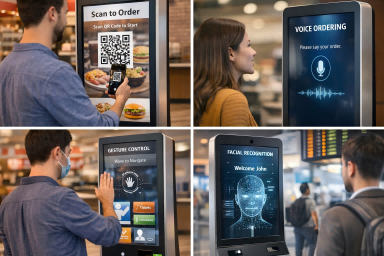
En esencia, un quiosco sin contacto transforma el modelo de interacción de “basado en el tacto” a “sin contacto”. Los usuarios pueden interactuar con el sistema a través de múltiples tecnologías, según el escenario de implementación. El enfoque más común es escaneo de código QR, donde los usuarios simplemente escanean un código y usan sus teléfonos inteligentes como control remoto para navegar, ordenar o realizar pagos. Además, reconocimiento de voz permite a los usuarios completar acciones mediante comandos de voz, mientras que control gestual Permite la interacción mediante simples movimientos de la mano sin contacto físico. Los sistemas más avanzados también pueden incorporar reconocimiento facial o detección de proximidad, lo que permite que el quiosco detecte y responda automáticamente cuando un usuario se acerca.
En comparación con un tradicional quiosco con pantalla táctil, La diferencia clave reside en la capa de interacción. Los quioscos con pantalla táctil dependen de la entrada física directa, mientras que los quioscos sin contacto se basan en un control indirecto, mediante el dispositivo o sensores. Este cambio no solo mejora la higiene, sino que también crea una experiencia más fluida y personalizada.
En definitiva, los quioscos sin contacto representan la siguiente evolución de quiosco de autoservicio Tecnología que combina comodidad, seguridad e interacción inteligente en una experiencia de usuario unificada.
Por qué los quioscos sin contacto están surgiendo en el autoservicio moderno
El auge de quioscos sin contacto Esto no es casualidad; es el resultado de la evolución de las expectativas de los usuarios y las exigencias operativas prácticas. Si bien las tecnologías de interacción sin contacto existían entre 2015 y 2019, su adopción seguía siendo limitada debido al costo, los hábitos de los usuarios y la falta de claridad en sus casos de uso. El verdadero punto de inflexión llegó con la pandemia de COVID-19, que aceleró rápidamente tanto el conocimiento como la aceptación de las soluciones sin contacto.
Desde la perspectiva del usuario, se produjeron dos cambios importantes. Primero, hubo un aumento significativo en la conciencia sobre la higiene, especialmente en entornos de mucho tránsito como restaurantes, hospitales y aeropuertos. Segundo, los usuarios se sintieron mucho más cómodos con experiencias sin contacto, incluyendo pedidos mediante códigos QR, pagos móviles e interacciones de autoservicio sin contacto físico.
Al mismo tiempo, los quioscos sin contacto se alinean perfectamente con las necesidades actuales. comportamiento priorizando los dispositivos móviles. La mayoría de los usuarios ya están acostumbrados a usar teléfonos inteligentes para las tareas diarias, lo que hace que la interacción con códigos QR y el control móvil resulten naturales, rápidos e intuitivos.
Desde el punto de vista operativo, las empresas también se benefician de menores requisitos de mantenimiento. Dado que las pantallas táctiles son uno de los componentes más utilizados en un sistema tradicional quiosco de autoservicio, Al reducir el contacto físico, se prolonga la vida útil de la pantalla, se minimiza la frecuencia de limpieza y se reducen los costes de mantenimiento a largo plazo.
Además, los sistemas sin contacto mejoran la eficiencia general. Al eliminar los puntos de contacto compartidos, los usuarios pueden interactuar simultáneamente a través de sus propios dispositivos, lo que reduce los tiempos de espera y alivia la congestión en entornos concurridos.
“El concepto de "sin contacto" ya no se limita a la seguridad, sino que representa un enfoque más inteligente, rápido y escalable para el autoservicio moderno.
Casos de uso y ejemplos reales en diversos sectores.
Quioscos sin contacto ya se están adoptando ampliamente en todas las industrias como parte de las estrategias de transformación digital, ayudando a las empresas a mejorar tanto la eficiencia operativa como la experiencia del cliente. Al eliminar la necesidad de interacción física, estos sistemas crean un entorno más flexible y escalable. entorno de autoservicio.
En el industria de la restauración, Los quioscos sin contacto permiten a los clientes escanear un código QR para ver los menús, realizar pedidos y pagar directamente en sus teléfonos inteligentes. Esto no solo acelera el proceso de pedido, sino que también aumenta rotación de mesa. Al mismo tiempo, las interfaces basadas en dispositivos móviles permiten recomendaciones personalizadas, lo que puede impulsar eficazmente las ventas adicionales y aumentar valor promedio del pedido.
En entornos sanitarios, Los quioscos sin contacto se utilizan para registro de pacientes y registrarse sin necesidad de contacto con superficies compartidas. Esto reduce el riesgo de contaminación cruzada al tiempo que mejora la experiencia general. flujo de pacientes, especialmente en clínicas y hospitales concurridos donde la eficiencia es fundamental.
Hoteles También están adoptando quioscos sin contacto para agilizar el proceso. proceso de entrada y salida. Los huéspedes pueden completar estos pasos de forma independiente, lo que reduce los tiempos de espera en la recepción y mejora la experiencia general. experiencia del huésped a través de una mayor comodidad y privacidad.
En entornos minoristas, Los compradores pueden escanear las exhibiciones de productos para acceder a información detallada, promociones o incluso completar compras. Esto crea una experiencia más... experiencia de compra interactiva al tiempo que permite a las empresas recopilar datos valiosos para marketing basado en datos.
Un ejemplo del mundo real se puede ver en marcas como McDonald's, que han integrado sistemas de pedidos sin contacto con infraestructura de quioscos. Este enfoque ha ayudado a reducir tiempos de cola mientras aumenta valor promedio del pedido, impulsado en gran medida por sistemas de recomendación basados en dispositivos móviles que fomentan compras adicionales.
Quiosco sin contacto vs. Quiosco con pantalla táctil: Diferencias clave y cómo elegir
Diferencias clave
Ambos quioscos sin contacto y quioscos con pantalla táctil Cada uno tiene sus propias fortalezas. La clave no es simplemente elegir uno sobre el otro, sino comprender cómo cada uno se adapta a las diferentes necesidades de los usuarios y a los escenarios comerciales, o cómo pueden trabajar juntos dentro de un entorno moderno. quiosco de autoservicio estrategia.
| Característica | Quiosco de pantalla táctil | Quiosco sin contacto |
|---|---|---|
| Método de interacción | Entrada táctil directa | Código QR, móvil, voz, gesto |
| Facilidad de uso | Intuitivo, curva de aprendizaje mínima | Puede requerir instrucciones para el usuario. |
| Accesibilidad para el usuario | Apto para todos los usuarios, incluidas las personas mayores. | Depende del nivel de familiaridad con dispositivos móviles/tecnología. |
| Higiene | Estándar | Alto (interacción sin contacto) |
| Experiencia de usuario | Sencillo y directo | Más personalizado y flexible |
| Preparación para el futuro | Tecnología madura | Más orientado al futuro |
quioscos con pantalla táctil Se caracterizan por su sencillez y accesibilidad. Los usuarios pueden interactuar al instante sin necesidad de instrucciones, lo que las hace especialmente adecuadas para entornos con público diverso, incluyendo personas mayores o menos familiarizadas con las herramientas digitales.
Por el contrario, quioscos sin contacto proporcionar una solución más avanzada e higiénica. Al permitir interacción basada en dispositivos, Estas plataformas ofrecen experiencias personalizadas, como pedidos a través del móvil y recomendaciones a medida. Sin embargo, dependen en gran medida de que los usuarios se sientan cómodos con los smartphones o con los métodos de interacción más recientes.
Cómo elegir la solución adecuada
| Escenario / Condición | Solución recomendada | Razón |
|---|---|---|
| Entornos de mucho tránsito (por ejemplo, aeropuertos, cadenas de comida rápida) | Quiosco sin contacto | Reduce la congestión y permite que varios usuarios interactúen simultáneamente a través de dispositivos móviles. |
| Requisitos estrictos de higiene (por ejemplo, hospitales, clínicas) | Quiosco sin contacto | Elimina los puntos de contacto compartidos y minimiza el riesgo de contagio. |
| Enfócate en el marketing personalizado o en las ventas adicionales. | Quiosco sin contacto | Permite recomendaciones basadas en dispositivos móviles e interacción basada en datos. |
| Diversos grupos de usuarios (incluidos usuarios mayores o con pocos conocimientos tecnológicos). | Quiosco de pantalla táctil | Interfaz sencilla e intuitiva que no requiere curva de aprendizaje. |
| Lugares con uso limitado de teléfonos inteligentes | Quiosco de pantalla táctil | No depende de dispositivos personales ni de la familiaridad digital. |
| Comportamiento de usuarios mixtos / entornos públicos | Híbrido (táctil + sin contacto) | Proporciona flexibilidad y permite a los usuarios elegir su método de interacción preferido. |
| Estrategia de transformación digital a largo plazo | Híbrido (táctil + sin contacto) | Equilibra la accesibilidad, la escalabilidad y la tecnología preparada para el futuro. |
Como tecnología de autoservicio sin contacto continúa evolucionando, el enfoque está cambiando de simplemente “sin contacto” a experiencias más inteligentes y conectadas. Los futuros sistemas de quiosco se integrarán cada vez más. Inteligencia artificial, ecosistemas móviles e interacciones basadas en sensores, lo que permite experiencias de usuario más personalizadas y fluidas.
En este contexto, un modelo híbrido Se está convirtiendo en el estándar de la industria. En lugar de reemplazar por completo los quioscos con pantalla táctil, las empresas los están combinando con soluciones sin contacto para satisfacer tanto las expectativas actuales de los usuarios como las futuras tendencias tecnológicas.
Este enfoque no solo garantiza la accesibilidad para todos los usuarios, sino que también prepara a las empresas para adaptarse a un entorno de autoservicio más inteligente, basado en datos y con prioridad a los dispositivos móviles.
Preguntas frecuentes
Un quiosco sin contacto es una estación de autoservicio que permite a los usuarios interactuar sin tocar físicamente la pantalla ni los controles. En su lugar, utiliza tecnologías como el reconocimiento de gestos, los comandos de voz, el reconocimiento facial o la conectividad con teléfonos inteligentes para completar las interacciones.
Estos quioscos utilizan sensores, cámaras y software de IA para detectar e interpretar los gestos o la voz del usuario. Algunos se conectan con los teléfonos móviles de los clientes mediante códigos QR o NFC para que puedan operar el quiosco desde sus propios dispositivos.
Mejoran la higiene, reducen la propagación de gérmenes y facilitan el acceso. Además, crean una experiencia más moderna y fluida, lo que aumenta la confianza de los usuarios en entornos públicos y de hostelería.
Están ganando terreno en aeropuertos, restaurantes de comida rápida, hospitales, tiendas minoristas y establecimientos de hostelería; básicamente, en cualquier lugar donde los clientes necesiten un servicio rápido, seguro y autónomo.
El futuro apunta hacia quioscos aún más inteligentes y personalizados que integren IA, biometría y sistemas IoT para proporcionar interacciones con el cliente más rápidas, seguras y basadas en datos.