In today’s fast-paced and hygiene-conscious world, the way people interact with self-service technology is rapidly evolving. From restaurants to hospitals, users are no longer satisfied with simply tapping a screen—they expect faster, safer, and more personalized experiences. This shift has led to the rise of touchless kiosks, a new generation of self service kiosk solutions designed to eliminate physical contact while improving efficiency. By combining mobile connectivity, AI-driven interaction, and sensor-based technologies, these systems are transforming how businesses deliver services. But what exactly is a touchless kiosk, how does it work, and why is it becoming an essential part of modern digital infrastructure?
What Is a Touchless Kiosk and How Does It Work?
A touchless kiosk, also referred to as a contactless kiosk, is a self-service terminal that enables users to complete tasks without physically using traditional touchscreen kiosk interaction. Instead of relying on traditional touch input, it leverages alternative interaction methods to provide a safer, more flexible, and increasingly intuitive user experience.
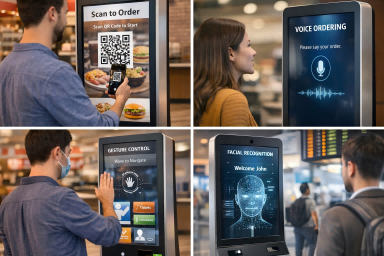
At its core, a touchless kiosk transforms the interaction model from “touch-based” to “contact-free.” Users can engage with the system through multiple technologies, depending on the deployment scenario. The most common approach is QR code scanning, where users simply scan a code and use their smartphones as a remote control to browse, order, or make payments. In addition, voice recognition allows users to complete actions through spoken commands, while gesture control enables interaction through simple hand movements without physical contact. More advanced systems may also incorporate facial recognition or proximity sensing, allowing the kiosk to automatically detect and respond when a user approaches.
Compared to a traditional touchscreen kiosk, the key difference lies in the interaction layer. Touchscreen kiosks depend on direct physical input, whereas touchless kiosks rely on indirect, device-based, or sensor-driven control. This shift not only enhances hygiene but also creates a smoother and more personalized experience.
Ultimately, touchless kiosks represent the next evolution of self service kiosk technology, combining convenience, safety, and smart interaction into a unified user journey.
Why Touchless Kiosks Are Emerging in Modern Self-Service
The rise of touchless kiosks is not accidental—it is the result of evolving user expectations and practical operational demands. While contact-free interaction technologies existed between 2015 and 2019, their adoption remained limited due to cost, user habits, and unclear use cases. The true turning point came with the COVID-19 pandemic, which rapidly accelerated both awareness and acceptance of contactless solutions.
From the user perspective, two major shifts occurred. First, there was a significant increase in hygiene awareness, especially in high-traffic environments such as restaurants, hospitals, and airports. Second, users became far more comfortable with contactless experiences, including QR-based ordering, mobile payments, and self-service interactions without physical contact.
At the same time, touchless kiosks align perfectly with today’s mobile-first behavior. Most users are already accustomed to using smartphones for daily tasks, making QR code interaction and mobile control feel natural, fast, and intuitive.
Operationally, businesses also benefit from lower maintenance requirements. Since touchscreens are one of the most heavily used components in a traditional self service kiosk, reducing physical contact helps extend screen lifespan, minimize cleaning frequency, and lower long-term maintenance costs.
In addition, touchless systems improve overall efficiency. By eliminating shared touchpoints, users can interact simultaneously through their own devices, reducing wait times and easing congestion in busy environments.
“Touchless” is no longer just about safety—it represents a smarter, faster, and more scalable approach to modern self-service.
Use Cases and Real-World Examples Across Industries
Touchless kiosks are already being widely adopted across industries as part of digital transformation strategies, helping businesses improve both operational efficiency and customer experience. By removing the need for physical interaction, these systems create a more flexible and scalable self-service environment.
In the restaurant industry, touchless kiosks enable customers to scan a QR code to view menus, place orders, and pay directly on their smartphones. This not only speeds up the ordering process but also increases table turnover. At the same time, mobile-based interfaces allow for personalized recommendations, which can effectively drive upselling and increase average order value.
In healthcare settings, touchless kiosks are used for patient registration and check-in without requiring contact with shared surfaces. This reduces the risk of cross-contact while improving the overall patient flow, especially in busy clinics and hospitals where efficiency is critical.
Hotels are also adopting touchless kiosks to streamline the check-in and check-out process. Guests can complete these steps independently, reducing wait times at the front desk and enhancing the overall guest experience through greater convenience and privacy.
In retail environments, shoppers can scan product displays to access detailed information, promotions, or even complete purchases. This creates a more interactive shopping experience while enabling businesses to collect valuable data for data-driven marketing.
A real-world example can be seen in brands like McDonald’s, which have integrated contactless ordering systems with kiosk infrastructure. This approach has helped reduce queue times while increasing average order value, largely driven by mobile-based recommendation systems that encourage additional purchases.
Touchless Kiosk vs Touchscreen Kiosk: Key Differences and How to Choose
Key Differences
Both touchless kiosks and touchscreen kiosks have their own strengths. The key is not simply choosing one over the other, but understanding how each fits different user needs and business scenarios—or how they can work together within a modern self-service kiosk strategy.
| Feature | Touchscreen Kiosk | Touchless Kiosk |
|---|---|---|
| Interaction Method | Direct touch input | QR code, mobile, voice, gesture |
| Ease of Use | Intuitive, minimal learning curve | May require user guidance |
| User Accessibility | Suitable for all users, including elderly | Depends on mobile/tech familiarity |
| Hygiene | Standard | High (contact-free interaction) |
| User Experience | Simple and direct | More personalized and flexible |
| Future Readiness | Mature technology | More future-oriented |
Touchscreen kiosks are known for their simplicity and accessibility. Users can interact instantly without needing instructions, making them especially suitable for environments with diverse audiences, including elderly users or those less familiar with digital tools.
In contrast, touchless kiosks provide a more advanced and hygienic solution. By enabling device-based interaction, they support personalized experiences such as mobile ordering and tailored recommendations. However, they rely more on users being comfortable with smartphones or newer interaction methods.
How to Choose the Right Solution
| Scenario / Condition | Recommended Solution | Reason |
|---|---|---|
| High-traffic environments (e.g. airports, fast food chains) | Touchless Kiosk | Reduces congestion and allows multiple users to interact simultaneously via mobile devices |
| Strict hygiene requirements (e.g. hospitals, clinics) | Touchless Kiosk | Eliminates shared touchpoints and minimizes cross-contact risk |
| Focus on personalized marketing or upselling | Touchless Kiosk | Enables mobile-based recommendations and data-driven interaction |
| Diverse user groups (including elderly or non-tech-savvy users) | Touchscreen Kiosk | Simple, intuitive interface with no learning curve required |
| Locations with limited smartphone usage | Touchscreen Kiosk | Does not rely on personal devices or digital familiarity |
| Mixed user behavior / public environments | Hybrid (Touch + Touchless) | Provides flexibility and allows users to choose their preferred interaction method |
| Long-term digital transformation strategy | Hybrid (Touch + Touchless) | Balances accessibility, scalability, and future-ready technology |
As contact-free self-service technology continues to evolve, the focus is shifting from simply “no-touch” to smarter, more connected experiences. Future kiosk systems will increasingly integrate AI, mobile ecosystems, and sensor-based interactions, enabling more personalized and seamless user journeys.
In this context, a hybrid model is becoming the industry standard. Instead of replacing touchscreen kiosks entirely, businesses are combining them with touchless solutions to meet both current user expectations and future technological trends.
This approach not only ensures accessibility for all users, but also positions businesses to adapt to a more intelligent, data-driven, and mobile-first self-service landscape.
FAQs
A touchless kiosk is a self-service station that allows users to interact without physically touching the screen or controls. Instead, it relies on technologies like gesture recognition, voice commands, facial recognition, or smartphone connectivity to complete interactions.
These kiosks use sensors, cameras, and AI software to detect and interpret user gestures or speech. Some connect with customers’ mobile phones through QR codes or NFC to let them operate the kiosk from their own devices.
They improve hygiene, reduce the spread of germs, and enhance accessibility. They also create a more modern and seamless experience, increasing user confidence in public and hospitality environments.
They’re gaining traction in airports, quick-service restaurants, hospitals, retail stores, and hospitality venues—essentially anywhere customers need fast, safe, and autonomous service.
The future points toward even smarter, more personalized kiosks that integrate AI, biometrics, and IoT systems to provide faster, safer, and data-driven customer interactions.