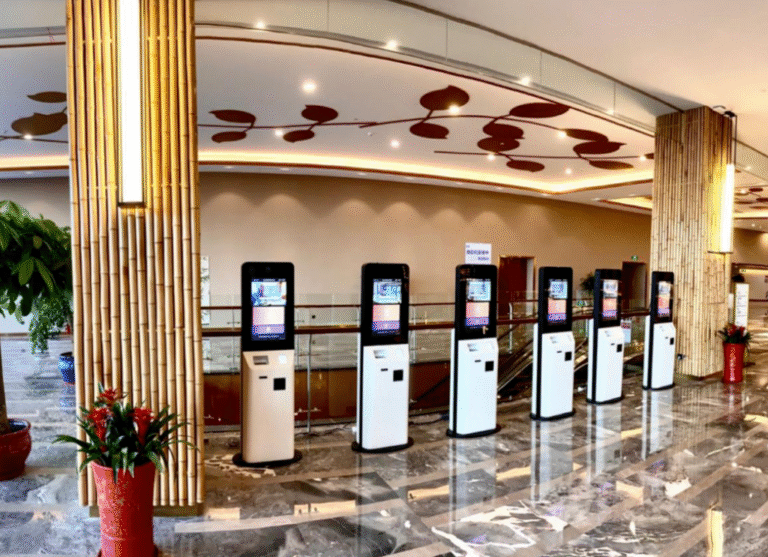
If you are a business traveler visiting global hotels today, you’ll quickly notice how many tasks once handled by people are now managed by smart hotel kiosks. From self check-in to digital concierge services, these intelligent devices have become a core part of the modern hospitality experience. In many international hotel chains, kiosks can scan passports, issue room keys, process payments, verify identity, and even recommend nearby attractions. Some advanced models offer surprisingly unique functions that go far beyond traditional front-desk duties.
In this article, I’ll walk you through the essentials of today’s hotel smart kiosks—how they work, why hotels are adopting them, and what technologies power this new era of automated guest service.
The Rise of Smart Self Check-In in Modern Hotels
Over the past few years, the global hospitality industry has entered a new stage of digital transformation, with unmanned front desks, automated check-in processes, and frictionless guest services becoming increasingly common. This shift accelerated significantly during the COVID-19 period, when hotels worldwide faced urgent pressure to reduce physical contact, streamline arrival procedures, and maintain operational efficiency despite limited staffing. As a result, many properties began adopting smart self check-in kiosks to meet evolving traveler expectations.
Guests today value speed, privacy, and contactless convenience more than ever. Instead of filling out forms or waiting in long lines after a long journey, travelers prefer a quick, independent, and discreet check-in experience. Smart kiosks allow guests to scan passports or IDs, verify personal information, complete their registration, make payments, and receive room keys—all within seconds. The process eliminates unnecessary social interaction, reduces pressure on front-desk personnel, and gives guests greater control over their arrival experience.
From the hotel’s perspective, self check-in kiosks help address major industry challenges: labor shortages, rising operational costs, and the need for 24/7 service. With automation handling repetitive administrative tasks, hotels can reallocate staff to higher-value roles such as guest relations and personalized services. At the same time, advancements in AI, OCR, and identity verification technologies have strengthened the reliability and security of automated check-in systems, reducing the need for constant human oversight.
For these reasons, smart check-in kiosks have evolved from an experimental technology into a standard feature of modern hotels—supporting cost reduction, service improvement, and the long-term digitalization of hospitality.
What Is a Hotel Self Check-In Kiosk?
A hotel self check-in kiosk is an intelligent terminal that automates the entire guest arrival process—from identity verification to room-key issuance—without requiring guests to wait at the front desk. Modern kiosks integrate a series of essential hotel functions, including passport/ID scanning, payment processing, registration form completion, face matching, and automatic room-key dispensing. In countries with stricter identity verification requirements, such as China, a smart kiosk can complete the entire workflow—ID authentication, facial comparison, PMS data submission, and key issuance—in under one minute, ensuring both compliance and efficiency.
These kiosks are used across various hotel types. Business hotels deploy them to speed up peak-hour arrivals. Chain hotels rely on kiosks to maintain standardized service across multiple branches. Boutique hotels use them to enhance privacy and create a seamless arrival experience. In fully unmanned or partially unmanned smart hotels, kiosks often serve as the primary check-in point, operating 24/7 without the need for front-desk personnel.
The introduction of self check-in kiosks does not eliminate the need for hotel staff but instead reshapes the front-desk role. Routine administrative tasks—data entry, payment collection, document verification—are handled by machines, while staff redirect their focus to high-value services such as guest assistance, concierge support, issue resolution, and personalized hospitality.
In this hybrid model, the kiosk becomes the core engine for fast, accurate, and secure check-in, while human staff enhance the overall guest experience. Smart hotel kiosks therefore act as both a replacement for repetitive tasks and an assistant that empowers hotel teams, supporting a more efficient and modern hospitality model.

Core Technologies Behind Modern Hotel Kiosks
Modern hotel self check-in kiosks rely on several advanced technologies that work together to deliver a fast, secure, and fully automated guest experience. At the core is OCR document recognition, which allows the kiosk to instantly read passports, national IDs, and driver’s licenses. Combined with face comparison verification, the system confirms that the guest matches the scanned document—essential in countries with strict identity regulations or hotels requiring enhanced security.
Payment processing is supported through secure integration with NFC, QR, and EMV terminals, enabling guests to complete deposits or room payments directly on the kiosk. Once verification and payment are complete, the kiosk communicates with the hotel’s PMS (Property Management System) to assign rooms, update guest status, and generate digital or physical room keys. Cloud-based workflows ensure that data is synchronized in real time across all hotel systems.
To protect guest information, modern kiosks apply data encryption, secure transmission protocols, and strict privacy safeguards, ensuring compliance with international security standards.
Together, these technologies significantly reduce check-in time, cut down the need for front-desk staff to handle repetitive tasks, and create a smoother, contactless arrival experience. The result is a more efficient hotel operation and a faster, more private check-in process for guests.
Key Configurations to Consider When Choosing Hotel Smart Kiosk
When choosing a hotel self check-in kiosk, the most important decisions revolve around hardware configuration. Screen size is the first factor—21.5″, 27″, and 32″ are the most common. Smaller screens suit boutique or low-traffic hotels, while larger displays provide better visibility and smoother guest interaction for busy business hotels or airport properties.
The touchscreen type also affects user experience. Capacitive touch is more responsive and premium, while infrared touch offers durability and easier maintenance in high-frequency environments.
For hotels with strict identity requirements, a passport/ID scanner paired with an OCR camera is essential. This allows the kiosk to recognize passports, national IDs, and driver’s licenses within seconds. Adding face matching further enhances security by verifying that the person checking in matches the document photo.
Another major configuration is the payment terminal. Hotels can choose simple QR payment, or opt for EMV/NFC terminals for credit card processing. If your property issues physical keycards, a motorized RFID card dispenser or encoder is required to deliver room keys automatically.
On the software side, hotels can choose Android or Windows OS depending on PMS integration needs. Windows generally offers stronger computing power and broader compatibility, but Android provides a lower cost and simpler maintenance.
Each module directly impacts price, experience, and stability. High-end scanners and card dispensers increase cost but ensure fast, reliable check-in during peak hours. Lower-end components reduce budget, but may introduce delays, scanning failures, or maintenance issues.
Choosing the right configuration ensures performance that matches your hotel’s scale, brand, and service expectations.
Price Guide: How Much Does a Hotel Check-In Kiosk Cost?
When you look at the global market, hotel check-in kiosks can range from under US$1,000 to well over US$3,000+ per unit, depending heavily on configuration and brand.
A basic model (often 15.6″–21.5″ screen, Android system, simple stand or desktop form) may be priced around US$900–1,600. These devices are closer to digital signage or light self-service terminals and may not include hotel-grade ID scanning or room-key dispensing.
A true hotel self check-in kiosk—with 21.5″–32″ touchscreen, industrial chassis, ID/passport scanner, receipt printer, and PMS-ready system—typically falls in the US$1,500–2,500 range. High-end branded solutions or all-in-one Windows kiosks with stronger CPU and metal enclosures also sit in this band.
A high-spec configuration with passport/OCR scanner, motorized RFID room-card dispenser, EMV/NFC payment terminal, camera for face comparison and enterprise-grade Windows PC can reach US$2,500–4,000+ per unit. Some customized or designer kiosks, or temporary/rental kiosks for special venues, can be much more expensive.
Several core elements drive the price:
- Scanners: ID/passport, QR, barcode
- Card dispenser: hotel keycard or RFID encoder
- Payment module: simple QR vs EMV/NFC/PCI-compliant terminals
- Operating system & hardware platform: Android vs industrial Windows PC
On top of hardware, hotels must also consider software licensing, PMS integration, cloud platform fees, maintenance, and mass-production costs.
When choosing based on budget, it’s best to:
- Define must-have workflows (ID, payment, key issuance)
- Start from a standard configuration
- Upgrade modules only where they clearly improve guest experience or ROI.
How to Choose the Right Self Check-In Kiosk
Selecting the right self check-in kiosk depends on your hotel’s size, operational model, and guest expectations. For small boutique hotels, a compact 15.6″–21.5″ kiosk with basic ID scanning and simple PMS integration may be sufficient. Medium-size business hotels usually need larger screens, faster processors, and more robust modules to handle higher guest volume. Large hotel chains benefit most from industrial-grade 27″–32″ kiosks with high-speed OCR, face matching, and room card dispensers for peak-hour efficiency.
Another important consideration is whether your property requires PMS integration. For hotels that rely heavily on automated workflows—room assignment, payment posting, membership points—PMS connection is essential. Without it, kiosks can only complete partial tasks and still require staff intervention.
You should also assess whether your hotel plans to operate a 24/7 unmanned or low-staff front desk. In this case, kiosks with AI-based Q&A, voice guidance, and multilingual assistance become highly valuable, ensuring guests can solve common problems without needing staff at late hours.
For high-end hotels such as Hilton or Marriott-affiliated properties, appearance and materials matter. Hotels often request premium finishes—brushed metal, champagne-gold panels, tempered glass fronts—or customized brand color accents to match lobby design. OEM/ODM manufacturers can tailor the kiosk appearance to align with the hotel’s identity.
Hotels also need to strike the right balance between configuration and price. Over-specifying modules raises costs unnecessarily, while under-specifying reduces service quality.
Finally, reliability, stability, and long-term technical support are non-negotiable. A hotel kiosk operates daily, often 24/7, so choosing a manufacturer with proven engineering quality, spare-parts availability, and remote support ensures smooth operation for years.
Why Choose Ikinor as Your OEM/ODM Hotel Kiosk Partner
Ikinor stands out as a reliable smart kiosk OEM/ODM factory thanks to our deep engineering expertise and strong production capability. Our in-house ID/MD design team supports full customization—from exterior styling and color schemes to structural modifications—ensuring each kiosk matches the hotel’s brand identity, lobby aesthetics, and functional needs.
We offer hardware + software integration, combining modules such as OCR passport scanners, payment terminals, face-matching cameras, and RFID card dispensers into one stable system. Every kiosk is engineered for seamless compatibility with major PMS platforms, payment gateways, and security systems, enabling smooth check-in workflows.
Ikinor also has proven mass-production capacity for chain hotels and international projects. For example, we successfully delivered 500 customized hotel smart kiosks to a client in South Africa, meeting strict timelines and ensuring consistent quality across all units.
Our commitment continues long after production. Ikinor provides long-term technical support, remote diagnostics, firmware updates, and guaranteed spare-parts supply to keep hotel kiosks operating reliably for years.
With strong R&D, flexible customization, and global delivery experience, Ikinor is a trusted partner for hotels seeking professional, scalable, and future-ready self check-in solutions.