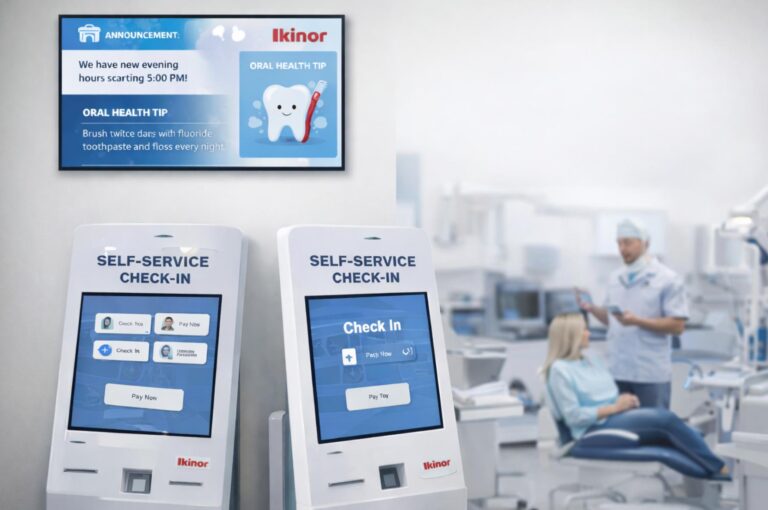
During the digital transformation of dental clinics, self-service kiosks are increasingly becoming a key tool for improving operational efficiency and patient experience. As patient volume continues to rise, front-desk labor costs increase, and patients’ expectations for service efficiency grow, traditional manual reception models are no longer sufficient to meet the operational needs of modern dental practices. By enabling functions such as self check-in, information entry, fee inquiry, and payment, self-service kiosks effectively reduce the workload at the front desk, shorten waiting times, and minimize the risk of errors caused by manual data entry. For dental chains and high-traffic clinics, self-service kiosks are not merely pieces of hardware, but a long-term investment in process optimization and service standardization.
What Problems Do Self-Service Kiosks Solve in Dental Clinics?
In the context of digital transformation, the most prominent challenges faced by dental clinics are often concentrated at the front-desk reception. Front-desk staffing is chronically tight, with personnel required to repeatedly handle high-frequency tasks such as patient check-in, information verification, and payment settlement on a daily basis. The workload is heavy, and errors are difficult to avoid. During peak hours, large numbers of patients arrive simultaneously, leading to longer waiting times, a noticeable decline in patient experience, and potential disruption to overall clinic operations. At the same time, reliance on manual entry of patient information and billing data introduces a certain level of error risk and compliance concerns. For clinics operating multiple treatment rooms and multiple dentists at the same time, workflows are often fragmented across different roles, further increasing management complexity. Compared with traditional models that do not deploy self-service kiosks, the introduction of self-service terminals centralizes patient workflows, standardizes data, effectively relieves front-desk pressure, and significantly improves overall operational efficiency and controllability.
How Do Self-Service Kiosks Integrate with Dental Clinic Workflows and Systems?
When planning to deploy self-service kiosks, the key consideration for dental clinics is whether they can be seamlessly integrated with existing systems and workflows. Modern self-service terminals typically support API integration with PMS, EMR, or HIS systems, enabling automatic synchronization of patient information, medical records, and financial data. The entire patient journey—from appointment booking and arrival to self check-in, form completion, and payment—can be automatically recorded, reducing repetitive manual data entry and minimizing errors.
Self-service kiosks also connect data flows across the front desk, clinicians, and finance teams. Front-desk staff can monitor patient arrivals in real time, clinicians gain rapid access to complete medical records, and the finance department can generate billing information simultaneously, creating a closed-loop flow of information across departments.
In terms of deployment, on-premises solutions offer stronger data security but require adjustments to the existing IT infrastructure, while cloud-based deployments provide greater flexibility and are well suited for multi-location clinics, though they require careful consideration of network stability and regulatory compliance. Overall, clinics with a high level of digitalization can integrate kiosks quickly and achieve efficiency gains, while clinics with fragmented or highly customized systems may need additional modifications—but the long-term improvements in operational efficiency can offset the initial investment.
Which Functions Are Essential in a Self-Service Kiosk for Dental Clinics?
When selecting self-service kiosks, the key for dental clinics is to clearly define core functions and avoid overconfiguration. Essential features include self check-in and identity verification to ensure accurate patient information and reduce the burden on front-desk staff; digital medical history collection and informed consent signing to improve data-gathering efficiency and reduce reliance on paper-based management; and fee inquiry and self-service payment, supporting both out-of-pocket and insurance billing to streamline the checkout process.
In addition, multilingual and accessible interfaces can accommodate patients from diverse backgrounds and those with special needs. Integration with queue management and call-in systems helps coordinate appointments across multiple treatment rooms and clinicians, ensuring smooth patient flow. During procurement, the functions above should be treated as “must-have” features, while options such as health education displays or advertising playback can be considered “optional,” selected flexibly based on budget and clinic requirements.
Clearly distinguishing between essential and optional functions helps control costs while improving operational efficiency and patient experience, laying a solid foundation for the clinic’s digital transformation.
How Does a Self-Service Kiosk Improve Patient Experience and Front-Desk Efficiency?
Self-service kiosks can significantly enhance patient experience and front-desk efficiency in dental clinics, while making return on investment measurable. Once patient check-in, information entry, and payment processes are handled through self-service, waiting times during peak hours are noticeably reduced, repetitive front-desk tasks decrease, and staff can devote more time to patient communication and service. Medical records, billing, and payment information are synchronized directly with the EMR system, reducing errors and improving billing efficiency. Single-location clinics see the most pronounced efficiency gains during peak periods, while dental chains benefit from standardized workflows and KPI monitoring across multiple locations. Quantifiable metrics—such as check-in time, data error rates, payment completion rates, and patient satisfaction—provide clear benchmarks for evaluating ROI.
For example, after Now Care Dental in Minnesota introduced CareStack self check-in kiosks, average patient check-in time was reduced to approximately 60 seconds. The front desk was able to free up about 15 hours per week for other tasks, while patient satisfaction improved significantly.
Why Is Data Security and Compliance Critical When Deploying Self-Service Kiosks in Dental Clinics?
When deploying self-service kiosks, data security and regulatory compliance are also critical for dental clinics. These terminals handle sensitive information such as patient check-in details, medical histories, and payment data, and any data breach may result in legal liability and reputational damage. In the United States, HIPAA requires the protection of Protected Health Information (PHI), with violations potentially leading to fines or mandatory corrective actions. In the European Union, GDPR requires that data collection be based on consent and that patients’ rights to data deletion be protected; violations can result in fines of up to 4% of global annual revenue or €20 million.
Self-service kiosks should incorporate safeguards such as screen privacy protection, automatic logout, data encryption, access controls, and audit logs, while also complying with local regulations governing hardware placement and software management.
Real-world cases highlight these risks. In the United States, Northcutt Dental was fined USD 25,000 after a former employee remotely accessed and exposed patient information. Memorial Hermann Health System was fined USD 2.4 million for failing to properly control employee access, leading to a data breach.
Therefore, when procuring and deploying self-service kiosks, dental clinics must ensure full compliance with HIPAA, GDPR, and applicable local regulations to protect patient data, maintain controlled workflows, and support stable clinic operations.
Which Dental Clinics Are Best Suited to Adopt Self-Service Kiosks?
Self-service kiosks are not suitable for immediate deployment in every dental clinic; their applicability depends on patient volume, business model, and return on investment. High-traffic clinics can use self check-in, payment, and digital form completion to relieve front-desk pressure and shorten waiting times, while clinics with high per-patient revenue can reduce manual errors and improve billing efficiency.
Dental chains are well suited for standardized deployment, enabling data synchronization and process standardization across multiple locations. Independent clinics can selectively adopt core functions to control upfront investment. New clinics can incorporate self-service kiosks into their initial design, whereas existing clinics must assess IT system compatibility and renovation costs. The typical ROI payback period ranges from 12 to 24 months.
If a clinic has low patient volume, a light front-desk workload, or limited budget, delaying deployment may be the more prudent option to avoid unnecessary expense and management complexity. Overall, clinics best suited for immediate deployment are those with high traffic, multiple treatment rooms, a solid digital foundation, or chain operations. Smaller or low-volume clinics can begin with pilot programs or phased rollouts to ensure that investment aligns with operational benefits.
Real Case Study: How Ikinor Helped a Serbian Dental Clinic with Digital Signage and Self-Service Kiosk Solutions
Ikinor assisted a dental clinic in Serbia by implementing a digital signage and smart kiosk solution to enhance operational efficiency and patient experience. As patient volumes increased, traditional manual reception models became inefficient. The self-service kiosks for dental clinics allowed patients to check in, enter information, inquire about fees, and make payments, significantly reducing front-desk workload and waiting times.
The kiosks seamlessly integrated with the clinic’s existing Practice Management System (PMS) and Electronic Medical Records (EMR), automatically syncing patient data across departments. This reduced manual data entry and minimized errors. By centralizing patient workflows, the solution optimized clinic operations and improved control over daily tasks.
Additionally, Ikinor integrated digital signage, enabling the clinic to display health information, announcements, and promotional content, enhancing patient engagement. The digital solution not only improved patient check-in times but also reduced operational costs associated with manual processes.
With Ikinor’s self-service kiosk solution, the Serbian dental clinic streamlined its workflows, enhanced patient satisfaction, and increased efficiency. This case demonstrates how digital signage and self-service kiosks are becoming essential tools in the digital transformation of healthcare facilities.
FAQs
What is a self-service kiosk used for in dental clinics?
It is primarily used for patient check-in, form completion, payment processing, and reducing front-desk workload while improving operational efficiency.
Can self-service kiosks integrate with existing dental management systems?
Yes, most commercial kiosks support integration with PMS, EMR, or HIS systems via APIs or middleware, depending on clinic IT architecture.
How much can a dental clinic improve efficiency with self-service kiosks?
Clinics typically reduce check-in time, lower manual data entry errors, and reallocate front-desk staff to higher-value patient services.
Are self-service kiosks compliant with healthcare data regulations?
When properly configured, kiosks can meet HIPAA and GDPR requirements through encryption, access control, and privacy-focused UI design.
Which dental clinics benefit the most from self-service kiosks?
High-volume clinics, multi-location dental groups, and clinics experiencing front-desk staffing pressure see the fastest ROI.
Is a self-service kiosk suitable for small or independent dental clinics?
Yes, but only when patient volume and workflow complexity justify the investment; otherwise, phased or lightweight deployments are recommended.