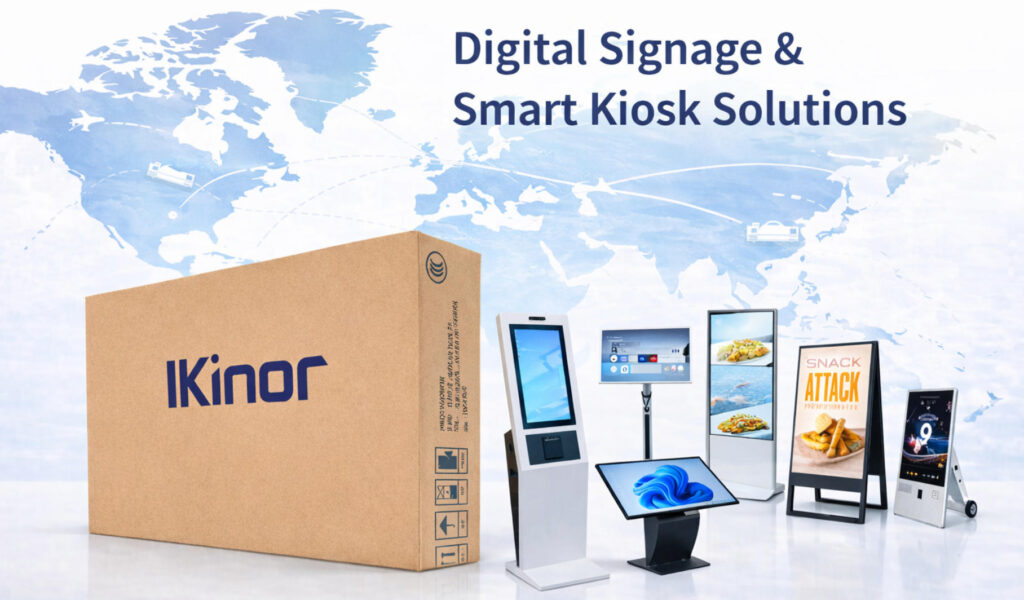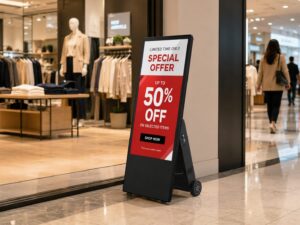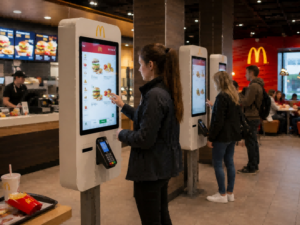
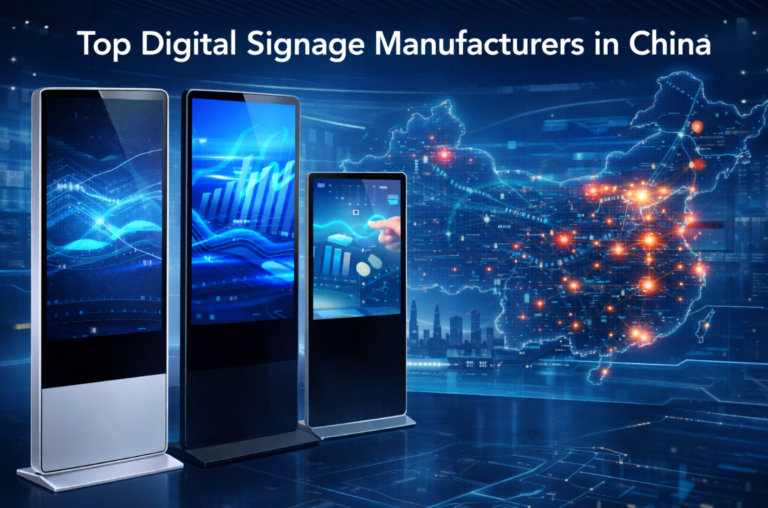
As the world’s largest industrial producer, China plays an irreplaceable role in the global digital signage supply chain. From floor-standing advertising displays to wall-mounted screens, kiosks, and large-format commercial panels, a significant share of the world’s digital signage hardware is designed, manufactured, or assembled in China.
With global demand for digital signage continuing to rise—driven by retail digitization, smart cities, transportation hubs, and enterprise branding—international buyers are increasingly turning to Chinese digital signage manufacturers for scalable production, competitive pricing, and flexible OEM/ODM solutions.
This article is designed to provide buyers with a clear, practical guide to outstanding digital signage manufacturers in China, along with a realistic overview of cost structures, customization options, and supply chain considerations to support informed sourcing decisions.

China Digital Signage Market Overview
China is widely recognized as the world’s largest digital signage manufacturing hub, driven by its unmatched commercial display supply chain, large-scale production capacity, and strong OEM/ODM ecosystem. A significant concentration of manufacturers is located in Guangdong Province, particularly Shenzhen and Dongguan, where upstream panel suppliers, PCB factories, enclosure makers, and system integrators operate within tightly connected industrial clusters. This proximity enables fast prototyping, flexible customization, and highly competitive pricing for global buyers.
From a market perspective, China’s digital signage market reached an estimated USD 2.7–4.7 billion in 2024, depending on whether software and system integration are included, and is expected to grow at a 7–10% CAGR over the coming years. By 2030–2033, the market size is widely forecast to roughly double. Behind this growth is China’s broader new-type display industry, which surpassed RMB 4,900 billion in total output value, providing a solid capacity foundation for digital signage terminals and exports.
OEM/ODM manufacturing dominates China’s role globally. A large share of digital signage hardware used in North America, Europe, the Middle East, and Southeast Asia is produced in China under private-label or customized programs. Export strength is supported by mature LCD/LED technologies, scalable labor, and efficient logistics.
On the demand side, key application growth comes from retail, transportation, smart cities, and enterprise environments. For example, many major Chinese cities have deployed unmanned convenience stores using automated digital signage solutions for pricing, promotions, and self-service interaction—illustrating how digital signage has moved beyond advertising into intelligent retail infrastructure.
Key Types of Digital Signage Products Made in China
China manufactures one of the most complete digital signage product portfolios in the world, covering almost every commercial application scenario. The diversity of products is a major reason why global buyers rely heavily on Chinese suppliers for both standard models and customized OEM/ODM projects.
Indoor vs. Outdoor Digital Signage
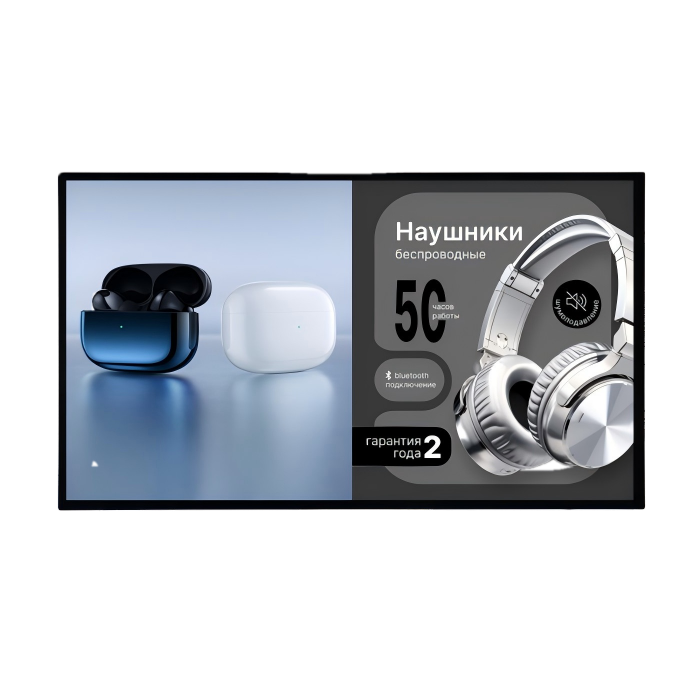
Indoor digital signage is the largest category, widely used in retail stores, shopping malls, offices, hospitals, hotels, and restaurants. These displays typically focus on slim design, high resolution, and long operating hours. Outdoor digital signage, on the other hand, is built for harsh environments, featuring high brightness (2,500–4,000 nits), weatherproof enclosures, temperature control systems, and anti-glare glass, making them suitable for streets, transport hubs, and outdoor advertising networks.
Form Factors: Floor-standing, Wall-mounted, and Kiosk Displays
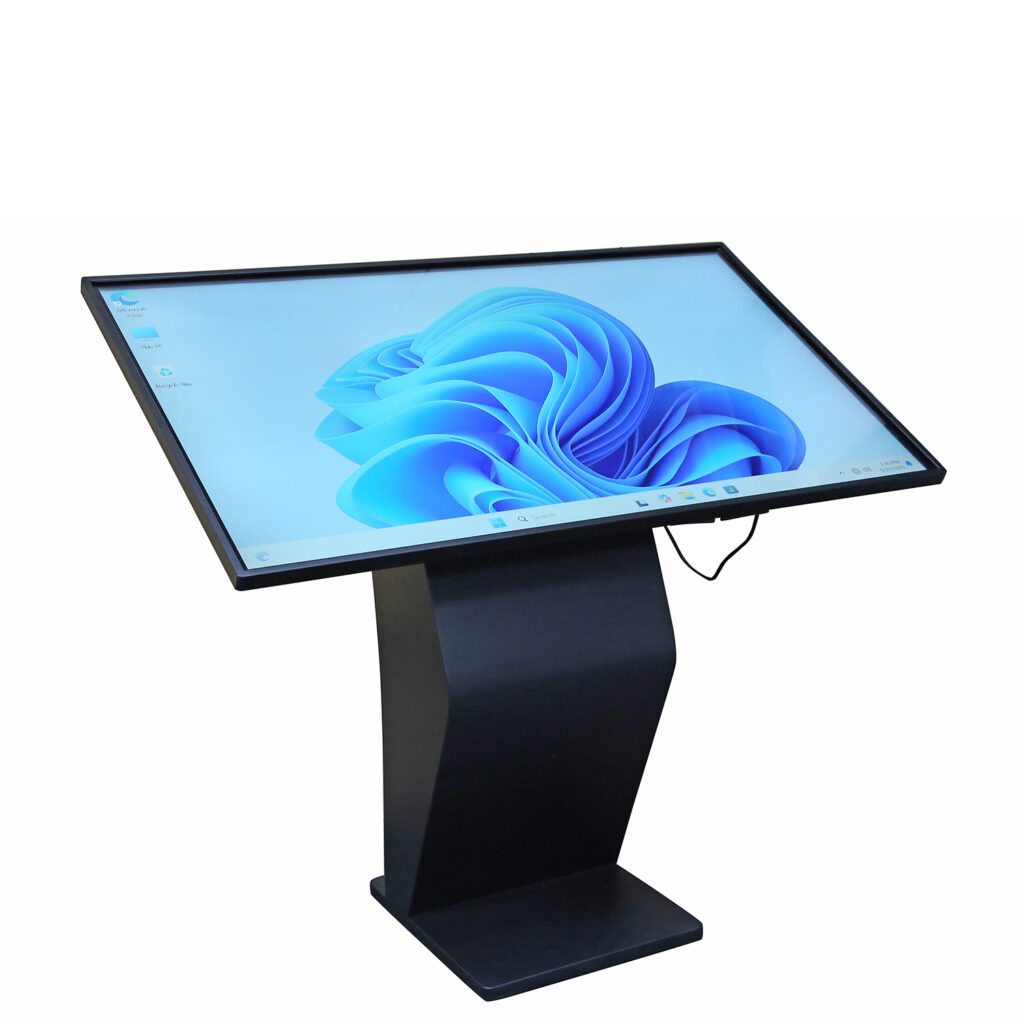
Chinese factories produce a full range of form factors, including floor-standing advertising displays, wall-mounted screens, window-facing displays, and self-service kiosks. Floor-standing models are especially popular globally for shopping centers and exhibitions, while kiosks integrate touch, cameras, printers, and payment modules for interactive use cases.

Display Technologies: LCD, LED, and Fine-pixel LED
LCD-based digital signage remains the mainstream choice due to cost efficiency and stable supply. LED and fine-pixel LED solutions are increasingly adopted for large-format video walls, flagship stores, and smart city projects, offering higher brightness, seamless visuals, and flexible sizes.
Most Chinese digital signage products are delivered with mature CMS platforms, enabling centralized content management, remote updates, scheduling, and real-time control of multiple devices across different locations, which is critical for large-scale deployments.
Top 10 Digital Signage Manufacturers in China
Hisense Commercial Display (海信商显)
| Item Details | Company Profiles & Capabilities |
|---|---|
| Company Name | Hisense Commercial Display (海信商显) |
| Company Bio | Backed by the multibillion-dollar Hisense Group, Hisense Commercial Display is a premier global provider of enterprise-grade visual solutions. Utilizing proprietary image-processing chips and global R&D centers, the company delivers high-end commercial display systems characterized by exceptional color accuracy and long-term hardware reliability, widely deployed in international transportation hubs, premium retail chains, and sports stadiums. |
| Core Product Line | Premium digital signage, outdoor high-brightness LCD displays, commercial TV systems (Hospitality Display), fine-pitch LED video walls, and interactive flat panels. |
| OEM / ODM Capability | World-class industrial manufacturing automation, dedicated commercial display production campus, in-house SoC/chipset architecture design, strict military-grade QA testing, and full tier-1 OEM/ODM large-scale cluster customization capabilities. |
| Main Export Markets | Europe, North America, Asia-Pacific, Middle East, and Latin America (Global sales and after-sales service network). |
| Contact | Inquire via WhatsApp |
TCL Commercial Display (TCL 商显)
| Item Details | Company Profiles & Capabilities |
|---|---|
| Company Name | TCL Commercial Display (TCL 商显) |
| Company Bio | As a subsidiary of TCL Group, TCL Commercial Display benefits from direct upstream screen panel integration via CSOT (China Star Optoelectronics Technology). This vertical supply chain setup allows the company to secure stable panel supply, optimize structural manufacturing costs, and engineer innovative commercial display units for multi-industry applications. |
| Core Product Line | Standard and ultra-wide LCD digital signage, zero-bezel video walls, smart interactive displays, high-brightness commercial monitors, and outdoor kiosk modules. |
| OEM / ODM Capability | Direct Open Cell processing and LCM integration, advanced industrial tooling, mass manufacturing scalability, comprehensive customization for corporate enterprise partners, and full-process global technical compliance certification. |
| Main Export Markets | North America, Western Europe, Southeast Asia, South America, and Africa. |
| Contact | Inquire via WhatsApp |
Skyworth Commercial Display (创维商显)
| Item Details | Company Profiles & Capabilities |
|---|---|
| Company Name | Skyworth Commercial Display (创维商显) |
| Company Bio | Skyworth Commercial Display focuses on delivering professional smart display hardware leveraging decades of electronics engineering heritage. The company stands out in specialized B2B display setups, hospitality system infrastructures, and high-performance commercial networks, aligning solid product architecture with competitive pricing structures. |
| Core Product Line | Smart signage displays, interactive smart boards, specialized hotel IPTV displays, indoor commercial LED screens, and wall-mounted advertising panels. |
| OEM / ODM Capability | Scalable assembly configurations, advanced software-hardware integration testing, comprehensive structural customizations, and long-term hardware reliability assurance under global supply networks. |
| Main Export Markets | Europe, Middle East, Southeast Asia, and Central Asia. |
| Contact | Inquire via WhatsApp |
BOE Technology Group (京东方)
| Item Details | Company Profiles & Capabilities |
|---|---|
| Company Name | BOE Technology Group (京东方) |
| Company Bio | BOE is a global semiconductor display titan and the largest LCD panel provider in the world. Shifting towards end-to-end smart IoT integration, BOE manufacturers integrated commercial display hardware from raw sub-panel level up to complex commercial networks, setting global benchmarks in high-end panel yield and optoelectronic technologies. |
| Core Product Line | Ultra-high-definition digital signage, ultra-narrow bezel industrial video walls, high-brightness outdoor displays, transparent OLED panels, and bespoke smart retail visual ecosystems. |
| OEM / ODM Capability | Unmatched vertical integration (fab lines to finished display systems), elite Tier-1 global enterprise ODM/OEM customization, pioneering flexible and transparent display technology, and absolute panel supply chain stability. |
| Main Export Markets | Global coverage (North America, Europe, Asia-Pacific, Latin America, Middle East). |
| Contact | Inquire via WhatsApp |
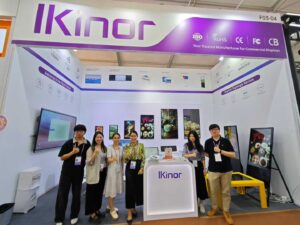
Dongguan Ikinor Industry Co. Ltd (东莞磐视电子科技)
Ikinor Digital Signage Factory Tour
Explore Ikinor’s smart display manufacturing, precision assembly, and quality control process in our factory tour video.
| Item Details | Company Profiles & Capabilities |
|---|---|
| Company Name | Dongguan Ikinor Industry Co. Ltd (东莞磐视电子科技) |
| Company Bio |
Dongguan Ikinor Industry Co., Ltd. (东莞磐视电子科技) is a leading Chinese manufacturer of commercial LCD/LED digital signage solutions, delivering scalable OEM/ODM hardware for global retail, transit, and smart city projects. Operating as a strategic pillar of the Ikinor Group, the company anchors the commercial broadcasting display market, while its sister enterprise, Ikinor Technology, specializes in interactive displays and smart whiteboards for corporate and educational environments. Benefiting from group-wide Grade-A panel procurement, in-house SMT production, and international compliance certifications, Dongguan Ikinor combines world-class manufacturing power with dedicated long-term service to optimize total cost of ownership (TCO) for overseas buyers. |
| Core Product Lines | Indoor digital signage displays, outdoor digital signage, floor-standing advertising displays, wall-mounted commercial displays, digital signage kiosks, stretched displays. |
| OEM / ODM Capability | Full OEM/ODM services including enclosure design, logo branding, hardware configuration, CMS pre-installation, SKD/CKD support for overseas assembly, and project-based customization. |
| Typical Screen Sizes | 32″ / 43″ / 49″ / 55″ / 65″ / 75″ / 86″ / 98″ |
| Display Technologies | LCD digital signage, LED digital signage, fine-pixel LED displays. |
| Installation Types | Floor-standing, wall-mounted, ceiling-mounted, kiosk-style. |
| CMS & Software | Supports integrated CMS platforms for centralized content management, remote monitoring, scheduling, and multi-site control. |
| Key Application Scenarios | Retail advertising, transportation hubs (airports, metro, stations), shopping malls, restaurants & QSR menu boards, hotels, office buildings, smart cities. |
| Main Export Markets | Europe, Middle East, Southeast Asia, Latin America, Africa. |
| Competitive Advantages | Strong China supply chain, fast lead times, competitive pricing, flexible customization, experience with large-scale rollout projects. |
| Compliance Support | CE, RoHS, FCC compliance for international markets. |
| Service Model | Factory-direct supply combined with local distributors and system integrators for installation, commissioning, and after-sales support. |
| Contact | Inquire via WhatsApp |
Other Digital Signage Manufacturers In China
| Item Details | UniviewLCD | Eastidea | Portworld | WinHi | MileStrong | Goodview | 360DigitalSignage |
|---|---|---|---|---|---|---|---|
| Company Name | UniviewLCD | Eastidea | Portworld | Ningbo WinHi Electronic Co., Ltd. (WinHi) | MileStrong | Shanghai Goodview Electronic Technology Co., Ltd. | 360DigitalSignage |
| Company Bio | UniviewLCD is a leading LCD digital signage manufacturer in China, operating its own high-tech engineering and manufacturing facilities with an annual production capacity exceeding 60,000 units. | Eastidea is an experienced digital signage manufacturer in China, supplying cost-effective commercial display solutions to global B2B clients. | Portworld is a China-based manufacturer well known for Android-based and floor-standing digital signage solutions with strong system integration capability. | WinHi is a Chinese manufacturer focused on advertising screens and digital signage hardware with competitive pricing and stable export capacity. | MileStrong is a professional commercial display manufacturer specializing in LED and LCD digital signage for large-scale projects. | Goodview is one of China’s leading digital signage brands, widely deployed in enterprise and retail environments across Asia. | 360DigitalSignage offers a wide portfolio of LCD and LED digital signage products, serving international commercial display projects. |
| Core Product Line | LCD digital signage, advertising displays, commercial LCD monitors | Advertising displays, digital signage, LED screens, touch kiosks, media projectors | Floor-standing digital signage, Android signage displays, industrial tablets | Advertising screens, digital signage, LCD monitors, media players | Commercial digital signage, LED displays, LCD signage systems | Digital signage, commercial LCD displays, enterprise signage solutions | LED display modules, indoor & outdoor LED screens, LCD video walls, stretched LCD panels |
| OEM / ODM Capability | In-house R&D, full production line, stable mass manufacturing, OEM & ODM customization supported | OEM/ODM manufacturing, flexible hardware configuration, custom housing and branding | Strong OEM/ODM service, Android OS customization, small to mid-batch flexibility | OEM manufacturing, cost-efficient mass production, export-oriented supply chain | OEM/ODM manufacturing for LED & LCD products, strong engineering support | Mature OEM/ODM platform, strong R&D team, large-scale factory capacity | OEM/ODM manufacturing, LED + LCD integrated solution provider |
| Main Export Markets | Europe, North America, Middle East, Southeast Asia | Europe, Middle East, Africa, South America | Europe, North America, Asia-Pacific | Europe, South America, Southeast Asia | Europe, Middle East, North America | Asia-Pacific, Europe, North America | Global markets |
| Contact | Inquire | Inquire | Inquire | Inquire | Inquire | Inquire | Inquire |
Price Range & Cost Structure Of Digital Signage In China
Digital signage pricing is largely determined by its underlying hardware architecture and the way products move through the supply chain. At the core level, key hardware components include the LCD or LED panel, main control board, processor (SoC), power supply, enclosure, and peripheral modules such as speakers, cameras, or touch sensors. Among these, the display panel (brightness, size, and grade) usually accounts for the largest share of cost, followed by the mainboard and chipset, which define system stability, decoding capability, and long-term compatibility.
Entry-level digital signage systems—typically 32″–55″ indoor LCD displays with standard brightness (300–350 nits) and Android-based players—are designed for retail, menus, and basic information displays. These models emphasize cost efficiency and standardized components.
Mid-range solutions—often 55″–75″ displays with higher brightness (400–700 nits), metal enclosures, and more powerful processors—are widely used in shopping malls, transportation hubs, and corporate environments.
High-end digital signage includes ultra-high-brightness outdoor screens, fine-pixel LED walls, or custom kiosks with reinforced enclosures, advanced thermal design, and long-life industrial components.
A major pricing difference comes from factory-direct sourcing versus branded retail products. Factory-direct manufacturers eliminate multiple distribution layers, typically offering 20–40% lower pricing than international brands, while still supporting OEM/ODM customization. Branded products, by contrast, include markups for marketing, regional distribution, and long warranty structures.
Key cost drivers include panel quality, brightness level, enclosure material, system performance, and software—especially when CMS licensing, remote management, or analytics are required. Understanding these factors helps buyers balance upfront cost with long-term operational value.
What Solutions Can Chinese Digital Signage Manufacturers Offer?
Chinese digital signage manufacturers are not only display hardware suppliers. For many overseas buyers, their value lies in combining scalable production, hardware customization, software compatibility, and OEM/ODM support into practical commercial display solutions. This is especially useful for distributors, system integrators, retail chains, hospitality groups, transportation projects, and local signage solution providers.
| Solution Type | What It Includes | Suitable Buyer Scenario |
|---|---|---|
| Large-scale commercial digital signage deployment | LCD, LED, OLED displays, video walls, wall-mounted screens, floor-standing displays, CMS compatibility, media player support, and multi-site device management | Retail chains, shopping malls, airports, supermarkets, hotels, corporate buildings, and smart city projects |
| Customized digital signage development | Screen size, brightness, enclosure structure, operating system, touch function, interface design, hardware modules, and application-specific software integration | Buyers with special local use cases, harsh environments, unusual installation conditions, or differentiated product requirements |
| Outdoor and high-brightness signage solutions | Outdoor digital signage, window displays, digital window displays, sunlight-readable screens, weather-resistant enclosures, ventilation, cooling, and anti-glare design | Street advertising, Gulf region projects, transportation hubs, storefronts, outdoor retail, and public service spaces |
| Specialized commercial display formats | Stretch strip displays, shelf-edge screens, digital menu boards, smart advertising posters, touchscreen displays, and freestanding digital signage | Restaurants, convenience stores, supermarkets, retail shelves, storefront windows, and promotional zones |
| OEM/ODM and branding customization | Logo branding, housing color, boot screen, UI style, packaging, CMS pre-installation, SKD/CKD support, and private-label product development | Local distributors, regional resellers, AV integrators, and brands that want to build their own digital signage product line |
For example, Ikinor’s supply chain has supported outdoor digital signage customization for clients in Gulf countries in the Middle East, where displays needed to remain stable and clearly visible under high temperatures and strong sunlight. In another Southeast Asian project, a floor-standing touchscreen digital signage solution was developed with an integrated shared power bank function, allowing the display to serve both advertising and local user-service needs.
These examples show why many buyers work with Chinese digital signage manufacturers for more than standard products. A capable manufacturer can adapt display hardware to the real installation environment, combine screens with interactive or service modules, and support local distributors with OEM/ODM branding. For buyers planning bulk deployment, outdoor projects, retail display upgrades, or private-label product lines, this flexibility can be more valuable than simply choosing the lowest-priced screen.
OEM / ODM Capabilities & Customization Options Of Digital Signage In China
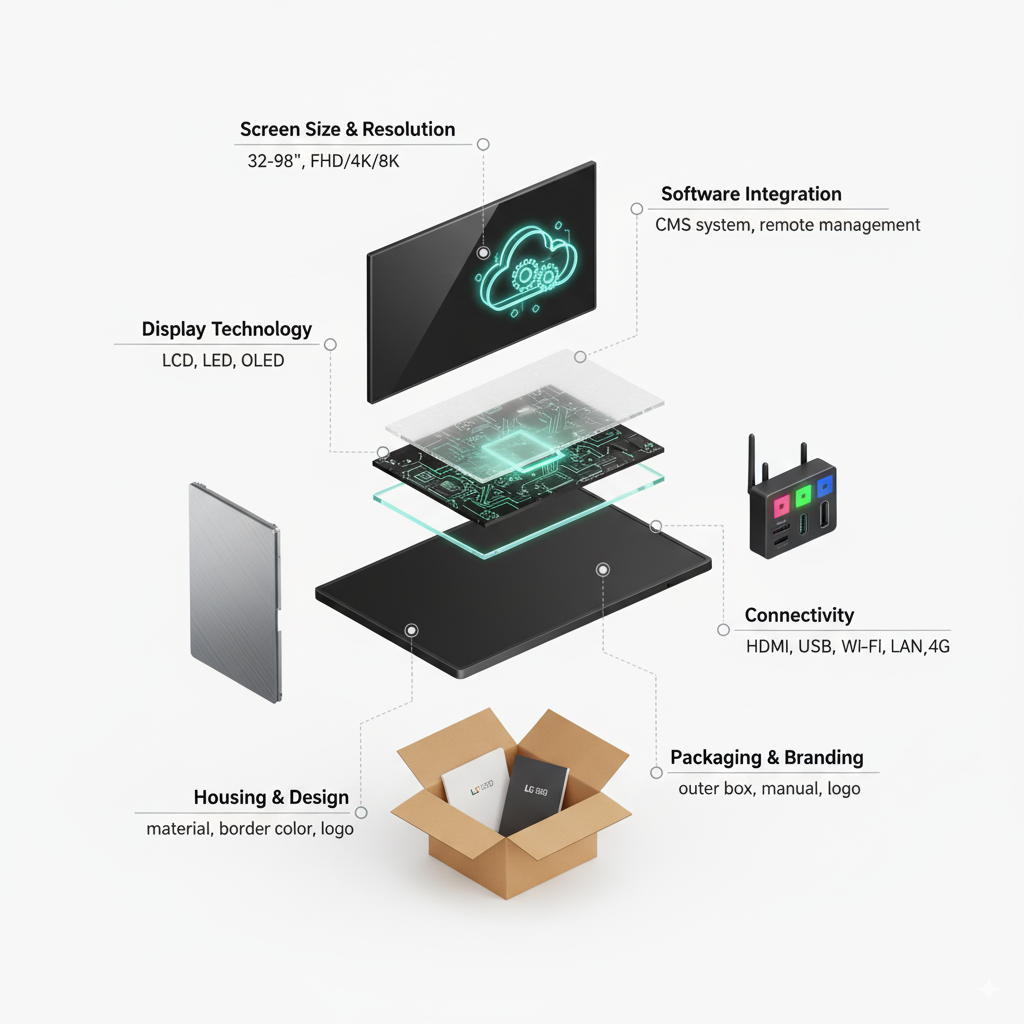
China-based digital signage manufacturers are widely recognized for their strong OEM / ODM capabilities, allowing global buyers to move beyond off-the-shelf products and build fully customized display solutions. Typical customization starts with branding elements, including logo printing on bezels, startup boot logos, UI skins, and customized packaging designed for retail or project delivery.
From a hardware perspective, manufacturers can tailor enclosure materials (metal, aluminum, tempered glass), screen sizes (from compact 21.5″ to large-format 98″+), brightness levels (standard indoor, high-brightness, or outdoor-ready), and even thermal design to suit different environments. Operating system options usually include Android, Windows (via OPS), or dual-system configurations, depending on application needs.
On the software side, CMS (Content Management System) integration is a key OEM/ODM advantage. Many factories support CMS pre-installation, API docking with third-party platforms, or full white-label CMS solutions, enabling buyers to offer their own branded management software for content scheduling, remote monitoring, and device control across multiple locations.
A practical example is Ikinor, which once developed a custom touchscreen digital signage system for a German automotive dealership group. The project focused on interactive car selection inside 4S showrooms, combining large touch displays, a tailored UI in German, vehicle configuration software, and CMS-based content updates—creating a seamless digital customer experience aligned with the brand.
In terms of MOQ and lead time, standard OEM projects often start from 10–30 units, while deeper ODM customization may require 50–100 units, with lead times ranging from 4–8 weeks depending on complexity.
What Quality Standards, Certifications, and Compliance Do China Digital Signage Manufacturers Provide?
As the backbone of the global supply chain, China digital signage manufacturers are deeply experienced in meeting international quality, safety, and compliance requirements. For export-oriented factories, certification is not optional—it is a baseline capability. Most professional manufacturers design digital signage hardware to comply with CE (Europe), FCC (United States), and RoHS standards, covering electromagnetic compatibility, electrical safety, and hazardous substance restrictions. These certifications enable Chinese-made digital signage to be legally sold across the EU, North America, and many emerging markets.
Beyond basic certification, leading manufacturers also support energy efficiency and environmental standards, such as ERP requirements for Europe and region-specific energy labeling. For outdoor and semi-outdoor applications, IP ratings (IP54, IP65) are commonly available, ensuring resistance to dust, humidity, and harsh environments—especially important for transportation hubs, smart cities, and outdoor advertising projects.
To ensure long-term stability, export-focused China digital signage manufacturers implement industrial-grade reliability testing. This typically includes 24/7 burn-in testing, high-temperature aging tests (often 50–70°C), power cycling, and vibration testing. These processes help guarantee reliable performance in continuous-operation scenarios such as retail chains, airports, and control rooms, where downtime is unacceptable.
From a compliance perspective, mature Chinese factories are also well prepared for export documentation, including Declarations of Conformity, test reports, and component traceability files. For buyers targeting the EU, US, or Middle East markets, this reduces certification risk and shortens time-to-market. In practice, strong compliance capability has become one of the most important competitive advantages of established China digital signage manufacturers.
How to Determine If You Need a China Digital Signage Manufacturer
Navigating the global display market can be challenging, but certain project requirements point directly to China’s manufacturing hubs as the ideal solution. If you are managing a large-scale project deployment that demands scalable production capacity, or if your project requires highly specific OEM/ODM customization but your budget remains constrained, sourcing factory-direct from a Chinese supplier is often the most strategic move. These manufacturers excel at eliminating intermediary markups, offering cost-efficient hardware without sacrificing technical performance or structural durability.
Furthermore, Chinese suppliers are increasingly competitive when it comes to specialized, highly integrated projects. A prime example is implementing a digital menu board network for a restaurant or café chain. These setups require seamless coordination between dedicated commercial-grade displays and specialized software backends for real-time pricing and scheduling updates. While standard digital signage might be too generic to handle these unique food and beverage workflows, leading Chinese factories provide the exact hardware-plus-software synergy required. For a deeper dive into selecting the right vendor for this specific niche, we highly recommend reading our specialized guide on digital menu board suppliers and their solutions.
Ultimately, if your deployment requires financial efficiency, extensive hardware tailored to your brand, or deep software-hardware integration, partnering with an established Chinese manufacturer will provide the long-term operational value your business needs.
How to Choose the Right Digital Signage Manufacturer in China
Choosing the right digital signage manufacturer in China is not only about price—it is about long-term reliability, service capability, and total cost of ownership.
The first and most important step is factory audit and sample testing. Whenever possible, buyers should visit the factory in person. A real visit allows you to verify production scale, assembly lines, aging test rooms, QC processes, and inventory management. You can quickly distinguish a true manufacturer from a trading company by checking whether they have in-house SMT lines, metal fabrication, and testing facilities. Before mass production, always request pre-production samples to evaluate brightness, touch accuracy, CMS compatibility, and overall build quality.
The second key factor is after-sales support and warranty capability. Reliable China digital signage manufacturers should clearly define warranty terms (usually 1–3 years), spare parts availability, and response time. Ask whether they provide remote technical support, firmware updates, and replacement parts for panels, power boards, and mainboards. For overseas projects, confirm if they can support DOA replacement, advance spare parts, or local service partners.
Evaluate the total cost of ownership (TCO), not just the unit price. A proper TCO checklist should include hardware cost, CMS software licensing, logistics, import duties, installation, maintenance, and downtime risk. A slightly higher-priced but stable manufacturer often results in lower long-term costs than a cheaper supplier with poor quality control. In practice, the best China digital signage partners combine manufacturing strength, export compliance, and long-term service commitment. For distributors, AV integrators, and local service companies, choosing a reliable manufacturer is also the foundation of building a sustainable digital signage reseller business, because hardware quality, CMS compatibility, customization support, and after-sales service all affect long-term customer trust.
To help procurement managers standardize their vendor evaluation during the vetting phase, we have compiled a comprehensive compliance matrix below. This checklist balances core production capabilities, QA protocols, and international export logistics.
China Digital Signage Vendor Compliance Checklist
| Evaluation Dimension | Critical Checkpoints | Compliance Standard | Risk Level if Deficient |
|---|---|---|---|
| 1. Manufacturing & Facility | In-house Metal Fabrication & SMT Lines | Verify if they own CNC machines, laser cutters, and dust-free assembly rooms. | High: Trading companies or small workshops outsource these, leading to poor batch consistency and prolonged lead times. |
| Aging Test Protocol | Mandatory 24–72 hours continuous burn-in test at full brightness with temperature monitoring. | Critical: High dead-pixel rates, premature backlight burnout, or power board failures upon arrival (DOA). | |
| 2. Technical & QA | Panel Grade & Source | Must use brand-new, original Grade-A panels (e.g., LG, BOE, Innolux, AUO). | High: Supplier might use refurbished or Grade-B open-cell panels, causing rapid color degradation and brightness drop. |
| Touch & CMS Integration | Pre-production validation of infrared (IR) or projected capacitive (PCAP) touch accuracy and OS (Android/Windows) stability with your CMS. | Medium: Screen lagging, touch drift, or firmware incompatibility with remote management software. | |
| 3. Export Compliance | Global Certifications | CE (EMC/LVD), FCC, RoHS, UL, or UKCA certifications matching the destination market. | Critical: Customs seizure, heavy border fines, or legal liability in case of electrical fires or interference. |
| International Logistics Packing | Plywood cases (fumigation-free) or honeycomb cardboard with thick EPE foam, drop-test certified. | High: Crushed screen glass or chassis bending during long-distance ocean freight. | |
| 4. Service & Financials | SLA & Warranty Terms | 1–3 years warranty with 1%–2% advance spare parts (mainboards, power boards, inverters) shipped with mass production. | Critical: Skyrocketing maintenance costs if you have to ship heavy hardware back to China for repair. |
| TCO & Software Transparency | Clear breakdown of hardware, CMS licensing fees (if any), customization NRE costs, and technical support response time (<24 hours). | Medium: Hidden software upgrade fees or unexpected costs for structural customization later. |
A Vital Industry Insight: Digital Signage vs. Interactive Kiosks
In practice, the boundary between hardware manufacturing for commercial displays is highly fluid. Because Digital Signage and Interactive Self-Service Kiosks share an identical supply chain ecosystem—relying heavily on customized sheet metal fabrication, industrial-grade open-frame monitors, touchscreen integration, and ruggedized thermal management—the vast majority of premium China digital signage manufacturers are also leading interactive self-service kiosk manufacturers.
If your project extends beyond pure content broadcasting into interactive transactions, check-ins, or ticketing, we highly recommend exploring our sister directory.
🔗 Explore the Comprehensive Guide to China Interactive Self-Service Kiosk Manufacturers Here →