ndonesia’s digital signage market is evolving rapidly, driven by the country’s vibrant retail scene, fast-growing F&B sector, and digitally savvy consumers. From interactive menu boards in restaurants to large-scale video walls in shopping malls, digital signage has become a powerful tool for engaging customers, delivering real-time information, and strengthening brand presence. As businesses compete for attention in high-traffic environments, choosing the right digital signage solution is no longer optional—it is a strategic investment.
This article explores the current digital signage landscape in Indonesia, analyzes key buying considerations, introduces the top digital signage suppliers in the market, and presents real-world case studies from Indonesian restaurants and shopping malls to help decision-makers make informed choices.
Why Is the Digital Signage Market in Indonesia Growing So Fast?
Indonesia’s digital signage market is experiencing strong growth as businesses across retail, hospitality, transportation, and corporate sectors increasingly adopt dynamic display solutions. In 2024, the Indonesian digital signage market was valued at approximately USD 281 million, and it is projected to grow at a compound annual growth rate (CAGR) of ~13.5 % through 2032, potentially reaching about USD 616 million by then.
A key advantage of the Indonesian market is its large and youthful population coupled with rapid urbanization, which fuels demand for modern in-store and out-of-home advertising formats. While Indonesia still relies on imported display panels and components—particularly from major electronics producers in East Asia—local integration and assembly services are maturing, with an expanding supplier ecosystem and after-sales support network emerging across major cities. This helps reduce logistics costs and improves responsiveness for buyers in the region.
In terms of product mix, standalone displays and smaller screens (below 32 inches) currently dominate due to their use in quick-serve restaurants and small retail outlets, while larger formats (above 52 inches) and video walls are among the fastest-growing segments, favored for malls, transportation hubs, and corporate lobbies. On the software side, cloud-based content management systems are gaining traction, with the Indonesian digital signage software market forecasted to grow at around 18 % CAGR through 2032, reflecting strong enterprise interest in scalable, remotely managed platforms.
Overall, Indonesia’s digital signage landscape is becoming more diverse and competitive, driven by urban retail expansion, a growing middle class, and an expanding supplier base that supports both hardware deployment and software innovation.
How Is Digital Signage Actually Used in Indonesia’s Retail and Commercial Spaces?
In Indonesia, digital signage has been widely adopted across retail and commercial environments, with clear, measurable impact. In the restaurant sector, a representative case is a fast-casual dining chain operating dozens of outlets in Jakarta and Surabaya. Facing long queues during peak hours and inconsistent menu presentation across stores, the brand aimed to increase average order value, shorten decision time, and maintain unified brand visuals. The solution combined 43-inch commercial LCD menu boards with a cloud-based CMS that allowed headquarters to update pricing, promotions, and visuals in real time. Installation was completed store by store during off-peak hours, with staff training focused on basic content scheduling. Within three months, the chain reported a noticeable reduction in customer queue time and an estimated 12–15% increase in upsell rates, driven by animated combo offers and time-based promotions displayed on screen.
A second case comes from a large shopping mall in Jakarta, where management sought to improve visitor navigation while creating new advertising revenue streams. The mall deployed a system built around large LED video walls at main entrances and interactive touchscreen kiosks on each floor. The displays were integrated with a centralized CMS, enabling real-time event promotion, tenant advertising, and dynamic wayfinding. As a result, customer inquiries at information desks dropped significantly, while branded advertising slots on the video walls attracted long-term partners, generating additional recurring income.
Across both cases, content strategy proved critical. High-impact visuals, clear menus, promotional highlights, and intuitive wayfinding performed best. Successful operators avoided cluttered layouts, kept messages concise, and scheduled content by time of day. Personalization, motion graphics, and consistent branding helped digital signage evolve from static displays into engaging communication tools.
What Content Works Best for Digital Signage in Indonesia, and Why?
Effective digital signage relies as much on content strategy as on hardware and software. In practice, the best-performing content is clear, relevant, and designed for short attention spans. In retail and food service environments, menus, price boards, and promotional offers consistently deliver the highest engagement. High-quality food imagery, limited-time offers, and combo suggestions help customers make faster decisions while increasing average order value. In shopping malls and large venues, wayfinding content—such as directories, maps, and directional guidance—reduces confusion and improves overall visitor experience.
Following established best practices is critical. Successful digital signage content prioritizes clarity and simplicity: large fonts, strong contrast, and concise messaging. Overloading screens with excessive text or too many visuals is a common mistake that reduces readability and impact. Content should be aligned with viewing distance and screen size, and animations should enhance—not distract from—the message. Consistency in brand colors, typography, and tone helps build trust and recognition across locations.
Scheduling and personalization significantly enhance performance. Time-based scheduling allows different content to appear during breakfast, lunch, or evening periods, while location-based content ensures relevance across multiple branches. Advanced systems can also integrate external data, such as promotions triggered by inventory levels or local events, making displays more dynamic and responsive.
From a creative perspective, engagement increases when content feels fresh and purposeful. Short motion graphics, subtle transitions, and clear calls to action perform better than long video loops. Rotating content regularly prevents “screen blindness,” while using real photos, icons, or localized messaging helps digital signage feel more human and less like static advertising. When executed well, content turns digital signage into an effective communication and conversion tool.
How to Choose the Right Digital Signage Supplier?
When selecting a digital signage supplier, manufacturing qualifications and compliance certifications are the first indicators of reliability. Reputable suppliers should hold ISO 9001 for quality management, along with product-level certifications such as CE and RoHS, which ensure electrical safety, environmental compliance, and smoother customs clearance in international markets.
Factory scale and production capacity directly impact delivery stability. Buyers should evaluate the number of production lines, monthly output capacity, and workforce size. Medium-to-large manufacturers typically operate multiple assembly lines with monthly capacities ranging from 3,000 to 10,000 units, enabling them to support both pilot deployments and large-scale rollouts without compromising lead times.
A strong supplier must also demonstrate technical capability. This includes in-house industrial design, PCB and system integration, as well as OEM/ODM services for customized enclosures, branding, and performance specifications. Engineering support for installation, system tuning, and troubleshooting is particularly important for complex commercial projects.
Equally critical is the quality control system. Mature factories follow structured processes such as IQC, IPQC, and OQC, supported by testing equipment for aging tests, high-temperature operation, vibration, and power stability. These controls significantly reduce field failure rates and long-term maintenance costs.
Supply chain strength is another key factor. Suppliers with stable upstream relationships for panels, chipsets, and power components can maintain consistent quality and predictable delivery schedules, even during component shortages.
Finally, selection criteria vary by buyer type: brand owners prioritize customization and compliance, distributors value flexible MOQs and fast replenishment, while project contractors focus on scalability, delivery reliability, and after-sales engineering support.
Top 10 Digital Signage Supplier In Indonesia
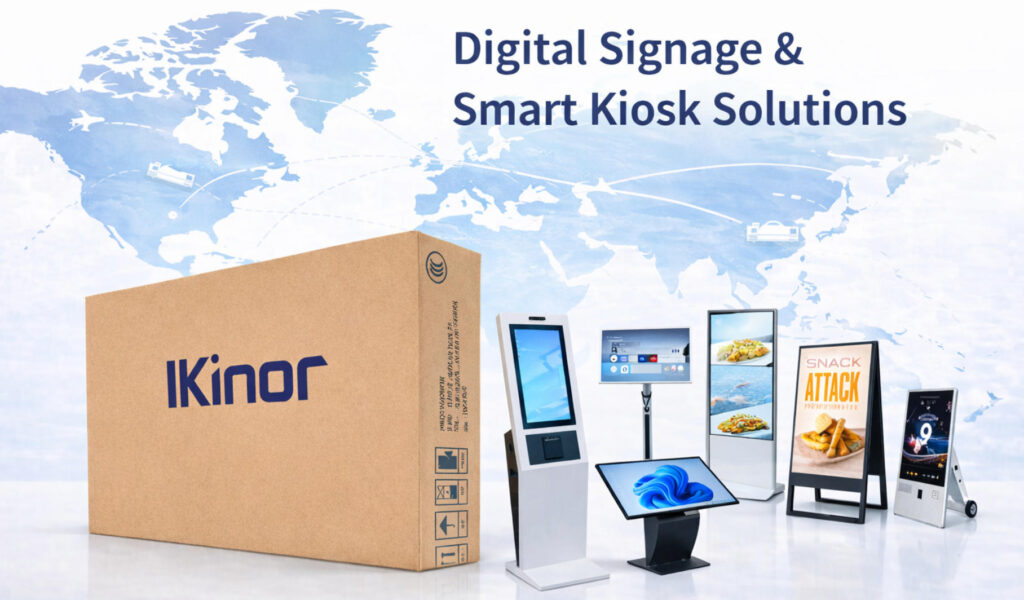
Ikinor Indonesia – Company Overview
| Item | Details |
|---|---|
| Founded | 2018 (Indonesia market expansion through regional partners) |
| Company Profile | Ikinor is an international digital signage and interactive display manufacturer, supplying commercial display solutions to partners and system integrators in Indonesia. The company focuses on OEM/ODM manufacturing, project-based customization, and cost-effective deployment for retail, education, corporate, and public environments. Ikinor supports Indonesian clients through local distributors and integrators, offering flexible configurations, branding options, and scalable delivery for both single-site and multi-location projects. |
| Core Products | • Commercial digital signage displays (32″–110″) • Interactive flat panels & smart whiteboards • Floor-standing and wall-mounted digital signage • Touchscreen kiosks & self-service terminals • Android-based media players and CMS-compatible hardware |
| Key Strengths | Ikinor’s strengths lie in OEM/ODM flexibility, competitive factory pricing, and strong customization capability. The brand supports private labeling, localized specifications, and bulk project delivery, making it suitable for integrators seeking reliable hardware without premium brand markups. Its experience across 100+ industries enables fast adaptation to different commercial use cases. |
| Location | Manufacturing and R&D based in China, with Indonesia market coverage via local distributors and project partners serving Jakarta, Surabaya, and other major cities. |
| Best For | Ikinor is best suited for system integrators, distributors, and project contractors handling retail chains, education projects, corporate offices, hospitality venues, and public-sector digital signage deployments that require flexible specs, branding, and cost control. |
| Contact | https://ikinor-interactive.com |
Polytron
| Founded | 1975 |
| Company Profile | Polytron is a leading Indonesian electronics manufacturer and one of the country’s longest‑standing consumer electronics brands. Owned by the Hartono family (also behind the Djarum Group), Polytron has grown from producing early televisions into a broad electronics and home appliances company, with a strong R&D base and distribution network across Indonesia. |
| Core Products | Polytron’s diverse product lineup includes digital signage and commercial displays, smart and LED TVs, audio systems and multimedia speakers, refrigerators, washing machines, air conditioners, small home appliances, and increasingly electric vehicles such as EV scooters and cars — reflecting its strategic diversification. |
| Key Strengths | Polytron’s strengths lie in its 50+ years of local manufacturing experience, national brand recognition, extensive distribution channels and service centers, and in‑house R&D teams that adapt products to Indonesian consumer needs. The company also emphasizes local content (TKDN) compliance and Indonesian workforce development |
| Location | Headquarters and principal manufacturing sites are in Kudus and Sayung (Demak), Central Java, Indonesia, supported by nationwide sales and service networks. |
| Best For | Polytron is well‑suited for consumer electronics and commercial display deployments in Indonesia, including retail digital signage, residential smart displays, and multi‑screen applications where a trusted local brand with broad after‑sales support is preferred. |
| Contact | https://www.polytron.co.id  |
Murni
| Founded | 1992 |
| Company Profile | Murni is an ISO 9001:2015–certified technology and systems integrator headquartered in Jakarta, Indonesia. With over 30+ years of experience, a nationwide service network including 6 branches and 100+ service points, and more than 700 staff, the company supports digital transformation across industries such as retail, banking, transportation, and corporate services. Its solutions range from national payment systems and cash management to AI‑powered digital signage and customer experience platforms. |
| Core Products | Digital signage and digital information displays, including interactive and touchscreen solutions tailored for retail, hospitality, corporate, and public venues. Digital wayfinding and directory solutions through partnerships with global providers like Abuzz. Integrated ICT systems including POS, queue management, and self‑service ordering. |
| Key Strengths | Strong ICT and system integration expertise across large‑scale, nationwide deployments.ISO 9001:2015 quality certification and extensive technical support infrastructure.Partnering with international tech brands (e.g., Abuzz) to bring advanced digital signage and wayfinding solutions to the Indonesian market.Broad service reach with 24/7 Helpdesk and centralized support. |
| Location | Headquarters in Jakarta Barat, Jakarta, Indonesia. |
| Best For | Murni is well‑suited for enterprise and multi‑location digital signage projects, retail chains, shopping malls, transportation hubs, and large corporate deployments that require integrated ICT solutions and strong local support. |
| Contact | https://www.murni.co.id |
V2 Indonesia
| Founded | 1992 |
| Company Profile | V2 Indonesia is a leading value‑added distributor and AV/digital signage solutions provider headquartered in Jakarta, Indonesia, with branch offices in Surabaya and Bali covering over 20 metropolitan regions. The company delivers comprehensive digital display and audiovisual solutions across corporate, government, retail, transportation, media, and event sectors — combining hardware distribution, project integration, and technical services. |
| Core Products | V2’s portfolio includes commercial digital signage displays, floor standing digitao signage, interactive kiosks, LED screens and large‑format displays, audio‑visual systems, and integrated command‑center solutions. They also offer SaaS platforms for content management and related services. |
| Key Strengths | V2 benefits from a long operational history since 1992, a broad local service network with certified engineers, and deep integration and installation expertise. Its strengths also include partnerships with global AV brands, nationwide after‑sales support, and the ability to deliver complex, multi‑site digital signage projects backed by professional technical services. |
| Location | Headquarters in Jakarta, Indonesia, with additional presence in Surabaya and Bali. |
| Best For | V2 is best suited for large‑scale and enterprise digital signage projects, including shopping malls, airports, corporate campuses, government facilities, and event venues, where integrated AV systems, professional installation, and ongoing support are essential. |
| Contact | https://www.v2indonesia.com |
Modernsign
| Founded | 2012 |
| Company Profile | ModernSign is a Bali‑based signage and digital display solutions company that specializes in custom signs, digital LED displays, and comprehensive visual communication services for businesses throughout Bali and broader Indonesia. They position themselves not just as a manufacturer but as a full visual branding partner, managing projects end‑to‑end from concept design to installation and after‑sales support. |
| Core Products | ModernSign’s offerings include indoor and outdoor digital signage, LED video displays, digital banners, custom signage (such as 3D signs, lightboxes, and pylon signs), wayfinding systems, and bespoke visual branding materials tailored to clients’ spatial and branding needs. |
| Key Strengths | Over 10 years of localized experience in design, fabrication, and installation for Indonesian businesses. Full design‑to‑install project management, reducing complexity for clients who want a single vendor from planning to execution. Ability to support both traditional custom signage and dynamic digital LED display solutions. Focus on long‑term service and after‑sales support, ensuring installed digital signage continues to perform. |
| Location | Their headquarters and workshop are located at Jalan Mahendradatta No. 81 A, Denpasar, Bali, Indonesia. |
| Best For | ModernSign is best suited for small‑to‑medium businesses, retail outlets, hospitality venues, and local enterpriseslooking for custom signage, LED display installations, and full project support from design through deployment. |
| Contact | https://modernsign.id |
Limko
| Founded | 2000 |
| Company Profile | Limko Indonesia is a private Indonesian enterprise based in Tangerang, Banten, Indonesia that specializes in distributing office equipment, audiovisual systems, and telecommunications products. Over the years, the company has acted as an exclusive dealer for brands like Panasonic, Polycom, Bosch, and others in business‑to‑business markets. |
| Core Products | Limko’s product range focuses on AV and communication solutions rather than direct manufacturing. Offerings include voice and video conferencing systems, PBX telephony, discussion systems, electronic & interactive whiteboards, conferencing solutions, and portable amplifiers — often deployed in corporate, education, and meeting environments. |
| Key Strengths | Longstanding market presence since 2000, building solid dealer relationships in Indonesia. Partnerships with well‑known global brands in office communications and audiovisual sectors. Broad product portfolio across conferencing, telephony, and interactive display equipment. |
| Location | Headquartered in Boulevard Raya, Ruko Permata Niaga 2 No. 35, Tangerang, Banten, Indonesia. |
| Best For | Limko Indonesia is best suited for corporate AV and communications needs, including interactive displays and conferencing systems for offices, training rooms, schools, and meeting spaces. Its role tends toward distribution and system integration rather than manufacturing bespoke digital signage panels. |
| Contact | http://www.limko‑indonesia.com |
Alvasta
| Founded | 2012 |
| Company Profile | Alvasta is an Indonesian technology solutions provider and distributor headquartered in West Jakarta, Indonesia, with branch offices in Surabaya and a presence in Singapore. It specializes in providing industrial networking products, ICT systems, and integrated digital signage platforms for system integrators and value‑added resellers. The company works closely with global technology brands to deliver comprehensive solutions across industries. |
| Core Products | Alvasta offers a range of digital signage solutions, including cloud‑manageable digital signage players (e.g., MDS‑100) and industrial display systems that support dynamic content such as videos, images, web pages, widgets, and streams from IP cameras. Its product lineup also includes networking hardware, industrial PCs, and integrated connectivity solutions used in smart signage and IVS applications. |
| Key Strengths | Cloud‑based signage management enabling remote content control and scheduling from a single dashboard. Flexible content support across media types, supporting dynamic layouts and event‑triggered content changes. Strong partnerships as distributor for major brands and an ability to integrate signage with broader industrial and networking systems. Local presence with technical support and sales offices in key Indonesian cities. |
| Location | Headquarters in Jakarta Barat, DKI Jakarta, Indonesia, with a branch in Surabaya and regional access via Singapore. |
| Best For | Alvasta’s solutions are best suited for enterprise digital signage deployments, industrial environments, retail and corporate sites that require cloud‑managed screens and integrated content management. |
| Contact | https://www.alvasta‑tech.com |
TVWall
| Founded | 2010 |
| Company Profile | TVWall Indonesia is a Jakarta‑based professional display and audiovisual provider that supplies and integrates video wall displays, digital signage, interactive screens, and related AV infrastructure. The company offers complete visual solutions for commercial and enterprise environments including retail, public venues, corporate spaces, and control rooms. |
| Core Products | TV Wall displays & video wall controllers for multi‑screen video walls. Digital signage displays and interactive TV solutions for dynamic content delivery. Professional AV equipment, such as edge blending projectors, KVM extenders, and wireless presentation systems. |
| Key Strengths | Official distribution partnerships, such as serving as a distributor for ATEN professional AV products in Indonesia, including video wall controllers and KVM solutions with local warranty and technical support. Provides professional installation, setup, and after‑sales service locally in Indonesia. Offers a broad range of AV and integrated display technologies beyond signage alone. |
| Location | Headquarters in East Jakarta, Indonesia. |
| Best For | TVWall is best for video wall installations, large‑format digital signage, interactive displays, and professional AV integration projects in retail malls, control centers, corporate offices, and event venues. |
| Contact | |
InnoGRAPH
| Founded | 1995 |
| Company Profile | InnoGRAPH is a Jakarta‑based visual display and promotional media solutions company specializing in large‑format printing, display signage, and digital signage systems. Over time, it has evolved from trading desktop publishing equipment into a comprehensive provider of both traditional and digital display technologies for retail, corporate, hospitality, and public spaces |
| Core Products | Digital signage solutions including LCD/LED displays, interactive signage, and touchscreen systems. LED videotron and outdoor digital displays for high‑impact visual communication. Self‑service kiosks, self‑order kiosks, and interactive flat panels. Traditional signage and promotional display products such as lightboxes, pop‑up displays, booth setups, and building signage. Cloud‑based CMS (Digisign Play) for remotely managing digital content on screens across locations. |
| Key Strengths | InnoGRAPH stands out for its long operating history in Indonesia’s signage market, a comprehensive product rangefrom printed and LED signage to interactive digital solutions, and project execution capabilities that include installation, customization, and nationwide deployment. The company’s ability to handle large projects — such as scaling hundreds or thousands of displays across multiple sites — highlights its project management and delivery strength. |
| Location | Headquartered at Jl. Lenteng Agung Raya No. 15, South Jakarta, DKI Jakarta, Indonesia. |
| Best For | InnoGRAPH is best suited for retail chains, shopping malls, banking and finance signage, restaurants, hotels, and corporate facilities that require both digital signage systems and integrated promotional display solutions with support for content management and installation. |
| Contact | https://www.innograph.com |
Displaystore.id
| Founded | 2022 |
| Company Profile | Patia is an audio visual, IT, and security system integrator headquartered in Kelapa Gading, North Jakarta, Indonesia. With a small, agile team (around 1–10 employees), Patia offers consultation, design & build, implementation, and managed services tailored to business communication and display needs. |
| Core Products | Patia’s offerings include digital signage solutions such as indoor/outdoor professional displays, video wall installations, interactive kiosks, and integrated display systems. They also provide AV system equipment, ICT solutions, security systems, and related services that support dynamic visual content across various environments. |
| Key Strengths | Patia’s strengths lie in its system integration expertise and customization capabilities, providing tailored visual and IT setups for clients based on project requirements. Its presence on Indonesia’s government eProcurement eCatalogue (LKPP) reflects its ability to support institutional and commercial projects. The company partners with well‑known brands such as LG, Samsung, Barco, and Uniview, enabling access to reliable display hardware and related technology. |
| Location | Headquarters in Kelapa Gading, North Jakarta, Indonesia. |
| Best For | Patia is best suited for small to medium enterprise digital signage projects, retail digital displays, interactive kiosks for shopping environments, corporate communication systems, and integrated AV/IT setups where customized solutions and local support matter. |
| Contact | https://patia.co.id |
Patia
| Founded | 2022 |
| Company Profile | Patia Avit Solusi is an audio‑visual (AV), IT, and security systems integrator based in Jakarta, Indonesia. The company provides end‑to‑end solutions including consultation, design & build, implementation, and managed services tailored for corporate, retail, event, and institutional environments. It is also registered as a reseller on Indonesia’s government procurement platforms such as the eCatalogue LKPP. |
| Core Products | Digital signage displays and professional commercial screens from brands like Samsung, LG, and Philips supplied through local distribution. Signage media players including Samsung and LG signage player boxes. AV systems such as professional audio, projection, and video wall solutions. IT and security integrations such as networked systems, CCTV, access control, and unified audiovisual solutions. |
| Key Strengths | Patia’s strengths include custom project design and managed services, a focus on end‑to‑end integration, and partnerships with well‑established global brands (LG, Samsung, Barco, Hikvision). Its reseller status on official government platforms reflects compliance and capacity to support institutional and commercial procurement. |
| Location | The company operates from Kelapa Gading / Pulo Gadung, Jakarta, Indonesia with offices in North and East Jakarta. |
| Best For | Patia is best suited for medium to large digital signage and AV integration projects, including retail environments, corporate offices, event venues, and government facilities requiring professional installation, hardware provisioning, and ongoing technical support. |
| Contact | https://patia.co.id |
How Much Does Digital Signage Applications Manufacturing Cost in Indonesia
Estimating the manufacturing cost of digital signage applications in Indonesia depends on hardware specifications, software architecture, and deployment scale. For standard indoor commercial displays, locally sourced or assembled 32–43 inch screens typically cost between MYR 2,120–6,110, while 43–55 inch professional displays range from MYR 2,350–12,220, depending on brightness level, panel lifespan, and brand positioning. Larger or interactive touch displays naturally sit at the higher end of the spectrum.
Outdoor digital signage significantly increases manufacturing cost. High-brightness panels, IP-rated enclosures, reinforced glass, and thermal control systems can push pricing to two or three times that of comparable indoor models. These additional components are essential in Indonesia’s hot and humid climate, especially for roadside, transit, or storefront applications.
Beyond the display itself, manufacturing costs also include media players, typically priced around MYR 940–3,055 per unit, and content management systems (CMS). CMS fees vary by provider, with some offering one-time licenses while others charge recurring subscriptions per screen, which should be considered part of long-term operating cost.
Installation and integration are another major cost driver. Professional mounting, electrical work, network setup, and on-site testing can add several hundred ringgit per screen. For customized projects such as shopping malls, corporate campuses, or video walls, additional expenses may arise from bespoke metal fabrication, structural reinforcement, and centralized control systems.
Overall, in Indonesia, a complete digital signage solution — including display, media player, CMS, and basic installation — typically ranges from MYR 4,700 to MYR 18,800+ per screen, with final cost highly influenced by performance requirements and project complexity.
Digital Signage Price & Configuration Guide In Indonesia
When planning a digital signage deployment, understanding price and configuration options by screen size helps buyers balance budget, performance, and application needs. For most commercial scenarios in retail, restaurants, and corporate environments, 43-inch, 55-inch, and 65-inch displays represent the most commonly adopted sizes.
The 43-inch digital signage display, priced at MYR 3,218, is widely used in quick-service restaurants, convenience stores, elevators, and smaller retail spaces. This size offers an excellent balance between visibility and cost efficiency. Typical configurations include Full HD resolution, 350–500 nits brightness for indoor use, Android or external media player support, and 16/7 operation. It is ideal for menu boards, promotional screens, and informational displays viewed at short distances.
The 55-inch model, priced at MYR 3,862 , is the market mainstream for shopping malls, brand stores, and corporate lobbies. Compared with 43-inch units, it delivers stronger visual impact while remaining cost-effective. Standard configurations often include 4K resolution, higher brightness (450–700 nits), optional touch functionality, and 24/7 commercial-grade panels. This size is frequently selected for advertising displays, wayfinding screens, and single-panel feature walls.
For premium applications, the 65-inch digital signage display, priced at MYR 5,792 , is designed for high-traffic and high-visibility environments. It is commonly deployed in mall atriums, exhibition spaces, and flagship stores. Typical configurations include 4K UHD resolution, enhanced color accuracy, higher brightness, reinforced chassis, and advanced CMS compatibility. The larger screen size improves content readability from longer viewing distances and supports more immersive visual experiences.
Overall, selecting the right size depends on viewing distance, installation space, content type, and long-term operational requirements rather than price alone.
Common Business Scenarios When You Need to Work With Manufacturers (and How to Handle Them)
In B2B operations, working with manufacturers is almost inevitable, and different scenarios bring distinct challenges. During product development and prototyping, companies need to validate their designs. Providing detailed specifications, CAD drawings, and samples, while maintaining close communication with the manufacturer, ensures the product develops according to expectations. It is also important to verify the manufacturer’s technical capabilities and sign confidentiality agreements to protect intellectual property.
When scaling up for large-volume production, companies often need to meet the demands of retail, distribution, or e-commerce. Evaluating the manufacturer’s capacity, lead times, and quality control systems is essential, while establishing a clear production schedule with key milestones helps prevent delays. Special attention should be given to potential bottlenecks during production and maintaining buffer inventory to avoid shortages.
For customized or OEM/ODM projects, businesses often require products with unique branding or features. Ensuring the manufacturer can handle design modifications, comply with relevant regulations, and maintain consistent quality is critical. Contracts should clearly specify product specifications, inspection protocols, and quality assurance procedures to prevent disputes.
In cross-border production scenarios, companies must also consider logistics, customs, and international compliance standards. Partnering with manufacturers experienced in exports and confirming shipping partners, documentation, and delivery timelines helps projects progress smoothly. For urgent or limited-run production, rapid communication and clear agreements on expedited costs ensure timely and high-quality delivery.
Successful B2B collaboration always relies on trust, transparency, and ongoing communication. Sample approvals, site visits, and regular progress reviews help minimize risks, ensuring products meet quality standards and are delivered on schedule.
FAQs
A business should engage a manufacturer during the product development stage, particularly when prototyping or preparing for mass production. Early collaboration ensures designs are feasible and manufacturable.
Evaluate the manufacturer’s production capacity, quality control systems, and lead times. Establish a clear production schedule with milestones, monitor progress, and maintain buffer inventory to prevent delays or quality issues.
Ensure the manufacturer can handle design modifications, comply with regulatory requirements, and maintain consistent quality. Formal contracts should specify specifications, inspection protocols, and intellectual property protection.
Partner with manufacturers experienced in export compliance. Confirm shipping partners, customs documentation, and delivery timelines to avoid delays and regulatory issues.
Negotiate fast-track production agreements, prioritize communication, and clarify costs for rush orders. Ensure quality standards are maintained despite accelerated timelines.
Trust, transparency, and ongoing communication are key. Regular sample approvals, site visits, and progress reviews help minimize risks and ensure products meet expected quality and delivery schedules.