In commercial display projects, the term “Waterproof TV” is often used broadly, but its real meaning depends heavily on the IP rating behind it. For B2B buyers, a Waterproof TV is not simply a screen that resists splashes — it is a device engineered to prevent dust and water intrusion under defined testing standards. This is where the IP (Ingress Protection) code becomes critical. Ratings such as IP65, IP66, IP67, or IP68 specify the level of protection against solids and liquids, directly influencing installation safety, durability, and maintenance costs. However, IP numbers are frequently misunderstood or oversimplified in procurement discussions. To make informed decisions, buyers must understand both what a Waterproof TV truly represents and how its IP rating translates into real-world performance.
What Does “Waterproof TV” Actually Mean in Commercial and B2B Contexts?
The term “Waterproof TV” often causes confusion because it does not automatically mean a screen can be submerged for long periods. In reality, it refers to televisions engineered to resist water exposure — such as rain, splashes, or routine cleaning — according to defined IP (Ingress Protection) standards. Understanding the IP rating behind a Waterproof TV is critical for making informed procurement decisions, as it directly affects installation safety, maintenance requirements, and overall reliability.
Consumer-grade waterproof TVs are generally designed for occasional residential use, such as patios, bathrooms, or small outdoor decks. They may not withstand continuous operation, high humidity, or extreme temperatures. Commercial-grade models, by contrast, feature reinforced sealing, corrosion-resistant materials, high-brightness displays, and extended operating capabilities. These structural and engineering differences ensure durability in demanding commercial environments and significantly longer service life.
It is also important to distinguish a Waterproof TV from an Outdoor TV. While both can handle water exposure, Outdoor TVs are optimized for high brightness, anti-glare visibility, and wide temperature tolerance, whereas Waterproof TVs focus primarily on preventing dust and liquid ingress. Some professional models combine both features, but the terms are not interchangeable.
Finally, deployment type further defines product positioning. Fixed installations, such as poolside resorts, spa facilities, or hotel terraces, have different protection requirements compared with mobile or temporary setups used for trade shows, exhibitions, or outdoor events. Clarifying the intended use ensures the “waterproof” label reflects actual operational performance rather than assumptions, allowing buyers to select the right product for their environment.
What Do IP Ratings (IP65, IP66, IP67, IP68) Mean in Waterproof TV Specifications?
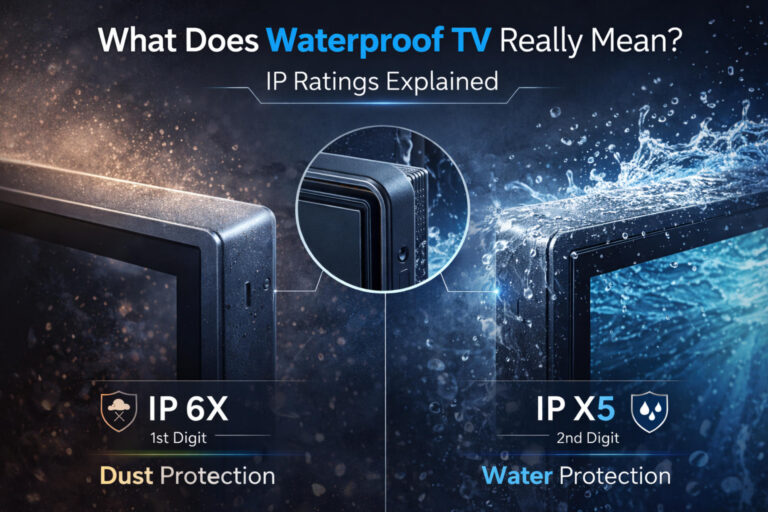
Once the concept of a Waterproof TV and its real-world applications are understood, the next critical factor for buyers is the IP rating, which defines the device’s ability to resist both dust and water intrusion under controlled testing conditions. Each IP rating consists of two digits: the first indicates protection against solid particles like dust and debris, while the second measures protection against liquids, ranging from splashes and rain to temporary or even continuous immersion in water. Properly interpreting these numbers is essential for commercial buyers, as misreading them can result in improper installations, unexpected maintenance costs, or even premature product failure.
For example, IP65 ensures full dust-tight protection and resistance to low-pressure water jets from any direction, making it suitable for semi-outdoor installations, poolside displays, or spa and wellness facilities. IP66 provides similar dust protection but can withstand stronger water jets, such as heavy rain or high-pressure cleaning. IP67 allows temporary immersion in water for a limited depth and duration, while IP68 supports prolonged submersion under specific conditions defined by the manufacturer.
However, a higher IP rating does not automatically mean a product is better for every commercial application. Over-engineering with IP68 can increase costs and complexity unnecessarily, while IP65 or IP66 may already meet most operational requirements. A common procurement mistake is assuming a higher rating guarantees overall durability without considering heat, UV exposure, or installation context. Understanding the meaning of IP ratings allows buyers to select the right Waterproof TV for their environment, balancing protection, cost, and long-term reliability.
How Should Buyers Match IP Ratings to Real Installation Environments?
After understanding IP ratings and their technical meaning, the next step for buyers is to carefully match these ratings to the real installation environment. Selecting a Waterproof TV purely based on a high IP number can be misleading if surrounding conditions are not fully assessed, as both over-protection and under-protection may result in unnecessary costs, installation complexity, or premature equipment failure. Fixed outdoor installations such as hotel terraces, poolside resorts, and spa facilities usually require protection against rain, splashes, humidity, and routine surface cleaning, where IP65 is often sufficient. Semi-covered patios or partially sheltered dining areas may only require IP64–IP65, depending on wind direction, drainage design, cleaning frequency, and proximity to water features.
More demanding environments justify higher protection. Marine and cruise applications, for instance, typically require IP66 due to direct water jets and salt exposure. Norwegian Cruise Line has deployed IP66-rated outdoor touch displays supplied by Reddie Group on vessels such as Norwegian Prima, where screens must endure salt spray, heavy rain, continuous humidity, and long operating hours while maintaining stable performance for passenger interaction. Rooftop restaurants, beachfront clubs, and luxury yachts facing both rain and corrosive air often require IP66–IP67 combined with anti-corrosion coatings, sealed connectors, and reinforced enclosures to extend service life.
In commercial kitchens or healthcare facilities subject to high-pressure washdowns and chemical sanitation procedures, IP66 or higher is typically necessary. By aligning environmental exposure with verified IP performance, structural durability, and maintenance planning, buyers can achieve cost-effective protection, operational stability, and longer product lifespan without unnecessary over-engineering.
Can IP Rating Be Considered the Only Durability Indicator for Waterproof TVs?
While IP ratings are essential for understanding a Waterproof TV’s resistance to dust and water, they cannot be considered the sole indicator of overall durability. Many commercial buyers mistakenly assume that a higher IP rating automatically guarantees long-term performance, but this is misleading. IP codes do not measure resistance to ultraviolet (UV) exposure, which over time can degrade plastics, housings, display surfaces, and electronic components. They also do not reflect corrosion resistance, which is critical in environments exposed to salt air, chemical cleaners, poolside humidity, or coastal conditions.
Thermal management is another often-overlooked factor. IP protection typically requires sealed enclosures, but excessive sealing without sufficient heat dissipation can cause internal components to overheat, potentially leading to performance degradation, system instability, or early failure. Balancing a fully sealed structure with effective thermal design is a key engineering challenge that directly affects a Waterproof TV’s reliability under continuous operation in demanding commercial settings.
In commercial environments where devices operate 12 to 24 hours daily — such as hotels, resorts, outdoor hospitality areas, poolside installations, medical facilities, high-frequency cleaning zones, or marine settings — these factors are decisive for long-term product lifespan. Durable materials, UV-resistant coatings, corrosion-resistant metals, and optimized thermal pathways are as important as IP ratings. For B2B buyers, understanding that IP is only one aspect of overall durability ensures smarter procurement. Evaluating environmental exposure, material quality, and internal engineering together allows buyers to select the right Waterproof TV, guaranteeing long-term reliability, consistent performance, and cost-effective operation in real-world commercial applications.
Which Certifications and Testing Standards Should B2B Buyers Verify?
When selecting a Waterproof TV or portable smart TV for commercial applications, verifying certifications and testing standards is crucial to ensure the supplier’s claims are reliable. IP ratings alone do not guarantee real-world performance, so buyers should confirm that devices are tested according to recognized standards. The IEC 60529 standard, for example, defines the methodology for measuring ingress protection against dust and water. Compliance with this standard ensures that the stated IP rating accurately reflects the device’s protective capabilities.
Third-party laboratory reports add another layer of confidence. Buyers should request independent test documentation to verify IP performance, water immersion resistance, and dust protection. Additional environmental tests, such as salt spray exposure and UV aging, are important for applications in coastal areas, outdoor terraces, or poolside installations, where corrosion and sun exposure can compromise longevity.
Export compliance is equally important for international procurement. Certifications such as CE, FCC, and RoHS demonstrate that the device meets safety, electromagnetic compatibility, and hazardous substance regulations. These standards also serve as a benchmark for quality and reliability, giving buyers assurance for both local and global deployments.
Finally, when evaluating potential suppliers, B2B buyers should check the manufacturer’s full certification and testing portfolio. A professional waterproof TV or portable smart TV manufacturer will provide a clear list of IP test standards, third-party lab reports, environmental aging tests, and compliance certificates. Verifying these documents ensures that the selected display is not only technically compliant but also durable, reliable, and suitable for demanding commercial applications.
How Can B2B Buyers Build a Practical Waterproof TV Selection Framework?
Building a practical selection framework for Waterproof TVs allows B2B buyers to make informed and reliable procurement decisions rather than relying solely on marketing claims. The first step is to clearly define the real-world usage environment. Understanding whether the device will be installed poolside, on a rooftop restaurant, in a spa, outdoor terraces, or in high-frequency cleaning areas is critical for determining protection needs, exposure risks, and operational constraints.
The second step is to match an appropriate IP rating to the environment. Selecting the right level of ingress protection ensures adequate resistance to water, dust, and temporary immersion without over-engineering, which can unnecessarily increase costs and complexity.
Third, buyers should verify additional durability and structural indicators, including UV resistance, corrosion protection, reinforced housing, and thermal management capabilities. These factors directly influence long-term reliability and performance in demanding commercial conditions.
The fourth step is to evaluate supplier engineering capabilities. A professional waterproof TV or portable smart TV manufacturer should provide third-party lab reports, IEC 60529-compliant IP testing, and evidence of environmental tests such as salt spray exposure and UV aging. Assessing the supplier’s technical expertise ensures that products meet both performance standards and quality expectations.
Finally, establishing a long-term Total Cost of Ownership (TCO) model helps buyers account for upfront price, maintenance, potential downtime, and operational costs over the device’s lifecycle. By systematically combining environmental assessment, IP matching, structural verification, supplier evaluation, and TCO analysis, B2B buyers can select the right Waterproof TV, ensuring durability, reliability, and cost-effective operation over the long term.
FAQs
What IP rating is recommended for semi-outdoor commercial installations?
Typically, IP65–IP66 is sufficient to withstand rain and water jet exposure, but buyers should also consider UV exposure and temperature variations for a comprehensive assessment.
Does IP68 mean a waterproof TV can stay underwater permanently?
Not necessarily. The specific immersion depth and duration for IP68 are usually defined by the manufacturer and may vary between models.
Is a higher IP rating always better for B2B buyers?
No. Excessively high IP ratings can increase costs and complicate heat dissipation. The rating should be matched to the actual deployment environment.
How can buyers verify whether IP certification is authentic?
Buyers should request third-party test reports based on IEC 60529 standards and verify the credibility of the testing laboratory.
Are portable smart TVs suitable for outdoor commercial use?
It depends. Buyers should select an appropriate IP rating for mobile deployment environments and ensure battery compartments and connectors are properly protected.