
An advertising machine is often misunderstood as just a digital screen, but in reality, it is a complete digital signage system designed to manage and deliver visual content in physical environments. From retail stores and transportation hubs to corporate spaces, these systems have become a core part of modern visual communication. What makes them valuable is not only the display itself, but the way content can be controlled, updated, and optimized in real time across different locations. As businesses shift from static posters to dynamic digital communication, understanding how advertising machines work, what technologies they use, and how to choose the right configuration becomes essential for making informed investment decisions in today’s fast-moving commercial environments.
What Is an Advertising Machine?
أن advertising machine is essentially a form of digital signage system. The term “advertising machine” is widely used in the market mainly because of its commercial application—displaying ads, promotions, and information in public spaces. In reality, it belongs to the broader category of اللافتات الرقمية, and is sometimes also referred to as a digital advertising display or media screen system.
Most people don’t encounter the term “digital signage” in daily life. Instead, they see these devices in shopping malls, airports, retail stores, or restaurants and naturally call them “advertising machines” based on what they do—showing advertisements and dynamic content on a screen.
At a functional level, an advertising machine is not just a screen. It is a content delivery system that combines display hardware with software control, allowing businesses to manage what appears on screen remotely and update content in real time. This is why it is widely used as a replacement for traditional printed posters and static signage.
To make it easier to understand, think of it like this:
- A printed poster = fixed content that cannot be changed
- An advertising machine = dynamic display system that can be updated anytime via software
For example, in a shopping mall, one advertising machine might show a morning coffee promotion in the morning, switch to fashion discounts in the afternoon, and display event information in the evening—all without replacing any physical material. This flexibility is what makes it fundamentally different from traditional advertising formats.
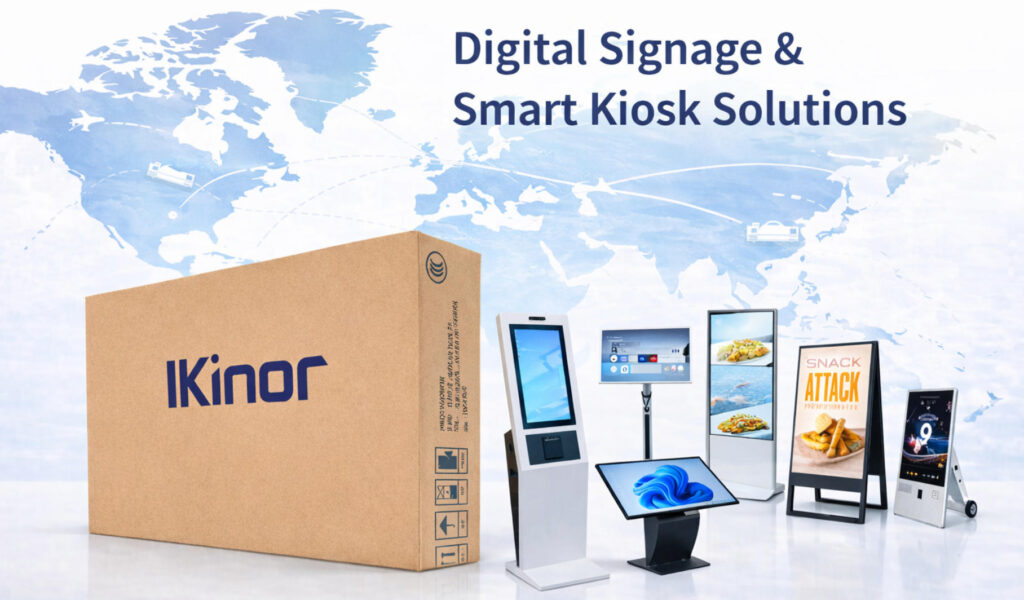
In terms of physical form, advertising machines come in several common types. Vertical standing units are widely used in retail stores and malls for eye-level advertising. Wall-mounted versions are often installed in tight spaces such as corridors or elevators. Interactive kiosk versions allow users to touch and navigate content, making them suitable for self-service applications like wayfinding or product browsing. Despite their different shapes, all of these devices serve the same core purpose: delivering digital content in a controlled and visually engaging way.
It is also important to distinguish an advertising machine from a regular television or monitor. While a TV is primarily designed for entertainment or personal viewing, an advertising machine is built for continuous commercial use. It often supports long operating hours, centralized content control, and multi-device synchronization. In many cases, businesses deploy multiple units across different locations and manage them through a single system, which is not possible with standard consumer displays.
How Advertising Machines Work: Hardware + Software System
An advertising machine is not a single device, but a complete integrated system composed of hardware components, computing modules, software platforms, and network connectivity working together to deliver and manage digital content at scale.
في hardware level, an advertising machine typically includes three core components.
The first is the لوحة العرض, which is responsible for presenting visual content such as images, videos, and animations. This can be LCD or LED-based depending on brightness, usage environment, and installation scenario.
The second is the media player (or embedded computing module). In professional digital signage systems, this is not simply a GPU. A GPU (graphics processing unit) is only responsible for rendering images, but an advertising machine requires a complete playback and control unit, which usually includes a CPU-based system-on-module (SoC), internal storage (such as eMMC or SSD), and decoding capability for video formats. In other words, it is a dedicated media playback controller, responsible for storing, decoding, scheduling, and running content rather than only rendering graphics.
The third is the enclosure structure, which plays a critical role in protecting internal components. In real-world deployments, especially outdoor advertising machines, the enclosure must meet industrial protection standards such as dustproof and waterproof design (often aligned with IP-rated protection levels). This ensures the device can operate under harsh environments such as heavy rain, high humidity, dust exposure, or temperature fluctuations. Sealed housing, reinforced glass, and thermal management systems are commonly used to prevent water ingress and overheating, allowing stable 24/7 operation in outdoor conditions.
On top of the hardware layer, the software system is typically managed through a نظام إدارة المحتوى (CMS). This platform allows users to upload content, organize playlists, and control scheduling across multiple devices without manual on-site intervention.
ال connectivity layer enables remote operation. Most advertising machines are connected via WiFi, Ethernet, or cellular networks, allowing content to be updated through cloud-based servers. This makes it possible to deploy synchronized campaigns across different cities or regions.
From an operational perspective, content follows a structured workflow: content is uploaded to the CMS → assigned to a schedule or playlist → distributed to one or multiple devices → then played according to time-based rules. This allows businesses to dynamically change advertising content based on time, location, or audience behavior.
In some cases, advertising machines can still operate offline. Once content is downloaded into local storage, the media player can continue playback according to the pre-set schedule. However, internet connectivity is required for remote updates, centralized control, and multi-device synchronization.
Overall, an advertising machine is best understood as a content delivery system rather than a simple display screen, combining hardware execution, software control, and network connectivity into a unified digital signage infrastructure.
Screen Technologies Behind Advertising Machines
The performance, cost, and application scenarios of an advertising machine are largely determined by one core factor: the display technology behind the screen. Different screen types are not interchangeable, and each technology defines how bright the content appears, how long the device can operate, and where it can be deployed.
In most advertising machines on the market, four main display technologies are used: LCD, LED, OLED, and emerging holographic display systems. Understanding their differences is essential for evaluating both performance and cost.
LCD (Liquid Crystal Display): The Most Common Solution
LCD is the most widely used screen technology in advertising machines, especially for indoor environments such as retail stores, restaurants, offices, and shopping malls.
LCD screens rely on a backlight system to illuminate liquid crystals, which then form images. This structure makes LCD technology relatively cost-effective and stable, which is why it dominates the mid- and low-range digital signage market.
Key characteristics of LCD advertising machines:
- Moderate brightness suitable for indoor use
- Lower production cost compared to LED
- Stable image quality for video and static content
- Widely available in multiple sizes
However, LCD screens have limitations in brightness and visibility under strong sunlight, which restricts their use in outdoor environments.
LED (Light Emitting Diode): High Brightness for Indoor & Outdoor Use
LED display technology is widely used in high-visibility advertising machines, especially in outdoor or semi-outdoor environments such as building facades, transportation hubs, and street advertising.
Unlike LCD, LED displays generate their own light using individual light-emitting diodes. This allows significantly higher brightness levels, making content visible even under direct sunlight.
Key characteristics of LED advertising machines:
- Extremely high brightness (suitable for outdoor use)
- Strong visibility from long distances
- Better durability in harsh environments
- Modular design for large-scale installations
However, LED systems are generally more expensive than LCD due to higher component costs, more complex manufacturing, and higher power requirements. The improved visibility and durability are the main reasons for the price difference.
OLED (Organic Light Emitting Diode): Premium Visual Experience
OLED technology is used in high-end display applications where image quality is the top priority. Unlike LCD, OLED pixels emit light individually, allowing true blacks, higher contrast ratios, and more vibrant colors.
Key characteristics of OLED advertising machines:
- Superior contrast and color accuracy
- Ultra-thin display design
- Faster response time
- High-end visual presentation
However, OLED is still less common in large-scale advertising machines due to higher cost and shorter lifespan compared to LCD and LED in heavy-duty commercial environments.
Holographic and Fan-Based Displays: Emerging Formats
In recent years, holographic display systems and LED fan screens have emerged as attention-grabbing advertising formats. These systems create a floating visual effect that appears to project 3D content into space.
Key characteristics:
- Highly eye-catching visual effect
- Often used in retail showcases and exhibitions
- Lightweight and portable designs
- Limited resolution compared to traditional screens
While these technologies are not yet mainstream, they are increasingly used for promotional and experiential marketing rather than continuous content playback.
Comparison of Screen Technologies
| Technology | سطوع | Cost Level | Best Use Case | عمر |
|---|---|---|---|---|
| شاشة LCD | واسطة | قليل | Indoor retail, malls | Long |
| LED | مرتفع جداً | متوسط إلى مرتفع | Outdoor advertising, large displays | Very Long |
| OLED | عالي | عالي | Premium indoor display | واسطة |
| Holographic/Fan | Low–Medium | واسطة | Events, exhibitions | واسطة |
Key Performance Factors That Affect Display Quality
Regardless of technology type, several core factors determine the real-world performance of an advertising machine:
- Brightness (nits): Determines visibility in different lighting conditions
- Resolution: Impacts image sharpness and clarity
- Viewing angle: Affects visibility from different positions
- Lifespan: Defines long-term operational cost
- Power efficiency: Impacts energy consumption and heat generation
These parameters often matter more than the screen type itself when choosing a suitable advertising machine for a specific environment.
Why LED Is More Expensive Than LCD
The cost difference between LED and LCD is mainly driven by three factors:
- Higher material cost of LED modules
- More complex assembly and calibration processes
- Increased brightness and durability requirements
However, LED systems are often more cost-efficient in long-term outdoor use due to lower replacement frequency and better environmental resistance.
Why Advertising Machines Have Huge Price Differences (Supply Chain Breakdown)
At first glance, advertising machines may look like similar products—most of them are just screens showing digital content. However, in reality, the price can range dramatically from around $100 entry-level units to $3000+ professional-grade systems. This large gap is not random. It is the result of a multi-layered supply chain structure, where every component and production decision directly impacts the final cost.
To understand advertising machine cost, it is necessary to break the system down into five key cost layers: display panel, computing hardware, software system, manufacturing process, and compliance/logistics.
Display Panel: The Largest Cost Driver
The display panel is usually the most expensive core component in an advertising machine.
There are two dominant directions:
- LCD panel systems (common in indoor signage)
- LED module systems (used in high-brightness or outdoor environments)
LCD panels are generally cheaper because they are mass-produced for consumer electronics and rely on a backlight system. LED modules, on the other hand, require individual light-emitting diodes, precise calibration, and higher brightness engineering, which significantly increases production cost.
In addition, brightness level directly affects cost. A standard indoor LCD display and a high-brightness outdoor display may use similar sizes but have very different panel specifications, driving large price differences.
Computing Hardware: CPU + Android Board / Media System
Another major cost factor comes from the internal computing system, often referred to as the media player or embedded motherboard.
This is not simply a GPU or basic chip. Most advertising machines use:
- ARM-based CPU or SoC (System on Chip)
- Android or Linux operating system
- Internal storage (eMMC or SSD)
- Video decoding modules
Higher-performance boards allow smoother video playback, faster content switching, and better multi-screen synchronization. Entry-level devices use basic boards, while commercial-grade systems include more stable industrial computing modules, increasing cost significantly.
Software Layer: CMS and Licensing Structure
ال نظام إدارة المحتوى (CMS) is another hidden cost component.
Some manufacturers provide basic CMS platforms for free, while more advanced systems include:
- Cloud-based content management
- Multi-device synchronization
- Scheduling and analytics features
- Remote monitoring and diagnostics
In many cases, software is not a one-time cost but part of a subscription or enterprise licensing model, which affects the total lifecycle cost of the advertising machine.
Manufacturing Model: OEM vs ODM vs Branded Systems
The production model also plays a major role in pricing differences.
- OEM (Original Equipment Manufacturer): Basic production based on provided specifications, usually lowest cost
- ODM (Original Design Manufacturer): Includes design + production, mid-range pricing
- Branded solutions: Integrated hardware + software + support, higher cost but more stable ecosystem
The same hardware specifications can have very different prices depending on whether the product is sold as a generic OEM unit or a fully integrated branded solution. When comparing digital signage manufacturers, buyers should therefore consider not only hardware specifications but also the production model, customization capabilities, software integration, and after-sales support.
Certification, Assembly, and Logistics Costs
Beyond hardware and software, there are additional real-world costs that significantly affect final pricing:
- Safety and compliance certifications (varies by region)
- Industrial assembly and quality control
- Packaging for long-distance transportation
- Shipping costs for large display units
- After-sales support and warranty structure
These factors are often underestimated, but they can account for a meaningful portion of the final advertising machine cost, especially for international shipments.
Why Price Ranges from $100 to $3000+
The wide price gap exists because advertising machines are not standardized consumer electronics. A low-cost unit may include a basic LCD panel and simple media player with limited software functionality. In contrast, high-end systems include industrial-grade displays, high-brightness LED technology, advanced CMS platforms, and certified durable enclosures designed for 24/7 operation.
In short, the price reflects not only the screen size, but the entire system architecture behind it.
What Determines the Final Cost?
The main cost drivers can be summarized as:
- Display technology (LCD vs LED vs OLED)
- Brightness and durability requirements
- Computing performance (media player / SoC)
- Software ecosystem (CMS capabilities)
- Manufacturing model (OEM vs ODM vs branded)
- Certification and logistics complexity
Among all these factors, the display panel and brightness specification usually account for the largest share of hardware cost.
Where Most of the Cost Comes From
In most advertising machines:
- Display system = highest cost component
- Computing module = secondary cost driver
- Software + logistics = variable long-term cost factors
This structure explains why two devices with similar sizes can have completely different pricing tiers in the market.
فهم advertising machine cost structure is not just about comparing prices—it is about understanding how the supply chain is built. Every decision, from panel selection to software system design, directly affects the final product positioning in the market.
For buyers, recognizing these layers helps avoid overpaying for unnecessary features or underestimating the requirements of long-term commercial use.
Types of Advertising Machines in the Market
Advertising machines come in different physical forms and configurations depending on where they are used, how users interact with them, and what type of content needs to be displayed. Although the underlying principle is the same—delivering digital advertising content—the market has developed several distinct product types to fit different environments and business needs.
Understanding these types helps clarify where each advertising machine is used and why certain formats dominate specific industries.
1. Vertical Advertising Machine
ال vertical advertising machine is the most common format in the market. It is a floor-standing digital display that presents content at eye level, making it highly effective in high-traffic public areas.
These machines are widely used in:
- مراكز التسوق
- Retail stores
- Hotel lobbies
- Exhibition halls
Because of their upright structure, they naturally attract attention from passersby and are often used for promotional videos, brand advertisements, and product highlights.
2. Wall-Mounted Advertising Display
A wall-mounted advertising machine is designed to be installed directly on walls, making it suitable for locations where floor space is limited.
Typical applications include:
- Corridors and hallways
- Elevator areas
- Store entrances
- Waiting areas
This type is commonly used when businesses want continuous visual messaging without occupying physical space. It is often integrated into building interiors for seamless digital communication.
3. Interactive Kiosk Advertising Machine
ال interactive kiosk goes beyond passive display and allows users to actively engage with the content through touch or input interfaces.
It is commonly used in:
- Self-service check-in systems
- Wayfinding and navigation
- Product browsing in retail
- Ticketing or information lookup systems
This type of advertising machine is especially important in environments where users need to search, select, or interact with information rather than just view it.
4. Holographic Fan Display
A holographic fan display is a newer type of advertising device that creates a floating visual effect using rotating LED blades. It is mainly used for attention-grabbing promotional content rather than continuous information display.
Typical use cases include:
- Retail product showcases
- Event marketing
- Exhibition booths
- Promotional displays in shopping areas
Although it does not replace traditional screen-based systems, it is increasingly used for visual impact and brand storytelling.
5. Outdoor High-Brightness LED Screen
Outdoor advertising environments require much higher brightness and durability, which is why high-brightness LED advertising machines are used in these scenarios.
They are commonly installed in:
- Building facades
- Street advertising spaces
- مراكز النقل
- Stadiums and large public venues
These systems are designed for visibility under direct sunlight and are often built to operate continuously in changing weather conditions.
Summary: What Types Exist and Where Are They Used?
In general, advertising machines can be categorized into five main types:
- Vertical units → indoor commercial spaces
- Wall-mounted displays → space-limited environments
- Interactive kiosks → self-service scenarios
- Holographic displays → promotional and experiential marketing
- Outdoor LED screens → high-visibility outdoor advertising
Each type is optimized for a different environment, which is why choosing the right format is more about application scenario matching than simply screen size or appearance.
The diversity of advertising machines in the market reflects one core reality: digital signage is not a single product, but a system adapted to different physical environments and user behaviors.
How Advertising Machines Deliver Value Through Core Functions
Advertising machines are widely adopted not because of where they are installed, but because of the core functions and operational benefits they provide in physical communication environments. Instead of static industry descriptions, it is more important to understand what problems they solve and what capabilities they enable.
1. Real-Time Content Updates and Instant Messaging
One of the most important functions of an advertising machine is the ability to update content in real time without physical intervention.
This enables businesses to:
- Change promotional content instantly across one or multiple screens
- React quickly to pricing, campaigns, or announcements
- Avoid the delay and cost of reprinting traditional materials
This makes communication significantly more flexible compared to static signage systems.
2. Centralized Multi-Screen Content Management
Advertising machines are designed to be controlled through a centralized management system (CMS), allowing multiple devices to be managed from a single platform.
Key benefits include:
- Controlling hundreds of screens from one dashboard
- Synchronizing content across different locations
- Reducing manual maintenance and operational workload
This centralized structure is especially valuable for businesses operating multiple physical sites.
3. Dynamic Content Scheduling and Automation
Unlike traditional displays, advertising machines support time-based content scheduling, enabling automated playback logic.
This allows users to:
- Display different content at different times of the day
- Automate promotional cycles without manual updates
- Optimize messaging based on audience timing patterns
This improves both operational efficiency and message relevance.
4. High-Impact Visual Communication
Another core function is the ability to deliver visually engaging digital content that captures attention more effectively than static media.
This results in:
- Higher visibility in crowded physical environments
- Better engagement compared to printed materials
- Stronger brand recall through motion-based content
Visual dynamism is a key reason why digital signage replaces traditional posters.
5. Interactive Information Access
Some advertising machines support touch interaction or input-based navigation, turning them into self-service information terminals.
This enables users to:
- Browse information independently
- Search for specific content or products
- Complete simple self-service tasks without staff assistance
This reduces operational pressure while improving user experience.
6. Remote Connectivity and Cloud Control
Modern advertising machines are often connected through cloud-based systems, enabling remote access and management.
This provides:
- Content updates without physical presence
- Real-time monitoring of device status
- Centralized control across multiple regions
This capability significantly reduces long-term maintenance complexity.
7. Key Insight: Function Over Form
The value of advertising machines is not defined by their physical appearance or installation location, but by the functional capabilities they introduce into real-world communication systems.
In essence, they transform static visual communication into a dynamic, centralized, and programmable content delivery system, which is why they are widely adopted across different environments.
How to Choose the Right Advertising Machine
Choosing the right advertising machine is not a matter of comparing specifications in isolation. In real-world purchasing decisions, the key is understanding how the device will perform under specific environmental conditions, operational demands, and content management needs. A better selection process is always based on context rather than individual parameters.
1. Indoor vs Outdoor Environment
The first decision point is always the installation environment, because it defines the entire system configuration.
Indoor environments such as retail stores, restaurants, and offices operate under relatively stable lighting and temperature conditions. In these cases, the primary requirement is not durability against weather, but consistent visual performance and stable operation.
Outdoor environments are fundamentally different. The device is exposed to sunlight, rain, dust, and temperature fluctuations, which means the machine must be designed for continuous exposure rather than controlled conditions. This is why outdoor models require stronger structural protection and higher display output to remain effective in real environments.
Typical industry reference ranges help illustrate this gap:
- Indoor operating temperature: 32°F to 104°F (0°C to 40°C)
- Outdoor operating temperature: -4°F to 122°F (-20°C to 50°C)
- Outdoor protection level: IP65 or higher (dustproof and water-resistant design)
These values are not just technical specifications—they directly reflect how much environmental stress the device must withstand during long-term operation.
2. Brightness Requirements (Measured in Nits)
Brightness is often misunderstood as a simple specification, but in practice it determines whether the content is actually visible in real environments.
In indoor spaces, lighting conditions are controlled, so moderate brightness is usually sufficient to maintain clarity without causing visual fatigue. However, once the device is placed in brighter or outdoor environments, ambient light becomes a major interference factor, and visibility becomes the main challenge.
Industry reference ranges:
- Indoor displays: 250 – 500 nits
- Semi-bright environments: 500 – 1000 nits
- Outdoor high-brightness systems: 1000 – 3000+ nits
Higher brightness improves visibility, but it also increases power consumption and heat output, which is why brightness selection should always be tied to real usage conditions rather than maximum specification.
3. Screen Size and Viewing Distance
Screen size is not an independent decision; it only becomes meaningful when matched with viewing distance.
In closer interaction scenarios, such as kiosks or product browsing, smaller screens are sufficient because users are positioned near the display. As the viewing distance increases—such as in malls or public areas—larger screens are required to maintain readability and visual impact.
Practical reference framework:
- 21–32 inch → 1.5 – 5 ft (interactive / close viewing)
- 43–55 inch → 5 – 10 ft (retail / indoor signage)
- 65–75 inch → 10 – 16 ft (lobbies / shopping malls)
- 75–100+ inch → 16 ft+ (large open spaces)
A mismatch between size and viewing distance often results in reduced content effectiveness, even if the display quality itself is high.
4. CMS (Content Management System) Requirements
Beyond hardware, the content management system plays a critical role in long-term operation efficiency.
In simple setups, content may only need to be uploaded manually or updated occasionally. But as the number of devices increases, or when multiple locations are involved, centralized control becomes essential.
This is where different CMS levels become important:
- Basic systems support local or USB-based updates
- Standard systems enable remote content updates and scheduling
- Advanced systems allow cloud-based multi-device control, real-time monitoring, and synchronized playback
In practice, CMS capability often determines how scalable and manageable the entire system will be over time.
5. Light Recommendation
In real procurement scenarios, uncertainty often comes from incomplete usage definitions rather than product differences. Before selecting a configuration, it is more effective to clearly define where the device will be used and how frequently the content will change.
Once these conditions are clear, even small specification adjustments—especially in brightness and CMS capability—can significantly improve long-term performance and reduce operational inefficiencies.
For project-based deployments, aligning the configuration with real-world usage conditions is often more important than optimizing individual technical specifications.
الأسئلة الشائعة
An advertising machine is a digital signage system that uses screens to display dynamic content such as ads, videos, and information. It combines hardware and software to enable remote content management and real-time updates, and is widely used in retail, transportation, and public spaces.
The main benefits include real-time content updates, centralized control across multiple screens, and stronger visual impact compared to static posters. It also reduces printing costs, improves communication efficiency, and allows businesses to adjust marketing messages instantly based on time or audience needs.
Yes, advertising machines can be customized in terms of screen size, brightness level, installation type (floor-standing, wall-mounted, kiosk), operating system, and CMS functionality. This flexibility allows businesses to adapt the device for different environments, industries, and communication requirements.
Key factors include installation environment (indoor or outdoor), brightness requirements, screen size based on viewing distance, and CMS capabilities for content management. It is also important to consider durability, usage frequency, and whether multi-device control is needed for long-term operation.