Choosing the right outdoor display technology is not simply about selecting a brighter screen.
For applications such as уличные киоски, self-service terminals, industrial control systems, and public information displays, visibility under sunlight, power consumption, operating reliability, and maintenance costs all affect the final display performance.
Traditional outdoor display solutions often rely on high brightness LCD panels to overcome strong ambient light. While this approach works well for digital signage and advertising applications, it may not always be the most efficient choice for interactive terminals that require continuous operation and direct user interaction.
This is where transflective LCD display technology provides an alternative approach. By combining transmissive and reflective display principles, transflective LCD solutions can use both LED backlighting and surrounding ambient light to improve readability while reducing unnecessary power consumption.
In this guide, we will explain how transflective LCD displays work, compare them with other LCD technologies, and help buyers understand when to choose transflective LCD or high brightness LCD for different outdoor applications.
What Is a Transflective LCD Display?
A transflective LCD display is a type of liquid crystal display technology that combines the advantages of both transmissive and reflective LCD systems.
The word “transflective” comes from the combination of two concepts:
- Transmissive: allowing light to pass through from a backlight source
- Reflective: using external light reflected from the environment
Traditional LCD displays usually rely on a backlight located behind the LCD panel. The backlight generates light that passes through the liquid crystal layer and creates the image viewed by users.
A transflective LCD adds a special optical layer called a transflector или transflective layer inside the display structure. This layer allows the display to operate in two different modes depending on the surrounding environment.
During bright outdoor conditions:
- Ambient sunlight enters the display
- The reflective layer redirects available light
- The screen becomes easier to view without requiring maximum backlight power
During low-light conditions:
- The LED backlight provides illumination
- The display works similarly to a conventional LCD
This dual-mode operation allows transflective LCD displays to maintain readability across different environments while reducing unnecessary power consumption.
The key value of transflective technology is not simply making the screen brighter. Instead, it improves optical efficiency by using available environmental light as part of the display system.
This makes it especially suitable for products where reliability, energy efficiency, and outdoor readability are more important than maximum visual impact.
Transmissive vs Reflective vs Transflective Display: Understanding How They Work
To understand why transflective LCD technology exists, it is useful to compare it with the two other major LCD approaches: transmissive and reflective displays.
The main difference between these technologies is the source of light used to create the image.
Transmissive LCD: Using Backlight as the Main Light Source
A transmissive LCD is the most common LCD structure used in modern displays.
The working principle is simple:
The LED backlight is placed behind the LCD panel. Light passes through the liquid crystal layer, where each pixel controls how much light can pass through. The controlled light then creates the final image.
The optical path can be summarized as:
LED backlight → LCD layer → Color filter → Viewer
Because the display controls a stable internal light source, transmissive LCD technology provides excellent image quality, color accuracy, and video performance. For applications where color accuracy, wide viewing angles, and image quality are priorities, IPS LCD technology is often considered a preferred panel option for commercial displays.
This is why transmissive LCD panels are widely used in:
- TVs
- Computer monitors
- Tablets
- Коммерческие дисплеи
- Digital signage systems
However, the same characteristic creates a challenge outdoors.
The display is competing against natural sunlight. When sunlight reflects from the front glass surface, the reflected light can reduce contrast and make the image appear washed out.
To overcome this problem, outdoor transmissive LCD systems usually require:
- Higher brightness backlights
- Anti-glare treatments
- Optical bonding
- Improved thermal management
This approach leads to high brightness LCD solutions.
Reflective LCD: Using Environmental Light as the Light Source
Reflective LCD technology takes a completely different approach.
Instead of generating its own light, reflective displays use external light sources, such as sunlight or indoor lighting, to illuminate the image.
The optical path is:
Ambient light → LCD layer → Reflective layer → Viewer
A reflective layer behind the LCD reflects incoming light back toward the viewer, allowing the screen to be visible without a traditional backlight.
The major advantage is extremely low power consumption because the display does not need to continuously drive powerful LEDs.
Reflective displays perform particularly well in bright environments because more available light can improve visibility.
К типичным областям применения относятся:
- Electronic shelf labels
- Low-power industrial instruments
- Outdoor measurement devices
- Specialized portable equipment
However, reflective displays have limitations.
Because they depend on external light, performance decreases in dark environments. Additional front lighting or backlighting may be required for nighttime operation.
They are also generally less suitable for applications requiring high-quality video, vivid colors, or large-format commercial advertising.
Transflective LCD: Combining Both Display Methods
A transflective LCD combines the advantages of transmissive and reflective technologies.
It includes a reflective structure while maintaining a backlight system.
This allows the display to adapt to different lighting conditions.
In bright sunlight:
Ambient light becomes an additional illumination source.
In darker environments:
The LED backlight supports normal viewing.
The optical path changes depending on the environment:
Outdoor daylight:
Ambient light → Reflective layer → Viewer
Low-light conditions:
LED backlight → LCD panel → Viewer
This makes transflective LCD particularly valuable for applications where displays must remain readable throughout the day without consuming excessive power.
Compared with reflective displays, transflective LCD offers better flexibility.
Compared with traditional transmissive LCD, it provides improved outdoor readability and lower power consumption in suitable conditions.
Key Advantages of Transflective LCD Display Solutions
The biggest advantage of transflective LCD technology is that it solves a specific outdoor display challenge: achieving reliable visibility without depending entirely on high-power backlighting.
However, its benefits go beyond sunlight readability.
Sunlight Readability for Outdoor Environments
The primary advantage of transflective LCD is improved readability under strong ambient light.
Because the display can use sunlight as part of its illumination system, it performs better than conventional LCD displays in outdoor environments where reflections and glare can affect visibility.
This makes it suitable for applications where users need to interact directly with the screen under sunlight conditions.
К примерам относятся:
- Outdoor self-service kiosks
- Parking payment terminals
- Ticketing machines
- Industrial control terminals
For these applications, users are typically standing close to the display and need to read information or complete operations quickly.
The goal is not maximum brightness from a distance, but reliable interaction.
Lower Power Consumption
Since transflective LCD displays can use ambient light instead of relying entirely on LED backlighting, they can reduce energy consumption.
This advantage becomes especially important for:
- Battery-powered devices
- Remote terminals
- Solar-powered equipment
- Long-term outdoor installations
Lower power consumption also reduces heat generation, which can simplify system design.
Better Long-Term Reliability
Outdoor equipment often operates continuously for many years.
High brightness displays require powerful LED systems that generate significant heat. Over time, heat management becomes an important factor affecting reliability.
By reducing dependence on maximum backlight output, transflective LCD solutions can help minimize thermal stress in certain applications.
For industrial and outdoor terminal manufacturers, this can contribute to more stable long-term operation.
Suitable for Interactive and Data-Focused Applications
One important point for buyers is that transflective LCD technology is not designed to replace every outdoor display solution.
Its strength appears in applications where users need to read information and interact with the screen, rather than simply view visual content from a distance.
For example, an outdoor self-service kiosk may only be used for several minutes at a time. Users need to:
- Read instructions
- Select options
- Scan QR codes
- Complete transactions
- Confirm information
In these situations, visibility, reliability, and energy efficiency are often more important than extremely high brightness or premium video performance.
This is why transflective LCD technology is frequently considered for interactive outdoor terminals and industrial equipment.
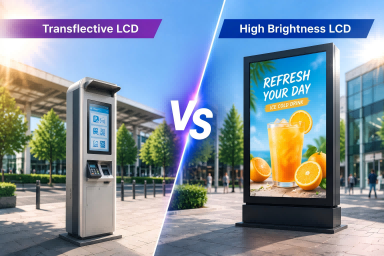
Transflective LCD vs High Brightness LCD: Which One Should Buyers Choose?
When selecting an outdoor display solution, many buyers face a common question:
Should they choose a transflective LCD or a high brightness LCD?
Both technologies can improve outdoor readability, but they solve different problems.
The right choice depends on the application requirements, viewing distance, content type, and operating environment.
High Brightness LCD: Designed for Visual Impact
High brightness LCD solutions improve outdoor visibility by increasing the output power of the backlight.
Instead of using environmental light, they generate enough brightness to compete with sunlight.
A typical outdoor high brightness display may include:
- High brightness LCD panel
- Powerful LED backlight
- Optical bonding
- Anti-glare or anti-reflective glass
- Thermal management system
- Weather-resistant enclosure
The goal is to ensure that images, videos, advertisements, and information remain visible even from several meters away.
High brightness LCD is commonly used for:
- Цифровые вывески для улицы
- Advertising displays
- Цифровые меню-табло
- Large information screens
- Transportation displays
These applications require strong visual communication. Customers may only see the display for a few seconds while walking or driving past, so brightness, color accuracy, and image impact are critical.
Transflective LCD: Designed for Reliable Interaction
Transflective LCD focuses on a different usage scenario.
Instead of maximizing brightness, it improves readability while reducing power consumption.
It is better suited for:
- Touchscreen terminals
- Self-service equipment
- Industrial interfaces
- Portable devices
- Outdoor control systems
The user is usually close to the screen and needs to complete a task.
For these applications, the most important factors are:
- Clear text visibility
- Stable touch operation
- Low power consumption
- Long operating life
Comparison Between Transflective LCD and High Brightness LCD
| Factor | Transflective LCD | High Brightness LCD |
|---|---|---|
| Main purpose | Interactive operation | Visual communication |
| Light source | Ambient light + backlight | Powerful backlight |
| Outdoor readability | Excellent for close viewing | Excellent for distance viewing |
| Power consumption | Ниже | Выше |
| Heat generation | Ниже | Выше |
| Video performance | Moderate | Excellent |
| Color performance | Good | Better |
| Typical size | Small to medium displays | Medium to large displays |
| Best applications | Kiosks, terminals, industrial equipment | Digital signage, advertising screens |
A simple decision rule:
Выбирать Transflective LCD when:
- Users operate the screen directly
- Low power consumption matters
- The device operates continuously outdoors
- Information display is more important than video quality
Выбирать High Brightness LCD when:
- The display needs to attract attention
- Content includes images and videos
- Users view the screen from a distance
- Maximum brightness and visual impact are priorities
For some advanced outdoor products, manufacturers may also combine multiple technologies. For example, an outdoor interactive kiosk may use a sunlight-readable display, optical bonding, anti-glare glass, and industrial protection features to achieve reliable performance.
Applications of Transflective LCD Display Solutions
Although transflective LCD technology is not the standard choice for every outdoor display, it provides significant advantages in specific applications.
The following scenarios are where this technology can provide real value.
1. Outdoor Self-Service Kiosks
Outdoor self-service kiosks are one of the most suitable applications for transflective LCD technology.
К примерам относятся:
- Tourist information kiosks
- Park navigation terminals
- Public service kiosks
- Campus information stations
- Smart city information terminals
Unlike outdoor advertising displays, kiosks require users to stand close to the screen and interact with the interface.
The display must remain readable when:
- Direct sunlight hits the screen
- Users wear sunglasses
- The terminal operates all day
- Power efficiency is important
A transflective LCD touchscreen solution can help provide consistent operation in changing outdoor conditions.
For system integrators and kiosk manufacturers, this technology can improve user experience while reducing unnecessary energy consumption.
2. Outdoor Parking Payment Terminals
Parking payment systems are another strong application area.
Outdoor parking terminals typically display:
- Parking fees
- Payment instructions
- QR codes
- Transaction status
- User guidance
Users normally interact with the device for a short period.
The priority is not advertising-quality visuals but:
- Fast recognition
- Reliable touch response
- Clear information display
Because parking terminals operate outdoors for extended periods, transflective LCD technology can help balance visibility and power efficiency.
3. Ticketing and Transportation Terminals
Outdoor ticket machines and transportation terminals often face challenging environments.
К примерам относятся:
- Theme park ticket machines
- Tourist attraction ticket kiosks
- Outdoor transportation terminals
- Public access systems
These devices require displays that can operate:
- During daytime sunlight
- At night
- Under changing weather conditions
A transflective LCD solution can support continuous operation without requiring maximum backlight power throughout the day.
4. EV Charging Station Displays
Electric vehicle charging stations are another potential application.
Charging terminals usually display:
- Charging status
- Energy consumption
- Payment information
- Charging progress
- User instructions
These screens do not require high-end video performance.
Instead, they need:
- Outdoor durability
- Low maintenance
- Long operation time
- Clear visibility
For this type of equipment, transflective LCD technology can be an efficient display option.
5. Industrial Outdoor HMI and Control Terminals
Industrial environments often require displays that can operate under difficult conditions.
К примерам относятся:
- Factory entrance terminals
- Warehouse access systems
- Outdoor control panels
- Equipment monitoring interfaces
These applications prioritize:
- Надежность
- Temperature resistance
- Continuous operation
- Clear data visibility
A transflective LCD combined with industrial protection design can provide a suitable solution for outdoor human-machine interfaces.
Applications Where High Brightness LCD Is Usually Better
While transflective LCD has many advantages, it is important to select technology based on actual requirements.
For applications focused on visual communication, high brightness LCD is usually the better option.
К примерам относятся:
Outdoor Digital Signage
Digital signage is designed to attract attention.
The display needs:
- Bright images
- Strong colors
- Video playback
- Long-distance visibility
A high brightness LCD solution is generally more suitable.
Outdoor Menu Boards
Restaurants and drive-through systems often require customers to view:
- Food images
- Promotions
- Brand content
High brightness displays provide better visual impact for these applications.
Large Outdoor Interactive Displays
Large-format displays such as 65-inch or 75-inch outdoor interactive screens usually require high brightness LCD technology because of:
- Size requirements
- Image quality expectations
- Manufacturing considerations
How to Select a Transflective LCD Display Solution
Selecting the right transflective LCD solution requires more than choosing a panel type.
Buyers should evaluate the complete display system.
1. Display Size and Resolution
The required size depends on the application.
Small displays may focus on:
- Information reading
- Portable operation
Larger displays may require:
- Higher resolution
- Better viewing experience
Common considerations include:
- Размер экрана
- Разрешение
- Viewing distance
- Content type
2. Optical Performance
Outdoor readability depends on multiple optical factors.
Important specifications include:
- Яркость
- Contrast ratio
- Reflective performance
- Transmissive performance
- Угол обзора
The balance between reflective and transmissive performance affects how the display behaves under different lighting conditions.
3. Touchscreen Requirements
Many transflective LCD applications involve interaction.
Buyers should consider:
- PCAP touch technology
- Multi-touch capability
- Glove operation
- Touch sensitivity
- Protective glass thickness
For outdoor environments, touch performance is just as important as display visibility.
4. Environmental Protection
Outdoor displays need protection beyond the LCD panel itself.
К числу важных факторов относятся:
- IP65 or higher enclosure protection
- Wide operating temperature range
- Dust resistance
- Water protection
- Anti-corrosion design
5. Optical Bonding and Cover Glass
For outdoor interactive products, optical bonding can improve visibility by reducing reflections between the LCD panel and cover glass.
Additional treatments such as:
- Anti-glare coating
- Anti-reflective coating
- Hardened glass
can further improve outdoor usability.
Customized Outdoor Display Solutions from Ikinor
Choosing the right outdoor display technology depends on the actual application requirements.
A display designed for outdoor advertising has different priorities from a self-service terminal or industrial control system.
Ikinor provides customized commercial display solutions for different application scenarios, including interactive kiosks, digital signage systems, and customized touchscreen displays.
For outdoor interactive applications, factors such as sunlight readability, touch performance, enclosure protection, and long-term reliability must all be considered together.
Depending on the project requirements, solutions may include:
- Sunlight-readable display systems
- Outdoor self-service kiosks
- Interactive terminals
- High brightness commercial displays
- Customized OEM/ODM display solutions
By understanding the differences between transflective LCD and high brightness LCD technologies, buyers can select a display solution that matches their environment, user behavior, and business objectives.
Часто задаваемые вопросы
Yes. Transflective LCD displays are designed for environments with strong ambient light. By using reflected environmental light together with backlighting, they can maintain better readability under sunlight compared with standard LCD displays.
Neither technology is universally better. Transflective LCD is better for low-power interactive applications such as kiosks and industrial terminals, while high brightness LCD is better for large outdoor displays requiring strong visual impact.
Yes. Transflective LCD displays can be integrated with touchscreen technologies such as PCAP touch panels, making them suitable for outdoor interactive terminals.
Common applications include outdoor kiosks, industrial HMIs, parking terminals, transportation equipment, EV charging stations, and portable professional devices.
Yes. Ikinor supports OEM/ODM customization for commercial displays, interactive kiosks, and outdoor display solutions based on different application requirements, including display configuration, mechanical design, and system integration.