Choisir la bonne technologie d'affichage extérieur ne se résume pas simplement à opter pour un écran plus lumineux.
Pour des applications telles que kiosques d'extérieur, les bornes en libre-service, les systèmes de contrôle industriels et les écrans d'information publique : la visibilité en plein soleil, la consommation d'énergie, la fiabilité de fonctionnement et les coûts de maintenance sont autant de facteurs qui influent sur les performances finales de l'écran.
Les solutions d'affichage extérieur traditionnelles s'appuient souvent sur des écrans LCD à forte luminosité pour compenser une lumière ambiante intense. Si cette approche s'avère efficace pour les applications d'affichage numérique et de publicité, elle n'est pas toujours le choix le plus efficace pour les bornes interactives qui nécessitent un fonctionnement continu et une interaction directe avec l'utilisateur.
C'est là que la technologie d'affichage LCD transflectif offre une alternative. En combinant les principes d'affichage transmissif et réfléchissant, les solutions LCD transflectives peuvent utiliser à la fois le rétroéclairage LED et la lumière ambiante pour améliorer la lisibilité tout en réduisant la consommation d'énergie superflue.
Dans ce guide, nous expliquerons le fonctionnement des écrans LCD transflectifs, nous les comparerons à d'autres technologies LCD et nous aiderons les acheteurs à déterminer s'il vaut mieux opter pour un écran LCD transflectif ou un écran LCD à haute luminosité en fonction des différentes applications en extérieur.
Qu'est-ce qu'un écran LCD transflectif ?
Un écran LCD transflectif est un type de technologie d'affichage à cristaux liquides qui combine les avantages des systèmes LCD transmissifs et réfléchissants.
Le terme “ transflectif ” résulte de la combinaison de deux concepts :
- Transmissif : permettant à la lumière provenant d'une source de rétroéclairage de passer à travers
- Réflectif : utilisant la lumière extérieure réfléchie par l'environnement
Les écrans LCD traditionnels fonctionnent généralement grâce à un rétroéclairage situé derrière la dalle LCD. Ce rétroéclairage génère une lumière qui traverse la couche de cristaux liquides et crée l'image que voient les utilisateurs.
Un écran LCD transflectif intègre une couche optique spéciale appelée transflecteur ou couche transflective à l'intérieur de la structure de l'écran. Cette couche permet à l'écran de fonctionner selon deux modes différents en fonction de l'environnement ambiant.
En cas de forte luminosité à l'extérieur :
- La lumière du soleil ambiante pénètre dans l'écran
- La couche réfléchissante redirige la lumière disponible
- L'écran devient plus lisible sans qu'il soit nécessaire d'utiliser la puissance maximale du rétroéclairage
En cas de faible luminosité :
- Le rétroéclairage LED assure l'éclairage
- L'écran fonctionne de la même manière qu'un écran LCD classique.
Ce fonctionnement bimode permet aux écrans LCD transflectifs de conserver leur lisibilité dans différents environnements tout en réduisant la consommation d'énergie superflue.
L'intérêt principal de la technologie transflective ne réside pas simplement dans le fait de rendre l'écran plus lumineux. Elle permet en effet d'améliorer le rendement optique en intégrant la lumière ambiante disponible au système d'affichage.
Cela le rend particulièrement adapté aux produits pour lesquels la fiabilité, l'efficacité énergétique et la lisibilité en extérieur priment sur l'impact visuel maximal.
Écrans transmissifs, réfléchissants et transflectifs : comprendre leur fonctionnement
Pour comprendre l'intérêt de la technologie LCD transflective, il est utile de la comparer aux deux autres grandes catégories d'écrans LCD : les écrans transmissifs et les écrans réfléchissants.
La principale différence entre ces technologies réside dans la source lumineuse utilisée pour créer l'image.
Écran LCD transmissif : utilisation du rétroéclairage comme source lumineuse principale
Un écran LCD transmissif est le type d'écran LCD le plus couramment utilisé dans les écrans modernes.
Le principe de fonctionnement est simple :
Le rétroéclairage LED est placé derrière la dalle LCD. La lumière traverse la couche de cristaux liquides, où chaque pixel contrôle la quantité de lumière qui peut passer. La lumière ainsi contrôlée permet alors de former l'image finale.
Le trajet optique peut se résumer ainsi :
Rétroéclairage LED → Couche LCD → Filtre de couleur → Écran
La technologie LCD transmissive, grâce à son écran doté d'une source lumineuse interne stable, offre une excellente qualité d'image, une grande précision des couleurs et de très bonnes performances vidéo. Pour les applications où la précision des couleurs, les angles de vision larges et la qualité d'image sont des priorités, Technologie LCD IPS est souvent considéré comme le choix privilégié pour les écrans à usage commercial.
C'est pourquoi les écrans LCD transmissifs sont largement utilisés dans :
- Téléviseurs
- Écrans d'ordinateur
- Tablettes
- Présentoirs commerciaux
- Systèmes d'affichage dynamique
Cependant, cette même caractéristique pose un problème à l'extérieur.
L'écran est en concurrence avec la lumière naturelle du soleil. Lorsque la lumière du soleil se reflète sur la surface en verre à l'avant, cette lumière réfléchie peut réduire le contraste et donner à l'image un aspect délavé.
Pour remédier à ce problème, les systèmes LCD transmissifs destinés à une utilisation en extérieur nécessitent généralement :
- Rétroéclairages à luminosité plus élevée
- Traitements antireflets
- Collage optique
- Amélioration de la gestion thermique
Cette approche permet d'obtenir des écrans LCD à forte luminosité.
Écran LCD réfléchissant : utilisation de la lumière ambiante comme source lumineuse
La technologie LCD réfléchissante adopte une approche totalement différente.
Au lieu de produire leur propre lumière, les écrans réfléchissants utilisent des sources lumineuses externes, telles que la lumière du soleil ou l'éclairage intérieur, pour éclairer l'image.
Le trajet optique est le suivant :
Lumière ambiante → Couche LCD → Couche réfléchissante → Utilisateur
Une couche réfléchissante située derrière l'écran LCD renvoie la lumière incidente vers l'observateur, ce qui permet de voir l'écran sans avoir recours à un rétroéclairage classique.
Le principal avantage réside dans une consommation d'énergie extrêmement faible, car l'écran n'a pas besoin d'alimenter en permanence des LED puissantes.
Les écrans réfléchissants offrent des performances particulièrement bonnes dans les environnements très lumineux, car une lumière ambiante plus intense permet d'améliorer la visibilité.
Parmi les applications courantes, on peut citer :
- Étiquettes électroniques de rayon
- Appareils industriels à faible consommation
- Appareils de mesure pour l'extérieur
- Équipements portables spécialisés
Cependant, les écrans réfléchissants présentent certaines limites.
Comme ils dépendent de la lumière extérieure, leurs performances diminuent dans les environnements sombres. Un éclairage frontal ou un rétroéclairage supplémentaire peut s'avérer nécessaire pour une utilisation nocturne.
Ils sont également généralement moins adaptés aux applications nécessitant une vidéo de haute qualité, des couleurs vives ou de la publicité commerciale grand format.
Écran LCD transflectif : la combinaison des deux modes d'affichage
Un écran LCD transflectif allie les avantages des technologies transmissive et réfléchissante.
Il intègre une structure réfléchissante tout en conservant un système de rétroéclairage.
Cela permet à l'écran de s'adapter aux différentes conditions d'éclairage.
Sous un soleil éclatant :
La lumière ambiante devient une source d'éclairage supplémentaire.
Dans les environnements plus sombres :
Le rétroéclairage LED permet un visionnage normal.
Le trajet optique varie en fonction de l'environnement :
Lumière naturelle à l'extérieur :
Lumière ambiante → Couche réfléchissante → Observateur
Conditions de faible luminosité :
Rétroéclairage LED → Écran LCD → Utilisateur
C'est ce qui rend les écrans LCD transflectifs particulièrement intéressants pour les applications où les affichages doivent rester lisibles tout au long de la journée sans consommer trop d'énergie.
Par rapport aux écrans réfléchissants, les écrans LCD transflectifs offrent une plus grande flexibilité.
Par rapport aux écrans LCD transmissifs traditionnels, il offre une meilleure lisibilité en extérieur et une consommation d'énergie réduite dans des conditions appropriées.
Principaux avantages des solutions d'écrans LCD transflectifs
Le principal avantage de la technologie LCD transflective réside dans le fait qu'elle apporte une réponse à un problème spécifique lié à l'affichage en extérieur : garantir une visibilité fiable sans dépendre entièrement d'un rétroéclairage à forte puissance.
Cependant, ses avantages ne se limitent pas à sa lisibilité en plein soleil.
Lisibilité à la lumière du soleil dans les environnements extérieurs
Le principal avantage des écrans LCD transflectifs réside dans leur meilleure lisibilité en cas de forte lumière ambiante.
Comme cet écran peut utiliser la lumière du soleil dans le cadre de son système d'éclairage, il offre de meilleures performances que les écrans LCD classiques dans les environnements extérieurs où les reflets et l'éblouissement peuvent nuire à la visibilité.
Il est donc particulièrement adapté aux applications dans lesquelles les utilisateurs doivent interagir directement avec l'écran en plein soleil.
En voici quelques exemples :
- Bornes en libre-service d'extérieur
- Terminaux de paiement pour parkings
- Distributeurs de billets
- Terminaux de commande industriels
Dans ces cas de figure, les utilisateurs se tiennent généralement près de l'écran et doivent lire des informations ou effectuer des opérations rapidement.
L'objectif n'est pas d'obtenir une luminosité maximale à distance, mais une interaction fiable.
Consommation d'énergie réduite
Les écrans LCD transflectifs pouvant utiliser la lumière ambiante au lieu de dépendre entièrement du rétroéclairage par LED, ils permettent de réduire la consommation d'énergie.
Cet avantage revêt une importance particulière pour :
- Appareils fonctionnant sur batterie
- Terminaux distants
- Équipements fonctionnant à l'énergie solaire
- Installations extérieures à long terme
Une consommation d'énergie réduite permet également de limiter la production de chaleur, ce qui peut simplifier la conception du système.
Une meilleure fiabilité à long terme
Les équipements d'extérieur fonctionnent souvent sans interruption pendant de nombreuses années.
Les écrans à haute luminosité nécessitent des systèmes LED puissants qui génèrent une chaleur importante. Au fil du temps, la gestion thermique devient un facteur important qui influe sur la fiabilité.
En réduisant la dépendance vis-à-vis de la puissance maximale du rétroéclairage, les écrans LCD transflectifs peuvent contribuer à minimiser les contraintes thermiques dans certaines applications.
Pour les fabricants de terminaux industriels et d'extérieur, cela peut contribuer à un fonctionnement plus stable à long terme.
Convient aux applications interactives et axées sur les données
Il est important que les acheteurs sachent que la technologie LCD transflective n'est pas destinée à remplacer toutes les solutions d'affichage en extérieur.
Ses atouts se révèlent particulièrement dans les applications où les utilisateurs ont besoin de lire des informations et interagir avec l'écran, plutôt que de se contenter de regarder du contenu visuel à distance.
Par exemple, une borne en libre-service installée à l'extérieur ne peut être utilisée que pendant quelques minutes à la fois. Les utilisateurs doivent :
- Lire les instructions
- Sélectionner les options
- Scanner des codes QR
- Effectuer des transactions
- Vérifier les informations
Dans ces situations, la visibilité, la fiabilité et l'efficacité énergétique priment souvent sur une luminosité extrêmement élevée ou des performances vidéo haut de gamme.
C'est pourquoi la technologie LCD transflective est souvent envisagée pour les terminaux interactifs d'extérieur et les équipements industriels.
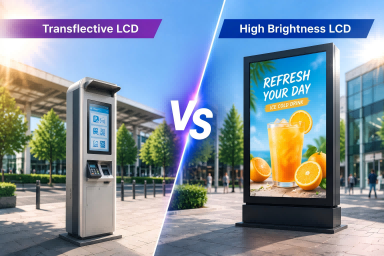
Écran LCD transflectif ou écran LCD haute luminosité : lequel les acheteurs devraient-ils choisir ?
Lorsqu'ils choisissent une solution d'affichage extérieur, de nombreux acheteurs sont confrontés à une question récurrente :
Devraient-ils opter pour un écran LCD transflectif ou un écran LCD à haute luminosité ?
Ces deux technologies permettent d'améliorer la lisibilité à l'extérieur, mais elles répondent à des problèmes différents.
Le choix approprié dépend des exigences de l'application, de la distance de visionnage, du type de contenu et de l'environnement d'exploitation.
Écran LCD haute luminosité : conçu pour un impact visuel maximal
Les solutions LCD à haute luminosité améliorent la visibilité en extérieur grâce à une puissance de rétroéclairage accrue.
Au lieu d'utiliser la lumière ambiante, elles produisent une luminosité suffisante pour rivaliser avec la lumière du soleil.
Un écran extérieur à haute luminosité classique peut comprendre :
- Écran LCD à haute luminosité
- Rétroéclairage LED puissant
- Collage optique
- Verre anti-éblouissement ou antireflet
- Système de gestion thermique
- Boîtier résistant aux intempéries
L'objectif est de garantir que les images, les vidéos, les publicités et les informations restent visibles même à plusieurs mètres de distance.
Les écrans LCD à haute luminosité sont couramment utilisés pour :
- Affichage numérique extérieur
- Présentoirs publicitaires
- Panneaux d'affichage numériques
- Grands écrans d'information
- Affichages liés aux transports
Ces applications exigent une communication visuelle percutante. Les clients ne voient parfois l'écran que pendant quelques secondes lorsqu'ils passent à pied ou en voiture ; la luminosité, la précision des couleurs et l'impact visuel sont donc essentiels.
Écran LCD transflectif : conçu pour une interaction fiable
Les écrans LCD transflectifs sont destinés à un autre type d'utilisation.
Au lieu d'optimiser la luminosité, cette technologie améliore la lisibilité tout en réduisant la consommation d'énergie.
Il convient mieux à :
- Terminaux à écran tactile
- Équipements en libre-service
- Interfaces industrielles
- Appareils portables
- Systèmes de commande pour l'extérieur
L'utilisateur se trouve généralement près de l'écran et doit effectuer une tâche.
Pour ces applications, les facteurs les plus importants sont les suivants :
- Visibilité claire du texte
- Fonctionnement tactile stable
- Faible consommation d'énergie
- Longue durée de vie
Comparaison entre les écrans LCD transflectifs et les écrans LCD à haute luminosité
| Facteur | Écran LCD transflectif | Écran LCD haute luminosité |
|---|---|---|
| Objectif principal | Fonctionnement interactif | Communication visuelle |
| Source lumineuse | Lumière ambiante + rétroéclairage | Rétroéclairage puissant |
| Lisibilité à l'extérieur | Idéal pour une observation de près | Idéal pour l'observation à distance |
| Consommation électrique | Inférieur | Plus élevé |
| Production de chaleur | Inférieur | Plus élevé |
| Performance vidéo | Modéré | Excellent |
| Rendement chromatique | Bien | Mieux |
| Taille habituelle | Écrans de petite à moyenne taille | Écrans de taille moyenne à grande |
| Les meilleures applications | Kiosques, terminaux, équipements industriels | Affichage numérique, écrans publicitaires |
Une règle de décision simple :
Choisissez Écran LCD transflectif quand :
- Les utilisateurs utilisent directement l'écran
- La faible consommation d'énergie est importante
- L'appareil fonctionne en continu à l'extérieur
- L'affichage des informations est plus important que la qualité vidéo
Choisissez Écran LCD haute luminosité quand :
- La présentation doit attirer l'attention
- Le contenu comprend des images et des vidéos
- Les utilisateurs regardent l'écran de loin
- La luminosité maximale et l'impact visuel sont des priorités
Pour certains produits d'extérieur haut de gamme, les fabricants peuvent également associer plusieurs technologies. Par exemple, une borne interactive d'extérieur peut intégrer un écran lisible en plein soleil, un assemblage optique, un verre antireflet et des dispositifs de protection industriels afin de garantir des performances fiables.
Applications des solutions d'écrans LCD transflectifs
Bien que la technologie LCD transflective ne soit pas le choix habituel pour tous les écrans d'extérieur, elle offre des avantages considérables dans certaines applications spécifiques.
C'est dans les scénarios suivants que cette technologie peut apporter une réelle valeur ajoutée.
1. Bornes libre-service d'extérieur
Les bornes libre-service d'extérieur constituent l'une des applications les plus adaptées à la technologie LCD transflective.
En voici quelques exemples :
- Points d'information touristique
- Terminaux de navigation dans les parcs
- Bornes de services publics
- Points d'information sur le campus
- Terminaux d'information des villes intelligentes
Contrairement aux écrans publicitaires extérieurs, les bornes interactives exigent que les utilisateurs se tiennent près de l'écran et interagissent avec l'interface.
L'affichage doit rester lisible lorsque :
- La lumière directe du soleil frappe l'écran
- Les utilisateurs portent des lunettes de soleil
- Le terminal est ouvert toute la journée
- L'efficacité énergétique est importante
Une solution d'écran tactile LCD transflectif peut contribuer à garantir un fonctionnement constant dans des conditions extérieures variables.
Pour les intégrateurs de systèmes et les fabricants de bornes interactives, cette technologie permet d'améliorer l'expérience utilisateur tout en réduisant la consommation d'énergie superflue.
2. Terminaux de paiement pour parkings extérieurs
Les systèmes de paiement de stationnement constituent un autre domaine d'application important.
Les bornes de stationnement en extérieur affichent généralement :
- Frais de stationnement
- Instructions de paiement
- Codes QR
- Statut de la transaction
- Guide d'utilisation
En règle générale, les utilisateurs interagissent avec l'appareil pendant une courte période.
La priorité n'est pas d'obtenir des visuels de qualité publicitaire, mais :
- Reconnaissance rapide
- Réponse tactile fiable
- Affichage clair des informations
Les bornes de stationnement fonctionnant à l'extérieur pendant de longues périodes, la technologie LCD transflective permet de trouver un bon équilibre entre visibilité et efficacité énergétique.
3. Guichets et terminaux de transport
Les distributeurs automatiques de billets en extérieur et les terminaux de transport sont souvent exposés à des conditions difficiles.
En voici quelques exemples :
- Distributeurs automatiques de billets pour les parcs d'attractions
- Guichets de vente de billets pour les sites touristiques
- Gares de transport en plein air
- Systèmes d'accès public
Ces appareils nécessitent des écrans capables de fonctionner :
- En plein soleil
- La nuit
- Dans des conditions météorologiques changeantes
Une solution d'écran LCD transflectif permet un fonctionnement continu sans nécessiter une puissance de rétroéclairage maximale tout au long de la journée.
4. Écrans des bornes de recharge pour véhicules électriques
Les bornes de recharge pour véhicules électriques constituent une autre application potentielle.
Les bornes de recharge affichent généralement :
- État de la charge
- Consommation d'énergie
- Informations relatives au paiement
- Progression de la recharge
- Mode d'emploi
Ces écrans ne nécessitent pas de performances vidéo haut de gamme.
Au contraire, ils ont besoin :
- Résistance à l'extérieur
- Peu d'entretien
- Longue durée de fonctionnement
- Une visibilité parfaite
Pour ce type d'équipement, la technologie LCD transflective peut constituer une solution d'affichage efficace.
5. Terminaux IHM et de commande industriels pour usage extérieur
Les environnements industriels nécessitent souvent des écrans capables de fonctionner dans des conditions difficiles.
En voici quelques exemples :
- Terminaux à l'entrée de l'usine
- Systèmes d'accès aux entrepôts
- Panneaux de commande pour l'extérieur
- Interfaces de surveillance des équipements
Ces applications accordent la priorité à :
- Fiabilité
- Résistance à la température
- Fonctionnement en continu
- Une visibilité claire sur les données
Un écran LCD transflectif associé à une conception de protection industrielle peut constituer une solution adaptée aux interfaces homme-machine destinées à une utilisation en extérieur.
Applications pour lesquelles un écran LCD à haute luminosité est généralement préférable
Bien que les écrans LCD transflectifs présentent de nombreux avantages, il est important de choisir la technologie en fonction des besoins réels.
Pour les applications axées sur la communication visuelle, un écran LCD à forte luminosité constitue généralement le meilleur choix.
En voici quelques exemples :
Affichage numérique extérieur
L'affichage numérique est conçu pour attirer l'attention.
L'écran nécessite :
- Des images lumineuses
- Couleurs vives
- Lecture vidéo
- Visibilité à longue distance
Une solution LCD à forte luminosité est généralement plus adaptée.
Panneaux d'affichage de menu pour l'extérieur
Les restaurants et les services au volant exigent souvent que les clients consultent :
- Images de plats
- Promotions
- Contenu de marque
Les écrans à forte luminosité offrent un meilleur impact visuel pour ces applications.
Grands écrans interactifs d'extérieur
Les écrans grand format, tels que les écrans interactifs d'extérieur de 65 ou 75 pouces, nécessitent généralement une technologie LCD à forte luminosité pour les raisons suivantes :
- Exigences en matière de dimensions
- Attentes en matière de qualité d'image
- Considérations relatives à la fabrication
Comment choisir une solution d'écran LCD transflectif
Pour choisir la solution d'écran LCD transflectif la mieux adaptée, il ne suffit pas de se contenter de sélectionner un type de dalle.
Les acheteurs doivent évaluer l'ensemble du système de présentation.
1. Taille et résolution de l'écran
La taille requise dépend de l'application.
Les petites expositions peuvent porter notamment sur :
- Lecture d'informations
- Fonctionnement portable
Les écrans de plus grande taille peuvent nécessiter :
- Meilleure résolution
- Une meilleure expérience visuelle
Parmi les éléments à prendre en compte, on peut citer :
- Taille de l'écran
- Résolution
- Distance de visionnage
- Type de contenu
2. Performances optiques
La lisibilité à l'extérieur dépend de plusieurs facteurs optiques.
Parmi les caractéristiques techniques importantes, on peut citer :
- Luminosité
- Rapport de contraste
- Réflexion sur les performances
- Performances de transmission
- Angle de vision
L'équilibre entre les performances de réflexion et de transmission influe sur le comportement de l'écran dans différentes conditions d'éclairage.
3. Exigences relatives à l'écran tactile
De nombreuses applications utilisant des écrans LCD transflectifs impliquent une interaction.
Les acheteurs devraient tenir compte des éléments suivants :
- Technologie tactile PCAP
- Fonctionnalité multitouch
- Utilisation avec des gants
- Sensibilité au toucher
- Épaisseur du verre de protection
Dans les environnements extérieurs, la réactivité de l'écran tactile est tout aussi importante que la lisibilité de l'affichage.
4. Protection de l'environnement
Les écrans d'extérieur nécessitent une protection qui va au-delà de la dalle LCD elle-même.
Parmi les éléments importants à prendre en compte, on peut citer :
- Indice de protection IP65 ou supérieur
- Large plage de températures de fonctionnement
- Résistance à la poussière
- Protection de l'eau
- Conception anticorrosion
5. Collage optique et verre de protection
Pour les produits interactifs destinés à une utilisation en extérieur, le collage optique permet d'améliorer la visibilité en réduisant les reflets entre la dalle LCD et la vitre de protection.
Des traitements complémentaires tels que :
- Revêtement antireflet
- Traitement antireflet
- Verre trempé
peut encore améliorer la facilité d'utilisation en extérieur.
Solutions d'affichage extérieur sur mesure proposées par Ikinor
Le choix de la technologie d'affichage extérieur la plus adaptée dépend des exigences concrètes de l'application.
Un écran destiné à la publicité extérieure n'a pas les mêmes priorités qu'un terminal en libre-service ou qu'un système de contrôle industriel.
Ikinor propose des solutions d'affichage commercial sur mesure adaptées à différents scénarios d'utilisation, notamment des bornes interactives, des systèmes d'affichage dynamique et des écrans tactiles personnalisés.
Pour les applications interactives en extérieur, il convient de prendre en compte simultanément des facteurs tels que la lisibilité en plein soleil, les performances tactiles, le niveau de protection du boîtier et la fiabilité à long terme.
En fonction des exigences du projet, les solutions peuvent inclure :
- Systèmes d'affichage lisibles en plein soleil
- Bornes en libre-service d'extérieur
- Terminaux interactifs
- Écrans commerciaux à haute luminosité
- Solutions d'affichage OEM/ODM sur mesure
En comprenant les différences entre les technologies d'écrans LCD transflectifs et à haute luminosité, les acheteurs peuvent choisir une solution d'affichage adaptée à leur environnement, au comportement des utilisateurs et à leurs objectifs commerciaux.
Foire aux questions
Oui. Les écrans LCD transflectifs sont conçus pour les environnements où la lumière ambiante est intense. En combinant la lumière ambiante réfléchie et le rétroéclairage, ils offrent une meilleure lisibilité en plein soleil que les écrans LCD classiques.
Aucune de ces deux technologies n'est universellement supérieure. Les écrans LCD transflectifs sont plus adaptés aux applications interactives à faible consommation d'énergie, telles que les bornes interactives et les terminaux industriels, tandis que les écrans LCD à haute luminosité conviennent mieux aux grands écrans d'extérieur nécessitant un fort impact visuel.
Oui. Les écrans LCD transflectifs peuvent être associés à des technologies tactiles telles que les écrans tactiles PCAP, ce qui les rend adaptés aux bornes interactives d'extérieur.
Parmi les applications courantes, on peut citer les bornes d'extérieur, les interfaces homme-machine (IHM) industrielles, les terminaux de stationnement, les équipements de transport, les bornes de recharge pour véhicules électriques et les appareils professionnels portables.
Oui. Ikinor propose des services de personnalisation OEM/ODM pour les écrans commerciaux, les bornes interactives et les solutions d'affichage extérieur, en fonction des différentes exigences des applications, notamment en matière de configuration d'affichage, de conception mécanique et d'intégration système.