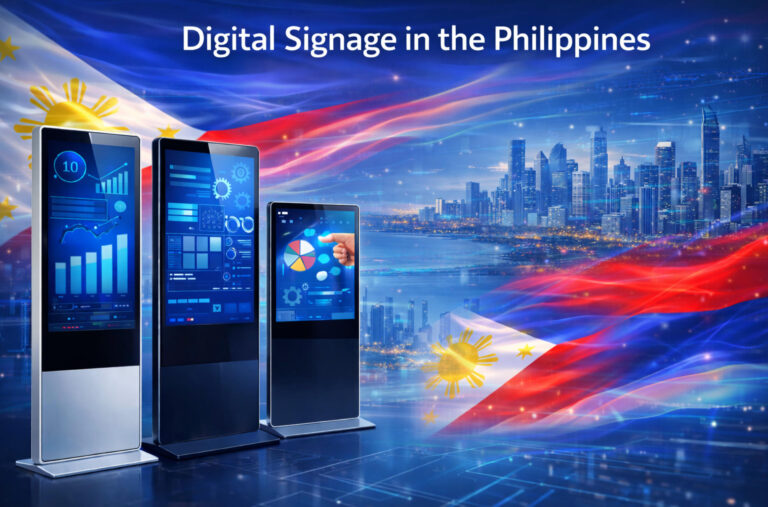
Across the Philippines, digital signage has become a familiar presence in shopping malls, restaurants, transport hubs, and corporate spaces. Floor standing displays, mobile smart screens, and touchscreen kiosks are widely used to enhance brand visibility, streamline operations, and improve customer engagement. This article provides an in depth overview of the digital signage market in the Philippines, explains key product categories and practical use cases, and highlights the growing role of smart kiosks in restaurant ordering and self service environments. It also introduces leading digital signage suppliers, compares typical pricing and configuration options, and offers clear guidance to help businesses select suitable digital signage solutions based on budget, application, and long term operational needs for growing retail and food service businesses.
Digital Signage Introduction
Digital signage is rapidly becoming an essential tool for businesses across the Philippines as competition intensifies and customer expectations continue to evolve. With high smartphone usage, dense urban environments, and strong foot traffic in commercial areas, companies increasingly rely on visual communication that can be updated quickly and managed centrally. Compared with traditional printed signage, digital displays provide greater flexibility, stronger visual impact, and the ability to deliver time-sensitive information in real time.
Across the country, digital signage is now embedded in a wide range of business scenarios. Retail chains use floor standing digital signage to promote campaigns, introduce new products, and improve in-store navigation within large malls. In the hospitality sector, hotels and resorts deploy digital displays for branding, event schedules, and guest information. Restaurants are seeing fast adoption of touchscreen kiosks and smart kiosks, which support self-ordering, menu customization, and faster service during peak hours. In corporate environments, digital signage is used for internal communications, reception displays, and meeting room information, while transportation hubs such as airports, MRT stations, and bus terminals depend on digital screens for real-time announcements and passenger guidance.
As these use cases expand, digital signage projects in the Philippines are becoming more complex. Buyers must evaluate not only screen size and appearance, but also performance specifications, touch technology, operating systems, software compatibility, and long-term maintenance requirements. Differences in configuration can significantly affect user experience, system stability, and total investment cost, making careful evaluation increasingly important before supplier selection.
Digital Signage Technology & Key Concepts
Digital signage refers to the use of dynamic electronic displays to deliver visual content such as images, videos, menus, and real-time information. Unlike static signage, which relies on printed materials that must be manually replaced, digital signage allows content to be updated instantly, scheduled remotely, and tailored to specific locations or audiences. This flexibility makes digital signage more responsive, cost-efficient over time, and better suited to fast-changing business environments.
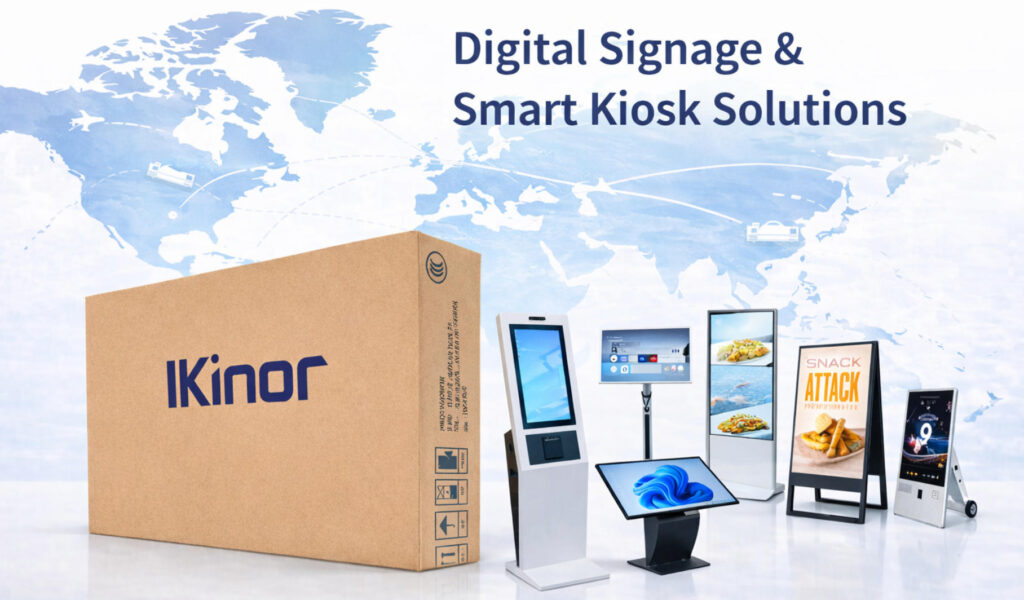
Among the most common formats, floor standing digital signage is widely used in lobbies, retail aisles, and shopping malls. These displays are designed for high visibility in busy areas, supporting branding, promotions, wayfinding, and announcements. Mobile smart screens represent a more flexible option. Typically equipped with built-in batteries and wireless connectivity, they can be easily moved between locations, making them ideal for exhibitions, pop-up stores, temporary campaigns, and event marketing.
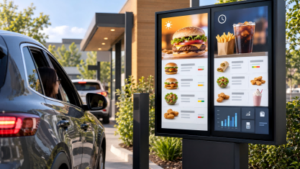
Touchscreen kiosks add an interactive layer to digital signage. They are commonly used for wayfinding, self-service information, ticketing, and customer check-in across commercial buildings, hospitals, and public facilities. In restaurant environments, smart kiosks have become a key application. These systems enable customers to browse menus, customize orders, place orders independently, and receive upsell recommendations, helping restaurants reduce wait times and improve order accuracy.
Behind all digital signage systems is a content management system (CMS). Cloud-based CMS platforms allow centralized control, remote updates, and easy scalability across multiple locations. On-premise CMS solutions offer greater control over data and security, often preferred by organizations with strict IT requirements. The choice between the two depends on operational scale, network stability, and management preferences.
Philippines Region’s Manufacturing Landscape & Industry Strengths For Digital Signage
The Philippines is emerging as an increasingly strategic market for digital signage manufacturing and integration in Southeast Asia, supported by a combination of growing local demand, a developing electronics ecosystem, and expanding digital transformation across industries. While the country does not yet host large-scale display panel factories like those in neighboring Taiwan or China, it has cultivated a strong electronics assembly and integration sector that supports commercial display assembly, enclosure fabrication, and system deployment. This positions the Philippines as a capable regional hub for value-added assembly, customization, and integration services tailored to domestic requirements.
One of the region’s primary strengths lies in its relatively cost-competitive labor force and an expanding pool of technical talent trained in electronics assembly, IT systems, and software services. This workforce supports local integrators and contract manufacturers in producing tailored digital signage hardware, configuring CMS platforms, and providing installation and maintenance services for businesses across retail, hospitality, and corporate sectors.
The Philippines also benefits from its strategic geographic location and established trade links, allowing providers to source high-quality display components (such as LCD/LED panels, touchscreens, and embedded players) from global suppliers and assemble or configure them locally. Free trade agreements and investment incentives offered by Philippine economic zones enhance the cost efficiency of importation, assembly, and export services, making the region attractive for light manufacturing and integration.
In terms of product focus, local integrators and assemblers concentrate on floor standing digital signage, touchscreen kiosks, and mobile smart screen solutions, with an increasing share of systems geared toward hospitality and fast-casual restaurant environments. These products often incorporate cloud-based CMS, remote management features, and tailored user interfaces for specific business use cases.
Overall, the Philippines combines technical competencies, competitive assembly costs, and supportive trade frameworks to strengthen its digital signage manufacturing and services landscape, meeting both domestic demand and regional integration requirements.
Top 10 Digital Signage Manufacturers and Providers in Philippines
Ikinor Philippines
| Founded | 2016 |
|---|---|
| Company Profile | Ikinor is a China-based commercial display manufacturer specializing in digital signage and interactive display solutions, with strong OEM/ODM customization capabilities for global retail, education, hospitality, corporate, healthcare, and public-sector environments. |
| Core Products | Floor-standing digital signage, wall-mounted digital signage, interactive flat panel displays, touchscreen kiosks, mobile smart screens, digital menu boards, commercial LCD/LED displays, and OEM/ODM customized display solutions. |
| Key Strengths | Factory-direct manufacturing, full OEM/ODM customization, in-house R&D, automated production lines, flexible configuration options, strict quality control, and international certifications including CE, FCC, and RoHS. |
| Location | Dongguan, Guangdong Province, China, with integrated manufacturing, R&D, and global export capabilities. |
| Best For | Global B2B distributors, system integrators, project contractors, brand owners, and enterprise clients seeking scalable production, customization, stable supply, and competitive factory pricing. |
| Contact |
Inewvation
| Founded | 2011 |
|---|---|
| Company Profile | Inewvation International Corporation is a Philippines-based digital display and signage solutions provider specializing in customized LED screens, digital signage systems, and visual communication technologies. |
| Core Products | LED display screens, indoor and outdoor digital signage, interactive kiosks, advertising kiosks, wayfinding kiosks, high-resolution LED video walls, and bespoke digital display systems. |
| Key Strengths | Large-scale project experience, in-house engineering and technical support, custom LED display design, complex configurations such as seamless and curved LED walls, and broad industry coverage. |
| Location | Headquarters in Manila, Philippines, with additional regional offices in Cebu, Singapore, and Hong Kong. |
| Best For | B2B resellers, system integrators, brand owners, and project contractors requiring customized LED and digital signage solutions for malls, venues, corporate clients, and outdoor installations. |
| Contact |
Horion
| Founded | 1995 |
|---|---|
| Company Profile | Horion is a global interactive display and digital signage solutions provider headquartered in Shenzhen, China, with exclusive partner operations in the Philippines. |
| Core Products | Commercial digital signage, interactive flat panels, mobile smart screens, all-in-one interactive whiteboards, LED video walls, touch-enabled panels, and collaboration displays. |
| Key Strengths | Strong display R&D and manufacturing ecosystem, large production capacity, international quality standards, multi-OS support, remote content management compatibility, and localized Philippine partner support. |
| Location | Headquarters in Shenzhen, Guangdong, China, with Philippine distribution and support through Horion Philippines partnership. |
| Best For | B2B resellers, system integrators, project contractors, corporate clients, retail chains, and educational institutions seeking scalable digital signage and interactive display solutions. |
| Contact |
xiphiastec
| Founded | 2002 |
|---|---|
| Company Profile | Xiphiastec is a digital kiosk and interactive signage provider with a presence in the Philippines, focusing on smart kiosks, interactive wayfinding, smart city displays, and public information systems. |
| Core Products | Interactive touchscreen kiosks, smart city kiosks, food ordering kiosks, digital notice boards, large digital displays, outdoor signage, and cloud-connected self-service systems. |
| Key Strengths | Smart kiosk deployment experience, customizable touchscreen systems, POS integration, cloud-based remote content management, interactive navigation, and real-time data integration. |
| Location | Operates in the Philippines with local service focus and broader regional support links. |
| Best For | Project contractors, government agencies, retail integrators, restaurant brands, and urban developers needing interactive signage, smart kiosks, and self-service digital touchpoints. |
| Contact |
Yodeck
| Founded | 2015 |
|---|---|
| Company Profile | Yodeck is a cloud-based digital signage platform provider headquartered in the United States, with global reach including deployments in the Philippines and Southeast Asia. |
| Core Products | Cloud digital signage CMS, remote screen monitoring, health-check dashboard, content templates, scheduling, playlist tools, data feed integrations, and hardware support for Raspberry Pi, Android, and Windows devices. |
| Key Strengths | Cloud-centric CMS, centralized multi-screen management, scalable subscription model, remote health monitoring, hybrid hardware support, and integrations with external data sources and business systems. |
| Location | Headquartered in Miami, Florida, USA, with global SaaS delivery and reseller partners serving the Philippines. |
| Best For | System integrators, resellers, retail chains, corporate clients, educational institutions, and hospitality groups seeking scalable cloud-managed digital signage. |
| Contact |
Hikvision
| Founded | 2001 |
|---|---|
| Company Profile | Hikvision is a global AIoT technology company known for security and surveillance products, while also offering digital signage displays and commercial visual solutions for business and public environments. |
| Core Products | Wall-mounted and floor-standing digital signage displays, LED video walls, interactive flat panels, information displays, and centralized signage control solutions. |
| Key Strengths | Large global R&D scale, 4K visual performance, high brightness, wide viewing angles, flexible deployment, centralized content and device management, and AIoT analytics integration. |
| Location | Global headquarters in Hangzhou, China, with operations and partner distribution in the Philippines through authorized resellers and integrators. |
| Best For | System integrators, large retailers, corporate clients, transportation hubs, and public institutions requiring enterprise-grade digital signage and display networks. |
| Contact |
RepeatSoftware
| Founded | 1999 |
|---|---|
| Company Profile | RepeatSoftware Ltd. is a UK-based technology provider known for Repeat Signage, a flexible digital signage CMS used globally, including deployments in the Philippines through partners and integrators. |
| Core Products | Repeat Signage CMS, media player software for Windows and Android, templates, scheduling tools, remote playback modules, and dynamic data integration features. |
| Key Strengths | Stable software platform, long development history, cross-platform support, template-driven content creation, cost-predictable licensing, and reseller ecosystem for localized support. |
| Location | Headquartered in Derbyshire, United Kingdom, with reseller and integration partners serving the Philippines. |
| Best For | System integrators, resellers, corporate users, educational institutions, and SMEs looking for software-centric digital signage that is easy to manage and scalable. |
| Contact |
ATI
| Founded | 1979 |
|---|---|
| Company Profile | ATI, American Technologies, Inc., is a leading IT and AV solutions distributor in the Philippines, offering enterprise-grade hardware and display technologies through partnerships with global brands. |
| Core Products | Commercial digital signage displays, touchscreen kiosks, video walls, interactive panels, professional monitors, panel PCs, and integrated hardware from global partners. |
| Key Strengths | Long-standing local market presence, authorized distribution partnerships, broad AV and display portfolio, nationwide service channels, and experience in large-scale deployments. |
| Location | Makati City, Metro Manila, Philippines, with nationwide distribution coverage and partner engagement. |
| Best For | System integrators, project contractors, enterprise clients, government agencies, and corporate IT departments seeking reliable display and interactive solutions. |
| Contact |
OptiSigns
| Founded | 2016 |
|---|---|
| Company Profile | OptiSigns is a global cloud-based digital signage software provider that enables organizations to manage and publish content to displays from anywhere, with adoption in the Philippines through resellers and integrators. |
| Core Products | Cloud digital signage CMS, templates, widgets, remote screen management, data feed integrations, business app integrations, and support for Android, Windows, Chrome OS, BrightSign, and commercial displays. |
| Key Strengths | Intuitive drag-and-drop content design, remote scheduling, multi-platform hardware support, real-time monitoring, remote reboot, alerts, multi-user access, role permissions, and cost-effective subscription tiers. |
| Location | Headquartered in the United States, with global SaaS delivery and reseller partners serving the Philippines and Southeast Asia. |
| Best For | System integrators, resellers, corporate clients, retail chains, hospitality groups, and educational institutions seeking scalable cloud-managed signage. |
| Contact |
Mediacast Digital Group Inc.
| Founded | 2014 |
|---|---|
| Company Profile | Mediacast Digital Group Inc. is a Philippine technology company specializing in digital signage hardware, software integration, media players, and end-to-end display solutions. |
| Core Products | Floor-standing digital signage, LED/LCD commercial displays, interactive touchscreen kiosks, mobile smart screens, media players, CMS, and integrated digital display networks. |
| Key Strengths | Local presence, nationwide service coverage, end-to-end solutions, hardware and software configuration, installation, content deployment, maintenance, and tailored configurations. |
| Location | Quezon City, Metro Manila, Philippines, with service capability across Luzon, Visayas, and Mindanao. |
| Best For | B2B resellers, system integrators, project contractors, brand owners, and corporate clients seeking locally supported signage solutions with hardware, software, and services. |
| Contact |
Selection Criteria for Top Digital Signage in the Philippines
When evaluating digital signage solutions in the Philippines, clear selection criteria are essential to ensure long-term performance, cost efficiency, and operational stability. As digital signage projects increasingly combine hardware, software, and ongoing services, buyers must look beyond screen size and appearance to assess overall system compatibility and supplier capability.
Product range and compatibility are a primary consideration. A strong supplier should offer multiple display formats, including floor standing digital signage, mobile smart screens, and touchscreen kiosks, while ensuring seamless integration with operating systems and content management software. Compatibility between hardware components and CMS platforms reduces deployment risks and simplifies future upgrades.
Pricing transparency and configuration flexibility are equally important. Digital signage costs can vary significantly based on screen size, brightness, touch technology, processing power, and mounting structure. Reliable suppliers clearly explain how pricing changes with different configurations and allow customization based on specific application requirements rather than forcing fixed packages.
Support, installation, and warranty coverage play a critical role after purchase. In the Philippine market, local installation teams, responsive technical support, and clearly defined warranty terms help minimize downtime and ensure stable system operation. Suppliers that provide on-site service and spare parts availability offer a distinct advantage, especially for multi-location deployments.
Scalability and remote management features should also be evaluated early. As businesses expand, the ability to add screens, manage content centrally, and monitor device status remotely becomes essential. A scalable system reduces long-term costs and avoids repeated reinvestment.
Finally, local presence and service capability matter. Suppliers with established operations in the Philippines are better positioned to provide timely support, understand local regulations, and adapt solutions to regional business needs, ensuring smoother project execution and ongoing reliability.
How Much Does Digital Signage Products Manufacturing Cost?
The manufacturing cost of digital signage products depends on display size, technology, and feature set. For basic indoor displays (32″–55″), panel costs are typically USD 150–350. When combined with standard chassis, power supply, and media player, total manufacturing cost for a basic unit ranges from USD 300–600. These entry-level units are common for retail aisles, corporate lobbies, and information displays.
Larger floor-standing digital signage (55″–75″) using commercial-grade panels and embedded players generally cost USD 450–900 to produce. If touchscreen capability is included, manufacturing costs rise to USD 700–1,400 due to the added touch layer and calibration.
Mobile smart screens with built-in battery packs and wireless connectivity are more complex. Basic models cost around USD 350–650 to manufacture, while ruggedized or high-performance versions can reach USD 800–1,200.
Touchscreen kiosks incorporate touch overlays, enclosed signage housings, and integrated computing hardware. Indoor kiosk units often cost USD 900–2,000 to build, largely driven by touchscreen panels and embedded systems. Outdoor or restaurant smart kiosks with POS integration generally cost USD 1,800–3,500 due to weatherproofing, payment modules, and higher-end CPUs.
Beyond hardware, software and CMS integration add cost. Basic cloud CMS licensing averages USD 15–40 per screen per month, while dedicated on-premise systems may incur upfront licensing of USD 300–1,200 plus annual maintenance.
Other contributors include assembly and testing (USD 30–100 per unit), packaging, and quality control. With volume production, per-unit costs can decrease significantly as components and labor scale.
Price & Configuration Guide
When evaluating digital signage solutions in the Philippines, pricing is closely tied to configuration choices rather than screen size alone. Entry-level indoor digital signage displays (32”–43”) typically fall in the USD 600–1,000 range. These models usually feature standard brightness (350–400 nits), Full HD resolution, basic Android players, and are suitable for retail shelves, offices, and indoor directories.
Mid-range floor-standing digital signage (49”–55”) is priced between USD 1,200–2,500, depending on panel quality, brightness level (500–700 nits), and enclosure design. Adding tempered glass, ultra-slim frames, or commercial-grade panels increases durability and cost but improves long-term performance in malls and hotel lobbies.
Mobile smart screens introduce additional configuration variables such as battery capacity, wireless connectivity, and rotation capability. Prices typically range from USD 1,500–3,000, with higher costs associated with longer battery life, metal housings, and larger screen sizes.
For touchscreen kiosks, pricing starts around USD 2,000 for basic indoor models and can exceed USD 4,000 for advanced configurations. Key cost drivers include touch technology (infrared vs. capacitive), embedded CPU performance, and peripheral integration. In restaurant environments, smart kiosks with self-ordering software, POS compatibility, and payment modules are usually priced between USD 2,800–5,500.
Software is another critical consideration. Cloud-based CMS platforms often charge USD 15–50 per screen per month, while on-premise systems involve higher upfront licensing but lower long-term operating costs. Ultimately, selecting the right configuration requires balancing budget, usage intensity, and scalability rather than focusing on hardware price alone.
Common Challenges When Working With Manufacturers (and Solutions)
When sourcing digital signage products from manufacturers, buyers often encounter challenges that can affect cost control, delivery timelines, and long-term system performance. For buyers comparing local Philippine providers with overseas OEM/ODM options, understanding the capabilities of digital signage manufacturers in China can also help evaluate production scale, customization flexibility, certification support, and export readiness. One of the most common issues is unclear specification alignment. Differences in brightness ratings, panel grades, or CPU performance may not be fully explained during early discussions, leading to products that underperform in real-world environments. This risk can be reduced by requesting detailed technical datasheets, sample units, and written confirmation of key specifications before mass production.
Another frequent challenge is lead time uncertainty. Manufacturing schedules can be impacted by component shortages, peak production seasons, or shipping constraints. To mitigate delays, buyers should confirm realistic production timelines, include buffer periods in contracts, and prioritize manufacturers with stable local or regional assembly capabilities.
Quality consistency is also a concern, particularly for large-volume orders. Variations in panel uniformity, touch sensitivity, or enclosure finishing may appear across batches. Implementing pre-shipment inspections, factory acceptance testing (FAT), and clear quality control standards helps ensure consistent output.
Communication gaps can further complicate projects. Time zone differences, language barriers, and unclear escalation paths often slow problem resolution. Working with manufacturers that offer local representatives or dedicated project managers can significantly improve coordination and responsiveness.
Finally, after-sales support and spare parts availability are frequently underestimated. Without clear warranty terms or local service coverage, maintenance costs can rise quickly. Buyers should confirm warranty duration, response times, and replacement part availability in advance. By addressing these challenges proactively through structured documentation, inspection processes, and service agreements, businesses can reduce risk and build more reliable, long-term manufacturing partnerships.
FAQs
In the Philippines, the most widely used digital signage formats include floor standing digital signage, mobile smart screens, and touchscreen kiosks. Retail chains and malls typically favor floor standing displays for promotions, while restaurants increasingly adopt smart kiosks for self-ordering. Corporate offices and transportation hubs often use wall-mounted displays and interactive information kiosks for announcements and wayfinding.
Pricing varies depending on screen size, brightness, touch functionality, and software requirements. Entry-level non-touch digital signage displays usually start at a lower price range, while touchscreen kiosks and mobile smart screens with battery systems and CMS integration cost more. Additional costs may include installation, content management software, and ongoing maintenance.
Both options have advantages. Local suppliers often provide faster installation, on-site support, and easier after-sales service. International brands may offer broader product portfolios, advanced display technology, and global certifications. The best choice depends on project scale, budget, and long-term support needs.
Buyers should evaluate display quality (brightness and resolution), operating system compatibility, CMS flexibility, remote management capabilities, warranty coverage, and scalability. For public or outdoor use, durability and continuous operation ratings are also critical.
Most modern digital signage solutions use cloud-based or centralized CMS platforms, allowing users to update content remotely with minimal technical expertise. With proper initial setup and training, daily management is generally straightforward.
Retail, hospitality, restaurants, corporate offices, education, and transportation are the main sectors adopting digital signage. These industries benefit from improved customer engagement, real-time information delivery, and more efficient communication across multiple locations.