
Finding the right destination in a large building, shopping mall, hospital, airport, or public venue can be frustrating when signs are unclear or information changes frequently. A wayfinding kiosk solves this problem by turning static directions into an interactive, searchable, and easy-to-update navigation experience. Visitors can search for stores, departments, offices, facilities, parking areas, or event locations and receive clear route guidance directly on the touchscreen. For property managers and operators, wayfinding kiosks do more than help people move around. They reduce pressure on front-desk staff, improve visitor satisfaction, support multilingual service, and create new opportunities for digital information and advertising. This article explains what wayfinding kiosks are, where they are used, and how to choose the right solution.
What Is a Wayfinding Kiosk?
A wayfinding kiosk is an interactive navigation device built on an interactive touchscreen combined with a digital signage system, designed to help users quickly find their destination in complex environments. Whether in shopping malls, hospitals, office buildings, airports, or large parks, these kiosks act as digital guides that replace or enhance traditional static signage.
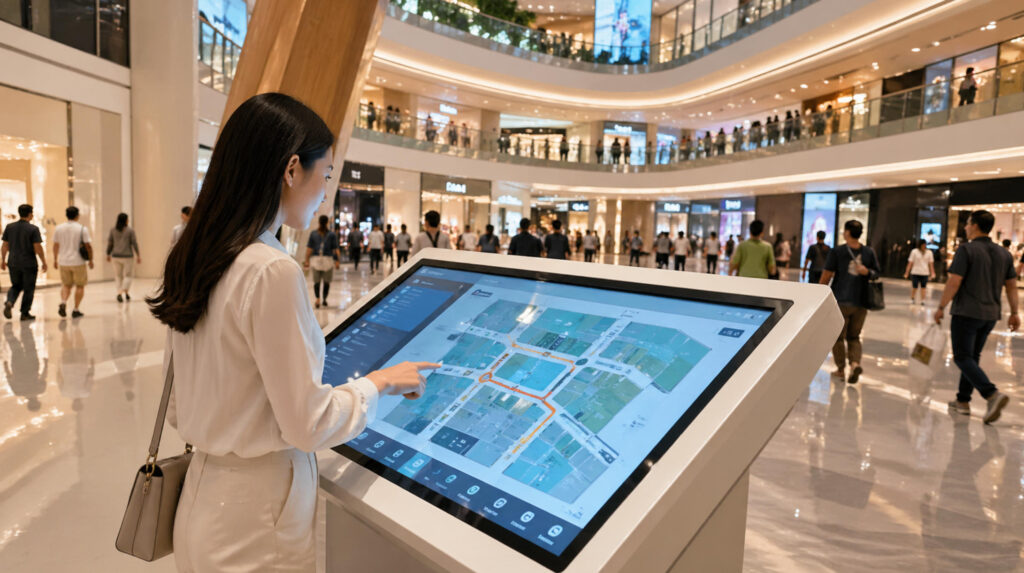
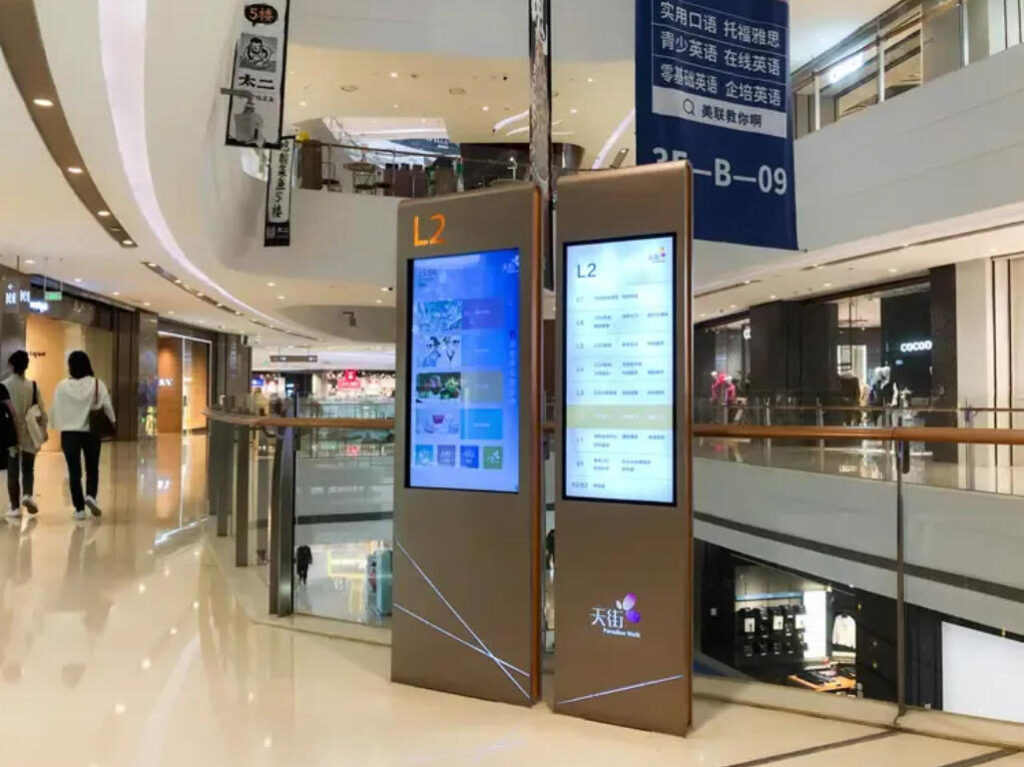
In large commercial complexes, for example, it is common to see wayfinding kiosks placed at entrances or high-traffic intersections. Visitors can simply tap the screen to search for a store, department, or facility, and instantly receive clear directions. This significantly reduces confusion and improves overall user experience.
Most wayfinding kiosks are equipped with several core functions:
- Searchable maps (by name, category, or floor)
- Step-by-step route guidance with visual navigation paths
- Real-time information updates, such as events, meeting schedules, or room availability
At its core, a wayfinding kiosk is an upgraded version of a traditional digital directory system—but far more dynamic, interactive, and data-driven. For office buildings, hospitals, campuses, and commercial lobbies that mainly need tenant search, department lookup, floor maps, and remote content updates, a building directory kiosk is often the more focused solution for organizing building information and guiding visitors.
From a system perspective, these kiosks can operate as standalone units or be integrated into a broader digital ecosystem. They often connect with:
- Content Management Systems (CMS) for centralized updates
- IoT devices for smart environment interaction
- Enterprise databases, such as meeting room systems or hospital HIS platforms
This combination of navigation, real-time data, and system integration makes wayfinding kiosks a key component in modern smart spaces.
Why Wayfinding Kiosks Are Widely Used
Wayfinding kiosks have seen rapid adoption across industries because they address multiple operational challenges while significantly improving user experience. One of the most immediate benefits is reducing labor costs. By enabling self-service navigation, these kiosks reduce the reliance on front-desk staff and information counters, allowing employees to focus on higher-value tasks instead of repeatedly answering directional questions.
At the same time, they greatly enhance user experience. Visitors can independently search for destinations and receive clear, step-by-step navigation instructions. Compared to traditional signage, which often requires interpretation and guesswork, interactive kiosks provide visual maps and guided routes, making navigation faster and more intuitive.
They are especially valuable in complex environments such as shopping malls, hospitals, airports, and large corporate campuses. These spaces typically have multi-level layouts, numerous departments, and constantly changing information, making it difficult for static signs to keep up. Wayfinding kiosks solve this by offering dynamic, up-to-date guidance.
From an operational perspective, they also improve efficiency by reducing congestion, minimizing queues at information desks, and preventing visitors from getting lost. Additionally, modern kiosks support multi-language interfaces and accessibility features, making them suitable for international and diverse user groups.
Perhaps most importantly, wayfinding kiosks enable data-driven operations. They can track user searches, movement patterns, and high-traffic areas, providing valuable insights for layout optimization and business decisions.
In essence, wayfinding kiosks have evolved from simple information displays into powerful tools that combine navigation, data analytics, and operational efficiency in one integrated solution.
Common Uses of Wayfinding Kiosks
Wayfinding kiosks are widely deployed across different environments, with commercial buildings and outdoor attractions being two of the most common scenarios.
In shopping malls and office buildings, wayfinding kiosks serve as essential navigation hubs. Visitors can quickly perform store or office searches by brand name, category, or floor location, eliminating the need to walk around aimlessly. Once a destination is selected, the kiosk provides optimized route guidance, often with clear visual paths that show the shortest or most convenient way to get there. This is especially valuable in large, multi-level complexes. In museums and cultural venues, the same wayfinding function can be configured as part of a broader Museum Kiosk solution, helping visitors find galleries, restrooms, elevators, cafés, exits, and exhibit areas while also supporting multimedia content, ticketing, multilingual guidance, and visitor feedback.
Beyond navigation, these kiosks also function as digital information and advertising platforms. Malls frequently use them to display promotions, events, and brand campaigns. This creates an additional revenue stream, as businesses can pay for advertising placements on the kiosk interface. At the same time, users benefit from discovering ongoing deals or activities in real time.
Parking guidance is another important use case. Wayfinding kiosks can help visitors locate parking zones, entrances, or exits, improving traffic flow and reducing frustration in large parking facilities.
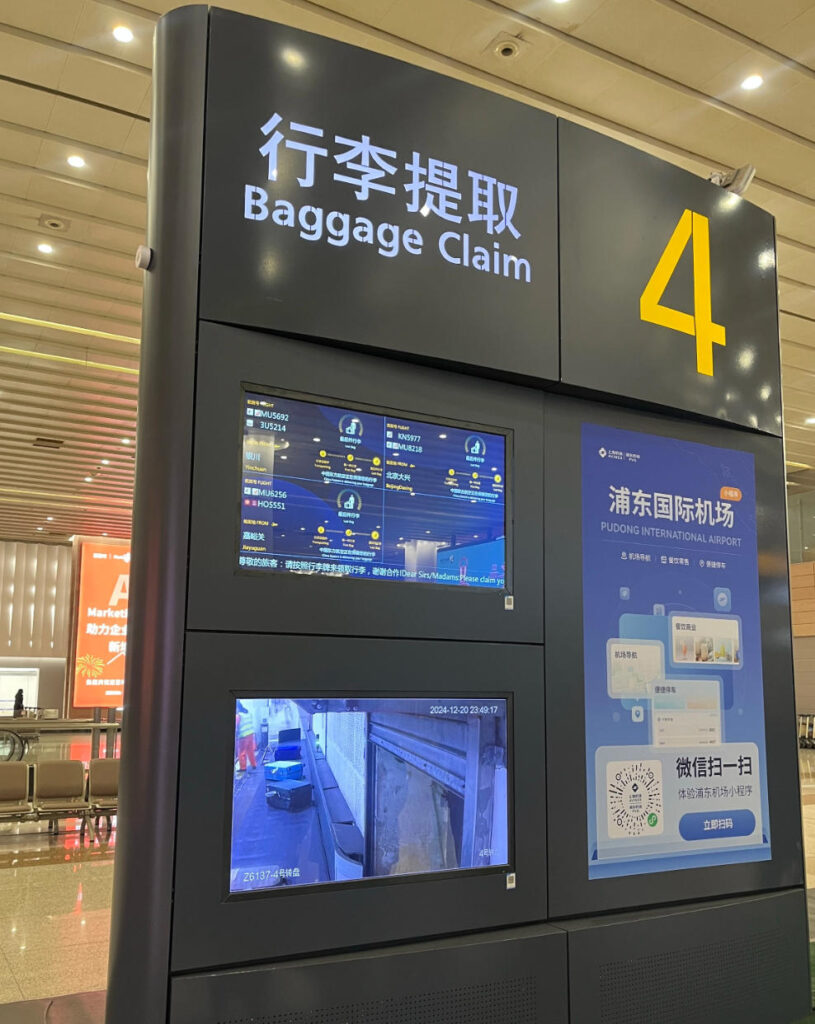
In outdoor scenic areas and tourist attractions, wayfinding kiosks play a slightly different but equally important role. They provide route suggestions, attraction highlights, and directional guidance across large open spaces. In addition, they can display weather forecasts, safety notices, and upcoming event announcements, helping visitors better plan their journey. For broader travel environments such as airports, railway stations, hotels, visitor centers, and scenic areas, buyers can also review this Transportation & Tourism Kiosks guide to compare ticketing, check-in, payment, map navigation, and outdoor deployment requirements within one kiosk solution.
Overall, wayfinding kiosks act as both navigation tools and information centers, enhancing convenience while supporting commercial and operational goals.
Innovation Trends Of Interactive Wayfinding Kiosk(2025–2030)
Between 2025 and 2030, wayfinding kiosks will evolve rapidly, driven by advances in AI, connectivity, and smart infrastructure. One of the most significant trends is the integration of AI and big data. Modern kiosks are moving beyond simple touch-based input to support voice and natural language search, allowing users to interact more intuitively. At the same time, they can analyze user behavior—such as search patterns and movement paths—to optimize navigation logic. Features like heatmap analytics and personalized recommendations (e.g., nearby stores or facilities) are becoming standard, transforming kiosks into intelligent assistants. In fact, AI-powered kiosks are already capable of combining smart Q&A with real-time navigation in a single interface.
Another key trend is the rise of all-in-one platforms. Wayfinding kiosks are no longer standalone tools; they now integrate navigation, advertising, and information publishing into a unified system. By connecting with ERP, CRM, IoT devices, and access control systems, kiosks can trigger real-time actions and synchronize data across the entire organization.
The shift toward online-to-offline integration is also accelerating. Users can scan a QR code to continue navigation on their smartphones, enabling seamless transitions between kiosk and mobile apps. This supports a unified indoor and outdoor navigation experience.
Sustainability is another emerging focus. Outdoor kiosks increasingly adopt solar power and battery-based systems, enabling flexible deployment with lower energy consumption.
Looking ahead, immersive experiences such as 3D maps, AR navigation, and virtual avatar guides will further redefine how users interact with physical spaces.
| Innovation Trend | Key Features & Capabilities |
|---|---|
| AI + Big Data |
Smart search (voice & natural language) User behavior analysis (path optimization) Crowd heatmap analytics Personalized recommendations (nearby facilities) AI-powered kiosks enable integrated smart Q&A + navigation |
| All-in-One Platform |
Wayfinding + advertising + information publishing Integration with ERP, CRM, IoT devices, and access control systems Real-time data synchronization and system linkage |
| Online + Offline Integration |
QR code scanning to continue navigation on mobile devices Integration with apps and mini programs Seamless indoor and outdoor navigation experience |
| Green Energy (Solar / Battery) |
Solar-powered outdoor kiosks Portable battery-based kiosks for flexible deployment Energy-efficient and sustainable operation |
| Immersive Experience |
3D interactive maps and AR navigation Virtual assistant (avatar guide) Enhanced user engagement and intuitive interaction |
Hardware Requirements of Wayfinding Kiosks (Indoor vs Outdoor)
The hardware requirements of a wayfinding kiosk vary significantly depending on whether it is deployed indoors or outdoors. The core principle is simple: the more complex the environment, the higher the hardware demands—especially for outdoor use.
For indoor wayfinding kiosks, the focus is on display quality and smooth interaction. Screen sizes typically range from 43 to 65 inches, depending on viewing distance and installation space, with 4K resolution preferred for clarity. A capacitive multi-touch panel ensures fast and intuitive user interaction. Most systems run on Android or Windows platforms, offering flexibility for different software ecosystems. Connectivity options usually include WiFi, LAN, or 4G, ensuring stable data access. Structurally, indoor kiosks use scratch-resistant glass and are designed for 24/7 commercial operation. Additional features such as cameras for AI analytics and speakers for voice guidance can further enhance functionality.
In contrast, outdoor wayfinding kiosks must withstand much harsher conditions. They require high-brightness displays (1000–3000 nits) to remain visible under direct sunlight. Protection is critical, with IP65 or IP66 ratings to guard against dust and water. Temperature control is another key factor. In hot regions such as Las Vegas or Dubai, kiosks must include advanced cooling systems (fans, air conditioning, or heat regulation modules) to prevent overheating and ensure stable performance. Durable, vandal-resistant enclosures are also essential.
Outdoor kiosks often rely on stable power systems or solar energy, combined with 4G/5G connectivity and remote management capabilities.
Ultimately, the key logic is clear: environmental adaptability matters more than display performance in real-world deployments.
| Solution Provider | Key Strengths | Best For | Website |
|---|---|---|---|
| Conceptkiosk |
Customizable wayfinding kiosks User-friendly UI/UX design Digital signage integration |
Shopping malls Corporate buildings Retail environments |
Visit Website |
| Meridian Kiosks |
Commercial-grade hardware manufacturing Durable kiosk structures Proven public-space deployments |
Airports Tourism locations Public infrastructure |
Visit Website |
| Abuzz Solutions |
Advanced interactive UX Refined navigation workflows Long-term solution development experience |
Hospitals Campuses Complex indoor navigation |
Visit Website |
| Appspace |
Cloud-based platform Searchable directories Workplace experience integration |
Corporate offices Smart workplaces Enterprise environments |
Visit Website |
| Advanced Kiosks |
Self-service directory systems Digital maps and navigation Easy deployment and customization |
Universities Hospitals Office buildings and campuses |
Visit Website |
| Ikinor |
OEM/ODM manufacturer with in-house hardware & software R&D Full-process customization (design, hardware, software, deployment) Supports branding, private label, and global project delivery |
Distributors, system integrators, and large-scale custom projects Smart city, retail, healthcare, and enterprise solutions |
Visit Website |