Monetizing digital signage has become strategically important as the global digital signage market continues to expand. Industry projections indicate the global market size is expected to reach about USD 36.74 billion in 2026, reflecting ongoing investment and increasing demand for dynamic display solutions in retail, hospitality, and public spaces.Compared with static advertisements, dynamic digital displays deliver more engaging content that captures consumer attention and enhances promotional effectiveness, particularly in high‑traffic environments such as shopping malls, transit hubs, and restaurants. By selling advertising space, featuring sponsored content, or integrating with third‑party ad platforms, businesses can transform their digital signage networks into sustainable revenue streams. Monetization not only boosts marketing impact but also increases overall return on investment, making digital signage a critical component of modern business strategies.
What Are the Main Revenue Streams in Digital Signage for Businesses?
Many businesses know that Digital Signage can be monetized, but they are often unclear about what the main revenue streams actually are. Understanding these streams helps companies determine the right strategy and maximize return on investment.
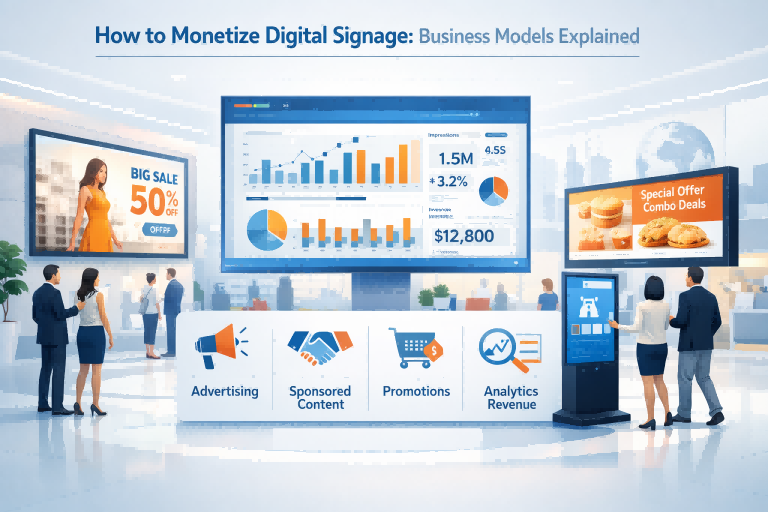
One of the most direct revenue sources is advertising. In high‑traffic environments, such as retail stores or commercial corridors, screens like Wall Mounted Digital Signage or Floor Standing Advertising Displays in Shopping Malls become valuable ad space. By selling this space to third‑party brands, businesses create a recurring income stream while enhancing customer engagement with dynamic promotional content.
Another important source is sponsored content. This involves partnering with brands to feature paid promotions, new product highlights, or seasonal campaigns directly on screens. These sponsorships not only bring in fees but also increase screen relevance to shoppers, boosting dwell time and brand affinity.
Beyond external advertising, internal promotions can indirectly drive revenue. Using digital signage to showcase bundle deals, loyalty rewards, or cross‑sell recommendations can increase average transaction value and improve conversion rates at the point of decision.
An emerging stream is data analytics as a value‑added service. Modern digital signage platforms with robust CMS and analytics can capture impressions, interaction patterns, and content performance. Businesses can package these insights for partners or use them to refine content strategies, creating additional monetization opportunities.
In summary, advertising sales, sponsored content, internal promotions, and analytics‑driven services form the primary revenue streams in Digital Signage, and each can be tailored to specific business needs to maximize long‑term profitability.
How Can CMS Software in Digital Signage Enable Monetization?
In real-world scenarios, many businesses are still uncertain about How Can CMS Software in Digital Signage Enable Monetization. In practice, a robust CMS can directly affect revenue generation, operational efficiency, and long-term ROI.
For chain coffee shops, quick-service restaurants, and light-meal brands in the Philippines, CMS enables remote content updates, allowing promotions, combo meals, and limited-time offers to be pushed across multiple stores before peak hours. This eliminates the need for manual updates at each location. According to operational case studies, multi-store update efficiency improved by around 70%, while staff involvement in order management decreased by 30%, indirectly boosting average transaction value and table turnover rates.
Ad scheduling management is another critical feature. Businesses can program third-party ads during high-traffic periods and internal promotions during off-peak hours, maximizing impressions and engagement. For example, mall-based floor-standing advertising displays in the Philippines with structured ad schedules reported a 20–25% higher advertising revenue compared to unscheduled displays.
CMS also supports centralized cross-store management, ensuring consistent branding, centralized budget control, and coordinated ad frequency across all locations. By integrating analytics, businesses can monitor playback, user interactions, and content effectiveness to optimize sponsored campaigns and internal promotions, unlocking direct monetization opportunities.
Furthermore, CMS dashboards allow businesses to track revenue impact per screen, measure ROI for specific campaigns, and quickly adjust content strategies based on real-time data. In combination, these capabilities demonstrate that CMS is not just a content management tool but a strategic enabler for maximizing advertising revenue, reducing labor costs, and achieving measurable, long-term profitability through digital signage.
Which Locations or Formats Generate the Highest Revenue Potential?
If businesses want to monetize digital signage, it is essential to evaluate the revenue potential of installation locations and device formats to maximize earnings. Placement and format decisions directly influence ad impressions, dwell time, customer engagement, and ultimately revenue generation. Proper assessment ensures that the chosen digital signage solution captures both high traffic and meaningful interactions, aligning with the business’s monetization strategy.
Wall Mounted Digital Signage is typically installed along shopping mall corridors, restaurant entrances, or within store interiors where foot traffic is consistent. According to market data, the Philippines OOH and DOOH market is projected to reach around USD 0.36 billion in 2026, with retail and consumer goods accounting for approximately 28.1% of total DOOH spend. This indicates that in-store wall mounted screens hold significant value for advertising revenue, allowing businesses to display dynamic content, promotions, and high-margin products to a captive audience.
Floor Standing Advertising Displays in Shopping Malls are often placed in high-dwell areas such as elevator lobbies, central lounge zones, or main entrances. Visitors tend to spend more time in these locations, which increases the likelihood of engaging with interactive or touch-enabled content. Retail DOOH campaigns in the Philippines during peak shopping periods have delivered hundreds of thousands of estimated impressions, demonstrating the strong potential for sponsorship and advertising revenue.
When selecting installation points and device formats, businesses should comprehensively evaluate foot traffic, visibility, dwell time, and interactivity. A strategic combination of wall mounted and floor standing devices can achieve an optimal balance between broad exposure and interactive engagement. Leveraging this approach allows companies to maximize revenue from digital signage, improve customer experience, and ensure measurable return on investment over time.
Can Sponsored Content or Third-Party Advertising Be Integrated Effectively?
In real deployments, many businesses wonder whether sponsored content and third‑party advertising can truly be integrated into a Digital Signage monetization strategy without compromising customer experience. The answer is yes—but only when the business carefully evaluates advertising partnerships, revenue models, and user impact upfront.
A key decision point is assessing the feasibility of ad cooperation with local merchants, national brands, or platform partners. In a high‑traffic retail mall or restaurant environment, even local SMEs often seek affordable ways to reach customers; offering sponsored slots to cafés, boutiques, or entertainment venues can generate recurring income while supporting community visibility. Larger brand collaborations—such as limited‑time promotions from beverage or FMCG companies—can command higher rates and broaden audience reach. For larger venues, stadium digital signage advertising can extend this model into sponsor loops, match-day promotions, and event-triggered brand exposure across concourses, VIP lounges, and concession areas.
Businesses also need to choose a pricing model that aligns with their traffic patterns and revenue goals. Common models include CPM (cost per thousand impressions), CPC (cost per click/interactions), and fixed sponsorship fees for seasonal campaigns. Hybrid pricing—combining guaranteed baseline fees with performance bonuses—can balance risk and reward for both the signage owner and the advertiser.
Maintaining a positive customer experience while maximizing ad revenue requires thoughtful placement and frequency control. Ads should be relevant to the location and audience; for example, a shopping mall’s floor‑standing advertising display may focus on promotions or events happening that day, while wall‑mounted digital signage inside a restaurant might show targeted offers or loyalty incentives. Scheduling should avoid overwhelming viewers with ads back‑to‑back, and interactive options (QR codes, touch prompts) should add value rather than distract.
When effectively integrated with relevant partners, flexible pricing models, and audience‑friendly design, sponsored content and third‑party advertising can become a sustainable revenue stream without undermining the core user experience.
How to Balance Monetization With Customer Experience?
Although sponsored content and third‑party ads can help digital signage generate revenue, it’s equally critical to protect the customer experience and avoid overwhelming viewers with irrelevant advertising. Research shows that in retail and hospitality environments, about 48 % of consumers say they are more likely to ignore or avoid digital ads that are not relevant to their context or interests, which can undermine both engagement and brand perception.
A key decision point is ad frequency control. Too many ad rotations in a short period can cause viewer fatigue, especially in high‑traffic locations like shopping malls or chain retail stores. Industry best practices suggest limiting direct ad breaks to every 5–7 minutes, interspersed with contextual content (e.g., menus, wayfinding), so that ads feel like part of the overall experience rather than an interruption.
Content relevance is also essential. In foodservice settings, approximately 62 % of customers are more likely to respond positively when digital signage displays offers that directly relate to their current context, such as “today’s specials” or “scan for loyalty rewards.” Targeted messaging like this not only improves conversion rates but also reduces the risk of customer annoyance.
Interactive elements further enhance experience without diminishing monetization. According to industry insight, digital signage equipped with QR codes, touch interactions, or gamified features can increase customer engagement by 22–38 % compared to non‑interactive displays.
By carefully controlling ad frequency, ensuring relevance, and integrating interactive features, businesses can strike a balance between monetization and user experience, making digital signage both a revenue‑driving and customer‑friendly asset.
Which Metrics Should Businesses Track to Measure ROI from Digital Signage?
Once businesses complete the deployment of Digital Signage and launch their content campaigns, the next critical step is tracking return on investment (ROI) to continuously optimize marketing strategies, operational efficiency, and customer engagement.
A key decision point is selecting measurable metrics that ensure every investment delivers quantifiable business value. Ad impressions reflect audience reach; for example, a wall-mounted digital display in a high-traffic shopping mall in the Philippines can reach 15,000–20,000 viewers per week, providing a clear baseline for exposure value. These impressions help brands forecast potential revenue from advertising or promotional campaigns.
Click-through and conversion rates measure the effectiveness of interactive campaigns. Promotions displayed on Self-Ordering Kiosks or QR-enabled signage can generate 5–12% click-through rates, while conversion rates reveal the percentage of interactions that lead to actual purchases. This links digital signage activity directly to revenue and supports data-driven decision-making.
Engagement metrics are also crucial. Touchscreen menus, QR scans, or gamified ads can increase customer participation by 20–35%, helping businesses assess content appeal and optimize design. For example, a coffee shop chain in Metro Manila reported an 8–10% increase in upsell orders within a month after implementing interactive kiosks.
Finally, sales growth serves as the ultimate ROI metric. Comparing revenue before and after signage deployment allows companies to evaluate the direct economic impact of promotions, combo highlights, or ad placements. By integrating impressions, clicks, engagement, and sales uplift, chain restaurants, coffee shops, and high-traffic malls can gain a comprehensive view of Digital Signage ROI, guiding future content strategy, expansion, and investment decisions.
How Can Businesses Scale Their Digital Signage Monetization Model Across Multiple Locations?
For businesses aiming to maximize revenue from Digital Signage, scaling the monetization model across multiple locations is a critical strategy. Expanding beyond a single site requires careful planning to ensure operational efficiency, consistent brand experience, and measurable ROI across all outlets.
A key decision point is implementing a centralized content management system (CMS) that supports multi-location scheduling. For example, a chain coffee shop operating in Manila uses a CMS to manage screens in 30 outlets simultaneously, updating promotions and advertisements remotely. This approach saves approximately 15–20 hours of weekly on-site maintenance while ensuring promotional content is displayed consistently during lunch and afternoon peak hours, maximizing exposure and potential revenue.
Standardizing advertising packages is another essential factor. Unified ad durations (e.g., 15–30 seconds), display frequency, and screen placement rules simplify internal operations and streamline agreements with local merchants or brand partners. In a shopping mall deployment case, standardized packages improved ad renewal rates by roughly 12%, while ensuring predictable exposure across multiple locations.
Additionally, establishing a transparent revenue-sharing mechanism is crucial. Headquarters can allocate advertising revenue based on foot traffic, screen utilization, and sales contribution, for example, using cost per thousand impressions (CPM). This incentivizes stores to maintain screen uptime and high-quality content while keeping overall ROI predictable.
By combining multi-location CMS capabilities, standardized ad packages, and a clear revenue-sharing model, businesses can effectively scale their Digital Signage monetization strategy. This approach not only enhances revenue potential for each outlet but also ensures operational efficiency, consistent customer experience, and sustainable long-term ROI.
FAQs
Why is a centralized CMS critical for multi-location Digital Signage deployment?
A centralized CMS allows businesses to remotely update content, synchronize promotions across outlets, and maintain brand consistency, reducing reliance on local staff and minimizing operational errors.
How can standardized advertising packages benefit multi-location deployments?
Standardization simplifies internal workflows, enables predictable ad exposure for clients, improves contract management with partners, and can increase ad renewal rates, as shown in shopping mall deployments.
What revenue-sharing models work best for multi-location Digital Signage?
Common approaches include allocating revenue based on foot traffic, screen utilization, or cost per thousand impressions (CPM), ensuring fair compensation to individual outlets while maintaining headquarters’ profitability.
How does multi-location scaling impact operational efficiency?
By coordinating content, promotions, and ad schedules through a unified CMS, businesses reduce manual updates, avoid inconsistent messaging, and ensure smooth operations during peak traffic hours across all locations.
Can small chains or limited-location businesses benefit from multi-location strategies?
Yes. Even with a handful of outlets, using CMS-driven multi-location management and standardized ad packages streamlines operations, enables consistent branding, and prepares the business for future expansion.
What KPIs should businesses track to measure ROI across multiple locations?
Key metrics include ad impressions, conversion rates, interactive engagement, sales growth per location, and revenue attributed to promotional campaigns, allowing businesses to evaluate effectiveness and optimize strategy.