Across Europe, even well-developed healthcare systems are facing a growing challenge: access. In countries like France, Spain, and Germany, patients often struggle to receive timely primary care due to doctor shortages and uneven resource distribution. This gap is especially visible in suburban and aging communities, where demand for routine consultations continues to rise.
As a result, healthcare providers are exploring new ways to deliver services more efficiently and closer to where people live. One solution gaining rapid traction is the telehealth kiosk—a compact, technology-driven system that brings medical consultations into everyday environments like pharmacies.
This article explores how telehealth kiosks are being deployed across Europe, how they work, and why their operational model is proving both scalable and effective in reshaping community healthcare delivery.
Project Background – Healthcare Access Gap in Europe
Across countries such as France, Spain, and Germany, healthcare systems are widely recognized for their quality and accessibility. However, beneath this strong foundation lies a persistent structural challenge: uneven distribution of primary healthcare resources and a growing shortage of general practitioners.
This issue becomes particularly visible in smaller cities, suburban areas, and regions with rapidly aging populations. In these locations, medical demand is steady but often underserved. Patients with non-emergency yet high-frequency healthcare needs—such as minor illnesses, prescription renewals, or routine consultations—face increasing difficulty accessing timely care.
As a result, many individuals are forced to wait several days, or even longer, to secure an appointment with a general practitioner. Others turn to hospitals for relatively simple conditions, unintentionally placing additional pressure on already burdened emergency departments and outpatient services. This imbalance not only affects patient experience but also reduces overall system efficiency.
The gap between healthcare demand and accessible primary care services has created a clear need for alternative delivery models. This is where telehealth kiosks begin to play a critical role. By enabling remote consultations and basic health assessments in convenient, community-based locations, these solutions help bridge the accessibility gap. They offer a practical way to extend healthcare reach without requiring significant expansion of physical medical infrastructure, making them especially relevant in regions where traditional systems are struggling to keep pace with demand.
The Solution – Telemedicine Booths Inside Pharmacies
To solve the “last-mile” challenge in healthcare access, a solution known as Telemedicine Booths—or telehealth kiosks—has rapidly expanded across Europe. These units are designed as compact, private consultation spaces where patients can connect with remote doctors, complete basic health checks, and receive medical guidance without entering a hospital.
In terms of deployment, these kiosks are typically installed in high-traffic, easily accessible locations such as pharmacies, shopping malls, and community centers. Among all these scenarios, pharmacies have proven to be the most critical and effective entry point. Unlike hospitals, which are often reserved for more serious conditions, pharmacies serve as a daily touchpoint for health-related needs, making them a natural gateway for telemedicine services.
The strength of pharmacy-based deployment lies in three key advantages. First, pharmacies already carry a strong foundation of medical trust, which helps users feel more confident using a telemedicine kiosk. Second, they benefit from stable and consistent foot traffic, creating a steady stream of potential users with immediate healthcare needs. Third, their widespread distribution forms a dense community network, allowing telehealth solutions to scale efficiently across different regions.
By integrating telemedicine booths into pharmacies, healthcare providers can extend services closer to where people live. This model effectively transforms pharmacies into accessible healthcare hubs, bridging the gap between physical locations and remote medical care.
How the Telehealth Kiosk Works
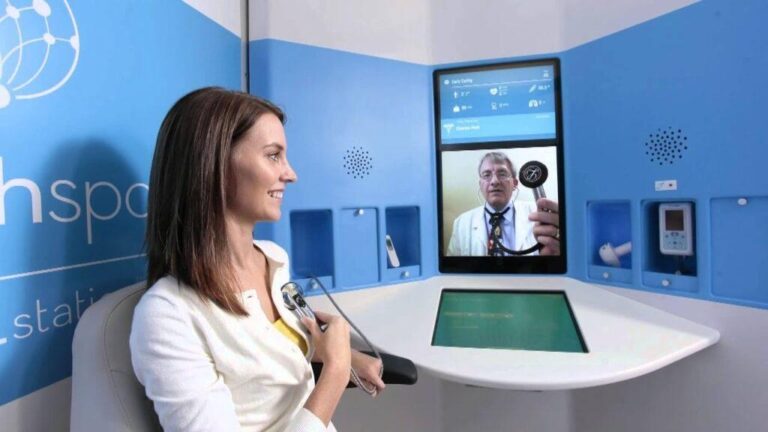
A typical telehealth kiosk is far more than just a video communication device—it functions as a fully integrated micro-clinic system. Designed to replicate key elements of a primary care visit, it combines hardware, software, and connectivity to deliver a seamless remote healthcare experience.
At the core of the system is high-definition video consultation, allowing patients to interact with licensed doctors in real time. This is supported by a range of built-in diagnostic tools that enable basic health assessments on-site. These commonly include devices for measuring blood pressure, heart rate, blood oxygen levels, and body temperature. The collected data is automatically transmitted to the remote physician, providing a reliable basis for evaluation.
In addition to diagnostics, the kiosk system supports electronic prescription generation, allowing patients to receive treatment recommendations immediately after the consultation. All medical data is securely uploaded to cloud-based systems, ensuring continuity of care and easy integration with broader healthcare networks.
From a user perspective, the process is designed to be simple and efficient. Patients enter the booth, complete identity verification, and follow guided instructions on the screen. The system then performs automated measurements before connecting them to a remote doctor. Within a single session—typically lasting 10 to 15 minutes—users can receive professional medical advice without the need for traditional appointments.
This streamlined workflow is what makes telehealth kiosks highly effective in delivering fast, accessible, and scalable healthcare services.
Operational Model – Why It Works
The success of telehealth kiosks in Europe is not driven by technology alone, but by a well-designed operational and business model that aligns multiple stakeholders into a sustainable ecosystem.
At the core is a multi-party collaboration structure. Remote healthcare providers supply licensed doctors and digital consultation platforms, ensuring medical compliance and service quality. Pharmacies contribute physical space and act as high-traffic access points, bringing in a steady flow of users with immediate healthcare needs. Meanwhile, kiosk operators are responsible for hardware deployment, system maintenance, and ongoing technical support, ensuring smooth day-to-day operations.
From a revenue perspective, the model is both flexible and scalable. In most cases, patients pay per consultation, making the service accessible without long-term commitments. In some European markets, part of the consultation fee may be covered by public or private health insurance, further lowering the barrier to adoption. Pharmacies also benefit indirectly, as consultations often lead to prescription fulfillment on-site, increasing product sales and customer retention.
Equally important is the model’s ability to optimize healthcare costs at a system level. By redirecting non-urgent cases away from hospitals, it helps reduce pressure on outpatient departments and emergency services. At the same time, doctors can serve more patients remotely, lowering the cost and inefficiency associated with in-person visits.
This combination of shared value, scalable revenue, and cost efficiency is what makes the telehealth kiosk model both practical and commercially viable.
Real Impact – Measurable Results
In real-world deployments across Europe, telehealth kiosks have already demonstrated clear and measurable impact on both patient experience and healthcare system efficiency. What began as an alternative access point has quickly evolved into a practical solution for addressing everyday medical needs at scale.
One of the most immediate benefits is the significant reduction in patient waiting time. Instead of waiting days for an appointment, users can access medical consultations within minutes, often completing the entire process in a single visit. This improved accessibility directly enhances patient satisfaction and encourages more proactive healthcare behavior.
At the same time, telemedicine kiosks have enabled doctors to expand their service reach. By removing geographical limitations, physicians can consult with more patients remotely, optimizing their time and increasing overall productivity. This is particularly valuable in regions facing shortages of general practitioners.
Another key outcome is the reduced burden on hospitals and clinics. By diverting non-urgent cases—such as minor illnesses or routine consultations—away from traditional facilities, telehealth kiosks help free up critical resources for more serious conditions. This leads to better allocation of medical staff and improved operational efficiency.
Equally important is the shift toward community-level healthcare access. By bringing services closer to where people live and work, these kiosks effectively decentralize healthcare delivery. In some regions, they have already become an essential supplement to primary care systems, supporting a more flexible and resilient healthcare infrastructure.