The market for 12 Volt RV TVs is expanding alongside the rapid growth of the global recreational vehicle industry. The worldwide RV market was valued at about $55.7 billion in 2022 and is projected to reach roughly $80 billion by 2030, growing at a CAGR of around 6.2%. This expansion is driving demand for energy-efficient onboard electronics, including televisions designed to run directly on RV battery systems. Industry analysis estimates the 12V RV smart TV segment at roughly $780 million globally, with forecasts suggesting about 14% annual growth through 2028 as mobile living, van-life travel, and off-grid camping become more popular. North America remains the largest market due to high RV ownership and long-distance road travel culture. As a result, many suppliers and portable smart TV manufacturers are increasingly developing low-power, RV-compatible displays and portable smart TV solutions tailored for mobile environments.
What Is a 12 Volt RV TV? Complete Buyer’s Guide for Beginners
Although 12 Volt RV TVs are becoming increasingly popular, many buyers still do not clearly understand what a 12V RV TV actually is. To make an informed purchase decision, it is helpful to first understand its definition and how it differs from a regular household television.
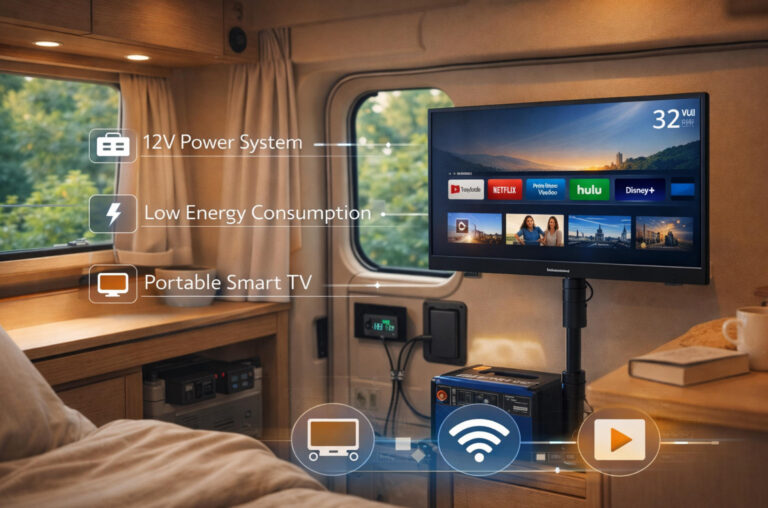
A 12 Volt RV TV is a television designed to operate on 12-volt direct current (DC) power, which is the standard electrical system used in most recreational vehicles. Unlike traditional home televisions, these TVs can run directly from an RV’s battery system without requiring complicated power conversion. This design makes them particularly suitable for mobile environments where stable AC electricity may not always be available.
The main difference between a 12V RV TV and a regular television lies in the power supply system. Most household TVs operate on 110V or 220V alternating current (AC) through wall outlets. When used in an RV, they typically require an inverter to convert the vehicle’s 12V DC battery power into AC electricity, which can lead to additional energy loss.
In contrast, a 12V RV TV connects directly to the RV’s 12V battery system, improving power efficiency and reducing unnecessary energy consumption. This is especially valuable during off-grid camping or long trips where battery capacity is limited. For this reason, 12V televisions are widely used in RVs, boats, yachts, trucks, and other mobile living environments.
Similarly, portable smart TVs have become increasingly popular for mobile use. A portable smart TV is a compact, energy-efficient television that also supports 12V DC power and integrates smart features such as WiFi, streaming apps, HDMI/USB ports, and wireless casting. Like 12V RV TVs, they are designed for flexible installation in camper vans, trucks, or boats. However, the ideal setup can vary significantly depending on vehicle size—for example, choosing the best RV TV for small campers vs large motorhomes involves different considerations in terms of screen size, mounting space, and viewing distance.
Why Do RV Owners Prefer 12 Volt TVs for Mobile Power Systems?
12 Volt TVs are popular not simply because of market trends, but because they offer clear advantages in outdoor and mobile environments, especially in terms of energy efficiency, stability, and compatibility with vehicle power systems.
Most recreational vehicles are built around a 12V battery system, which powers essential equipment such as lighting, refrigerators, and water pumps. A 12 Volt RV TV is designed to operate directly on this same DC power system. Because it connects directly to the RV battery, it eliminates the need for additional power conversion and integrates more smoothly into the vehicle’s electrical setup.
By contrast, using a regular household television inside an RV usually requires an inverter to convert the vehicle’s 12V DC battery power into 110V or 220V AC electricity. While this makes it possible to run standard appliances, the conversion process often causes energy loss, additional heat generation, and higher battery consumption. For travelers who rely on limited battery capacity, this can quickly reduce the available power for other devices.
A 12V RV TV avoids these issues by running directly on DC power, which helps improve efficiency and extend battery runtime. This is particularly important for off-grid camping, boondocking, and long-distance road travel, where reliable and low-power electronics are essential.
It is worth mentioning that, with continuous updates and innovations in entertainment devices, there are now portable smart TV products available. These products not only support 12V power input but also integrate smart streaming features, providing a more flexible entertainment experience for RVs and mobile living. Working with an experienced portable smart TV manufacturer can help businesses and buyers source devices optimized for both mobility and vehicle-based power systems.
How Much Power Does a 12 Volt RV TV Typically Consume?
Since 12 Volt RV TVs are typically used in outdoor or mobile environments, many buyers naturally wonder about power consumption before making a purchase. To get a clear picture, it helps to break this question down and examine the details.
Most 12V RV TVs consume between 20W and 60W, depending on screen size and display technology. Smaller screens, such as 19–22 inches, usually draw less power, while larger 27–32 inch models or high-brightness panels sit at the higher end of the range. Understanding these differences allows RV owners to plan energy usage effectively, ensuring other essential systems remain powered.
In contrast, standard household TVs require 110V or 220V AC and an inverter to run from an RV battery. Inverter conversion often introduces 10–15% energy loss, increasing battery drain. For example, a 50W AC TV might consume closer to 55–60W from a 12V battery when operated through an inverter. A direct DC-powered 12V TV avoids this waste, improving efficiency and extending runtime.
This efficiency is particularly valuable for off-grid camping, long road trips, and extended mobile living, allowing users to enjoy entertainment without compromising other critical systems.
Similarly, portable smart TV products also require careful attention to power consumption. While these devices provide integrated smart OS, WiFi streaming, and multiple connectivity options, their wattage typically falls in the same 20–60W range depending on screen size and brightness. Buyers should evaluate the energy usage of a portable smart TV in the same way as a standard 12V RV TV, considering the RV battery capacity and expected runtime. By choosing a model optimized for low power draw, RV owners can enjoy smart entertainment features while maintaining efficient energy management.
What Smart Features Should Buyers Look for in a 12 Volt RV TV?
Screen size and power consumption are just the basics. Nowadays, many buyers also pay close attention to smart features when selecting a 12V RV TV. In mobile and outdoor environments, having integrated smart capabilities can significantly enhance the entertainment experience without adding extra devices. For RV owners, a TV that combines streaming, connectivity, and local signal reception can replace multiple gadgets, saving space and simplifying setup.
A key consideration is whether the TV supports Android TV, Google TV, or other smart operating systems. These platforms allow direct access to popular streaming services such as Netflix, YouTube, Hulu, and Disney+, enabling travelers to watch their favorite shows and movies seamlessly on the go. Built-in WiFi connectivity is essential, as it allows for smooth streaming, app updates, and access to online content without relying on additional adapters or devices.
Connectivity options are also critical. Most buyers look for multiple HDMI and USB ports, as well as wireless screen mirroring or casting capabilities. These features make it easy to connect external devices, such as gaming consoles, laptops, or smartphones, and extend the TV’s usability beyond just streaming.
Portable smart TV products often combine these features in a compact, mobile-friendly design. Many models include built-in smart OS, WiFi, preloaded streaming apps, Bluetooth audio support, and screen casting from phones or tablets. Some even integrate OTA antennas for local channel reception, making them versatile for both wired and wireless viewing. By embedding these smart functions directly into a 12V TV, manufacturers allow RV users to enjoy full-featured streaming, media playback, and connectivity without extra devices, while keeping energy consumption low and installation simple. This combination of mobility and functionality makes portable smart TVs an increasingly popular choice for modern RV entertainment.
Which Screen Size Is Best for Different RV Interior Spaces and Budgets?
Besides power consumption, another key factor to consider when purchasing 12V RV TVs is screen size. Buyers need to choose a size that fits their RV interior, balances viewing comfort, and aligns with their budget.
Common screen sizes for 12V RV TVs range from 19″ and 22″, to 24″, 27″, and up to 32″. For smaller camper vans, compact 19–22 inch screens are usually sufficient. They save space, consume less power, and can often be mounted in tight areas without obstructing movement. A 22-inch model typically costs around $219, making it an affordable choice for small setups.
Mid-sized RVs generally accommodate 24–27 inch TVs. These sizes offer a good balance of screen visibility and power consumption, providing an enjoyable viewing experience in the main seating or lounge areas. A 24-inch TV usually costs $249, while a 27-inch model is about $299.
For large motorhomes, owners often prefer 32-inch displays to create a more immersive home-theater feel. A 32-inch model is priced around $329, offering a good compromise between size, visibility, and budget.
Furthermore, portable smart TV products provide extra flexibility for small spaces, with prices ranging from $219 to $329 depending on screen size. Their compact designs and lightweight mounts make them easy to install in camper vans, foldable setups, or areas with limited wall space, while still delivering smart streaming features. For distributors and RV equipment suppliers, partnering with a reliable portable smart TV manufacturer ensures these TVs meet both space efficiency and entertainment quality requirements.
How Can Buyers Choose a Reliable 12 Volt RV TV Supplier or Manufacturer?
Relying solely on price to choose a 12 Volt RV TV can easily lead to unreliable products. With numerous suppliers and manufacturers available, buyers need to understand which factors indicate quality, reliability, and long-term supportbefore making a purchasing decision.
One of the first considerations is whether the supplier or manufacturer offers OEM or ODM capabilities. This ensures that products can be customized to meet specific client requirements, from screen size and brightness to smart features and connectivity options. For B2B buyers, this flexibility is particularly valuable when sourcing TVs for different RV models or mobile applications.
Product certifications are also critical. Reliable manufacturers typically provide CE, FCC, RoHS, or other recognized approvals, demonstrating compliance with international safety, electromagnetic compatibility, and environmental standards. Certification not only guarantees product safety but also simplifies the process of exporting TVs to different markets.
Durability and stability are equally important. A dependable 12V RV TV should withstand vibrations, temperature fluctuations, and variations in mobile power systems. Buyers should review specifications, long-term performance data, and user feedback to ensure consistent operation in off-grid or mobile environments.
Additionally, after-sales support and supply chain reliability play a key role. A trustworthy supplier offers clear warranty terms, replacement parts, and responsive customer service, minimizing downtime for end users.
Collaborating with a professional portable smart TV manufacturer provides further advantages. These manufacturers understand the unique demands of mobile and RV applications, offering energy-efficient, feature-rich TVs designed for 12V DC systems. Partnering with such a supplier ensures products are both technically reliable and commercially viable, reducing risks and improving customer satisfaction.
FAQs
Can a regular household TV be powered directly by a 12V RV battery?
No. Most standard TVs require an inverter to convert the RV’s 12V DC into 110V or 220V AC. Direct connection can damage the TV.
What is the most common screen size for RV TVs?
24 inches is currently the most popular size among RV users, balancing visibility, power consumption, and installation flexibility.
Are portable smart TVs suitable for use in RVs?
Yes. Many portable smart TVs support 12V DC power and compact installation, making them ideal for mobile and off-grid environments.
Can 12V RV TVs run streaming apps?
Many modern models support WiFi and streaming platforms like Netflix, YouTube, and Hulu, allowing users to enjoy content on the go.
How can buyers find a reliable portable smart TV manufacturer?
Evaluate suppliers based on production capability, product certifications (CE, FCC, RoHS), OEM/ODM experience, and industry case studies to ensure product quality and reliability.
Are 12V RV TVs more energy-efficient than regular TVs?
Generally, yes. They run directly on DC power without requiring an inverter, reducing energy loss and extending battery runtime.